
Short Description
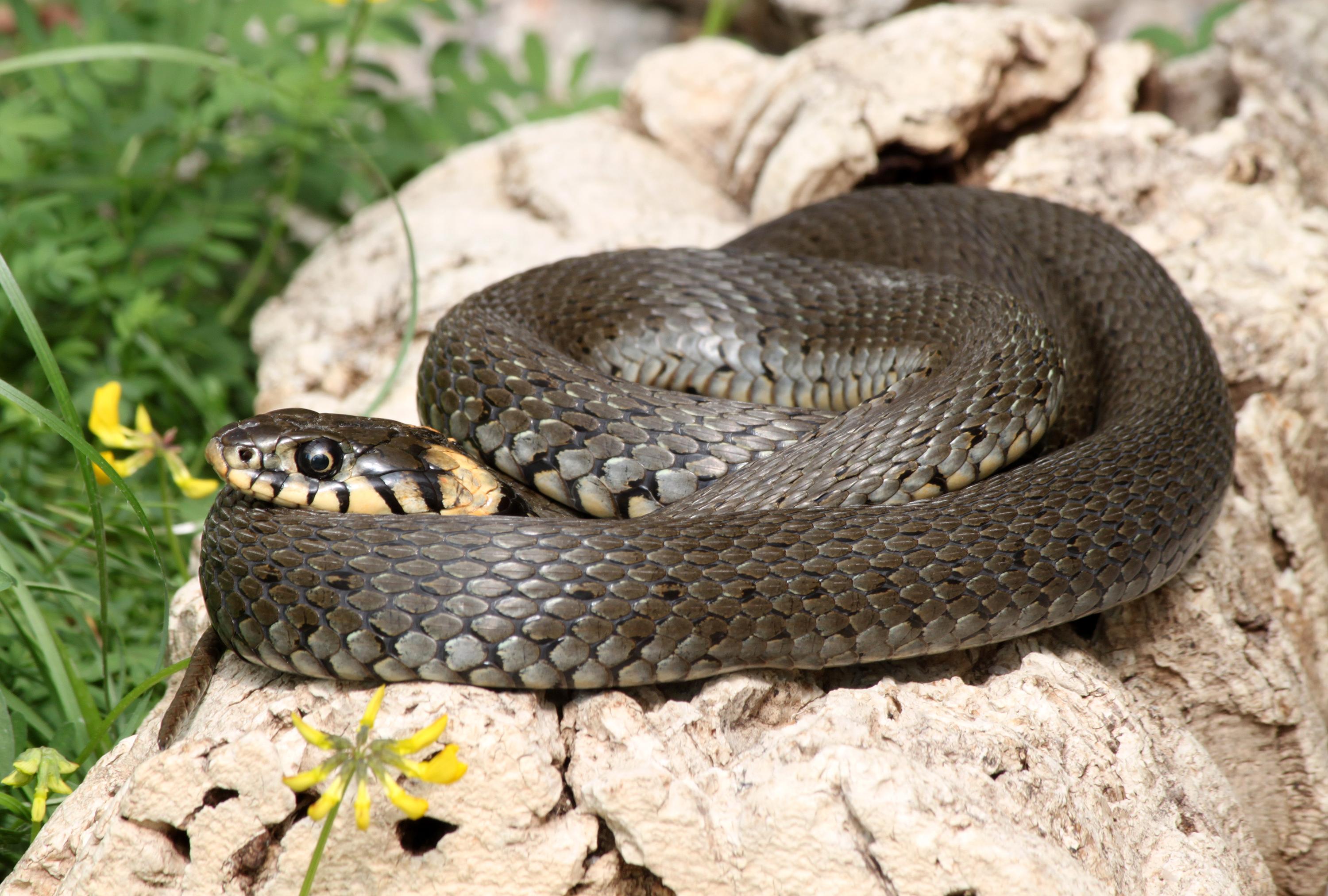
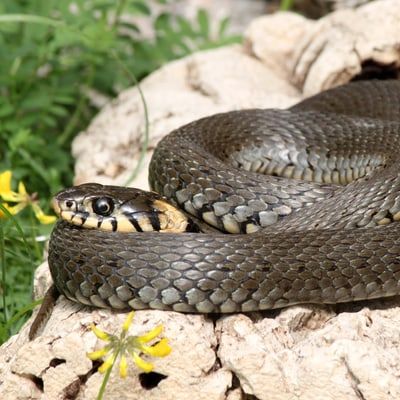
Grass snakes are blue-grey to greenish-grey with a dark angular pattern of patches on the underside. Their pupils are round. At the back of the head are two distinctive yellow crescents, mostly delineated by black patches.
These yellow crescents are particularly pronounced in juveniles.
Features
Grass snake
Natrix natrix
paired yellow crescent patches on the back of the head
rectangular black and white markings on the underside
In the city
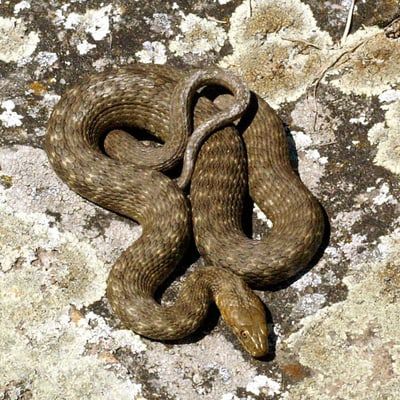
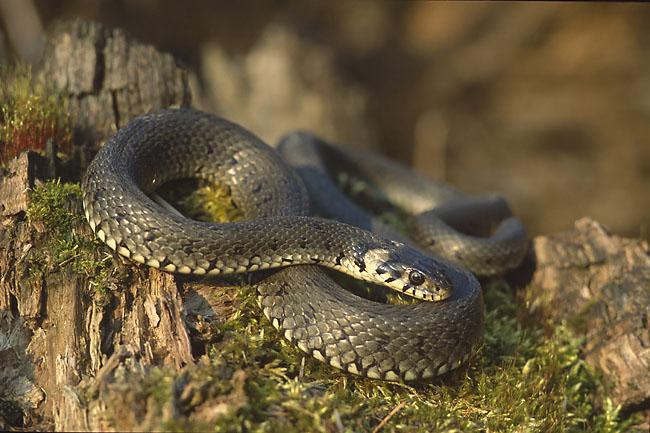
In addition to aquatic habitats such as streams, canals and quarries, grass snakes also inhabit habitats away from water such as damp meadows, gardens and sparse deciduous forests. They prefer to alternate between dry, sunny and shaded sites with moist soils, both with good hiding places.
Contact with humans generally triggers flight behaviour. In defence, grass snakes secrete a foul-smelling yellowish liquid or pretend to be dead.
Fun Facts
In the mating season, in the fight for a female, mating balls can develop consisting of up to 20 males and one female.
Grass snakes always swallow their prey alive.
They feed mainly on amphibians and their young.
All European reptiles are specially protected and must not be captured, injured or killed.
- Endangerment level Germany: not evaluated
The grass snake used to be considered a lucky charm for house and farm. It was said to be able to keep diseases out of the stable and thus ensure milk production.
The Latin name "natrix" means "water snake".
Grass snakes are not venomous to humans.
Sources
Habitus , H. Krisp, CC BY 3.0, https://commons.wikimedia.org/wiki/File:Ringelnatter_Natrix_natrix.jpg

Habitus , Marek Szczepanek, CC BY-SA 3.0, https://commons.wikimedia.org/wiki/File:Natrix_natrix_(Marek_Szczepanek).jpg
.jpg)
NABU – Naturschutzbund Deutschland e.V. (n.d.) Scheue Froschjägerin. Aus dem Leben der Ringelnatter, URL: https://www.nabu.de/tiere-und-pflanzen/amphibien-und-reptilien/reptilien/04985.html (Accessed: 11.08.2016).
Kwet, A. (2015) Reptilien und Amphibien Europas. 250 Arten mit Verbreitungskarten, Stuttgart: Franckh Kosmos Verlag.
Blab, J. & Vogel, H. (2002) Amphibien und Reptilien erkennen und schützen, München: BLV.
Glandt, D. (2015) Die Amphibien und Reptilien Europas, Wiebelsheim: Quelle & Meyer Verlag.
Kühnel, K.-D., Scharon, J., Kitzmann, B. & Schonert, B. (2017) Rote Liste und Gesamtartenliste der Kriechtiere (Reptilia) von Berlin. : Der Landesbeauftragte für Naturschutz und Landschaftspflege / Senatsverwaltung für Umwelt, Verkehr und Klimaschutz (eds.) Rote Listen der gefährdeten Pflanzen und Tiere von Berlin, URL: https://www.berlin.de/sen/uvk/natur-und-gruen/naturschutz/artenschutz/artenlisten-rote-listen/reptilien/ (Accessed: 16.04.2021).