
Short Description
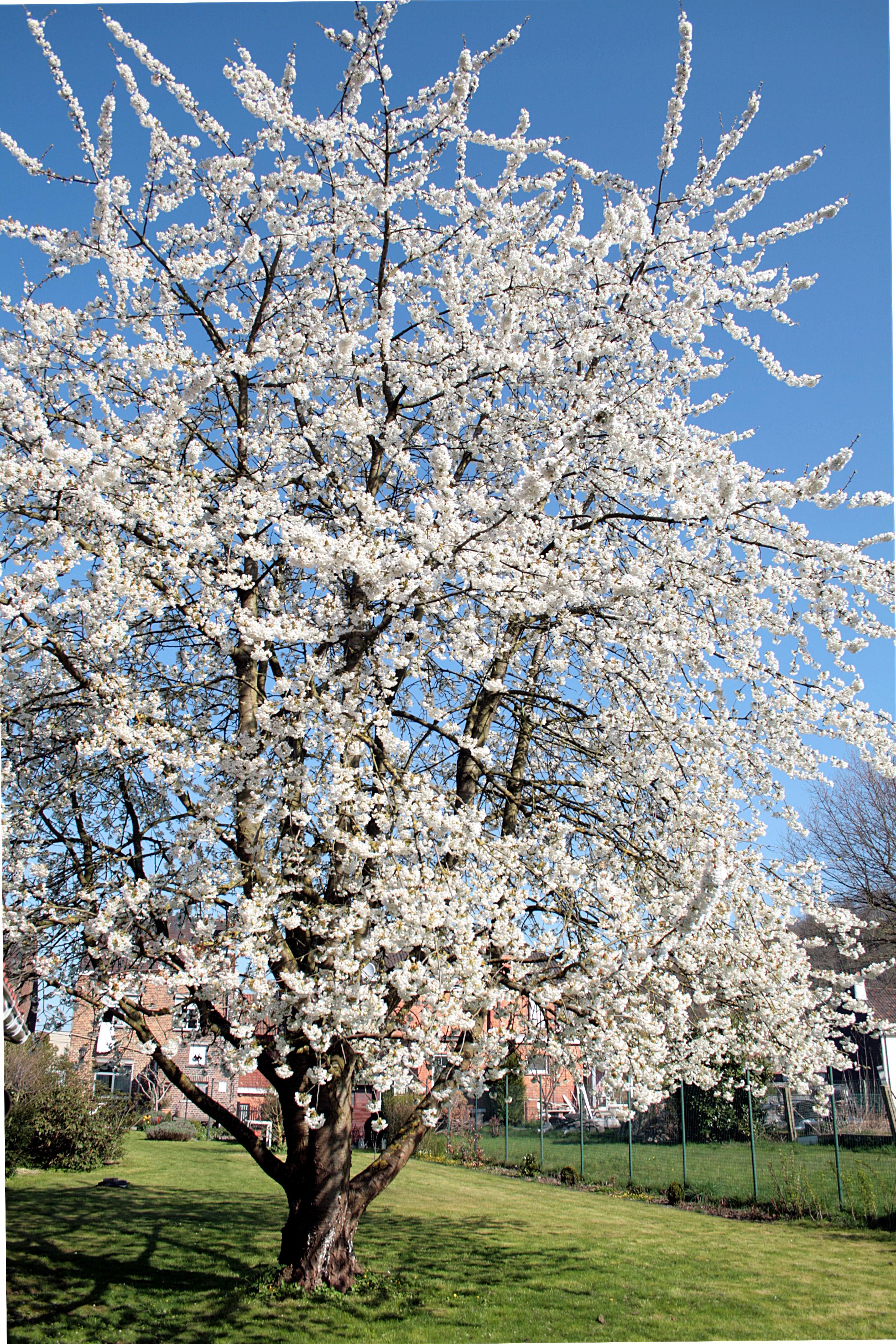
Wild cherry trees can grow up to 30 m tall with dense branching in the crown but sparse leaves.
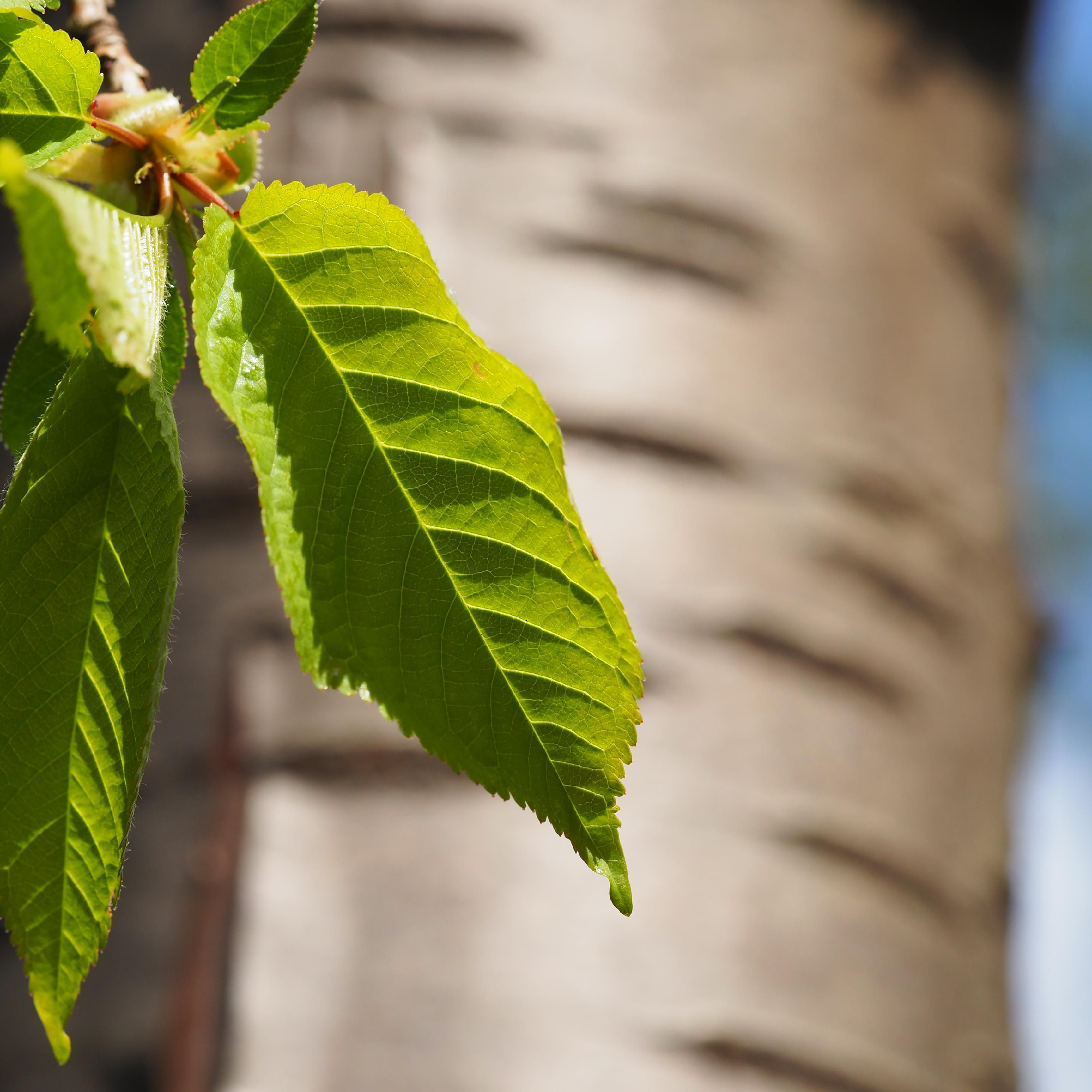
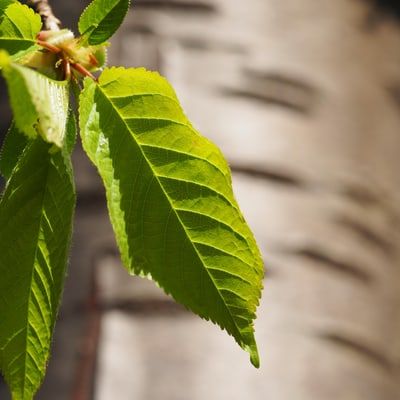
The leaves are oval and pointed. The leaf edge is rough and double-serrated. They grow alternately on the branch. Each leaf stalk generally has two reddish nectar glands.
The bark is initially smooth, red-brown to grey and shiny with transverse cork warts (lenticles). The cork bark peels off in transverse bands. Older trees form a black-grey vertically fissured bark.
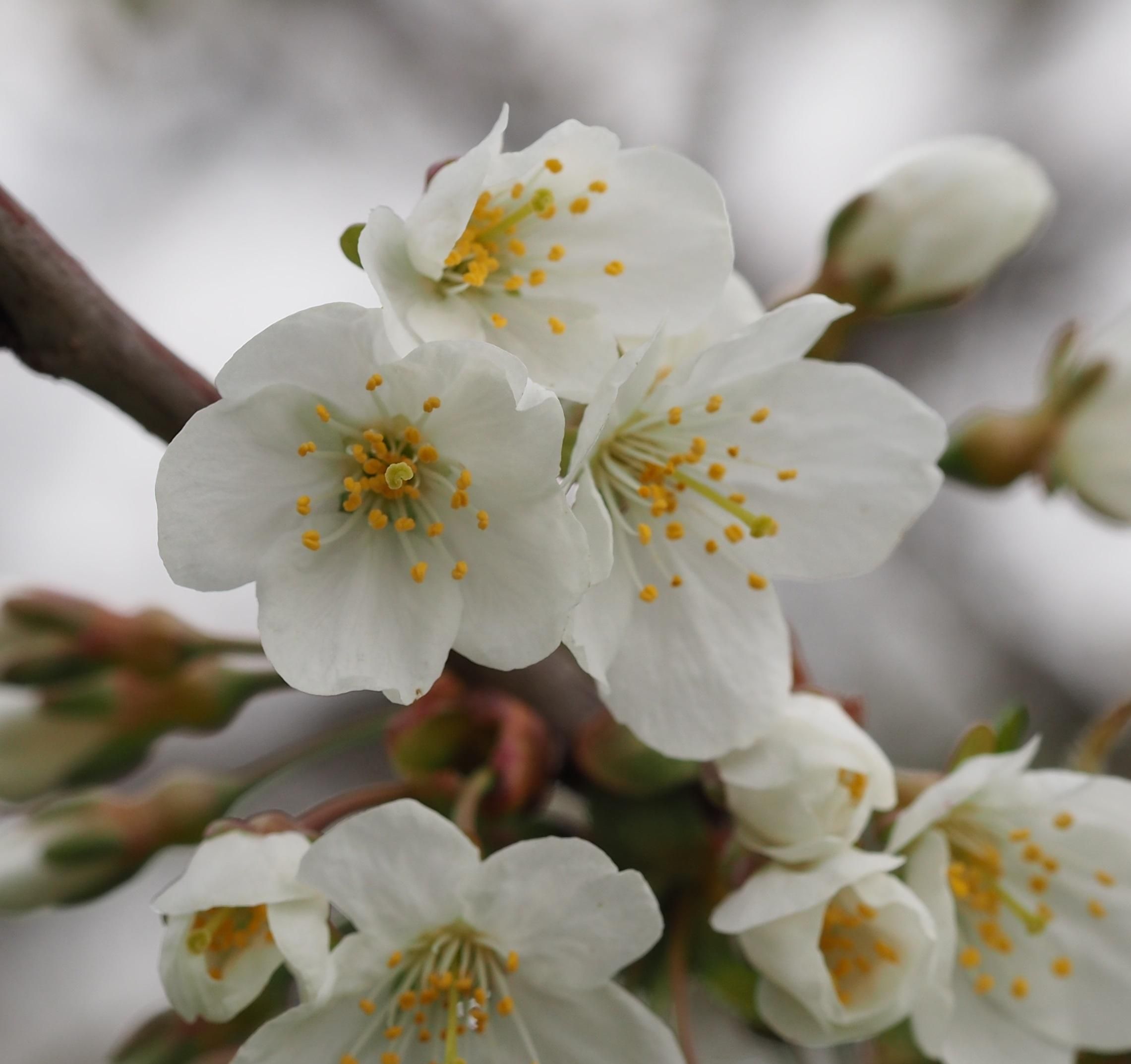
The white flowers are clustered in tufts of pendulous flower heads. The anther in the middle of the flower is generally yellow to reddish.
The stone fruits are spherical drupes that look like cherries. When ripe, they are red to very dark red and shiny. The hard-shelled stone in the middle encloses one seed.
Features
Wild cherry
Prunus avium
leaf stalk with two red nectar glands
cork bark peels off in transverse bands
Similar species
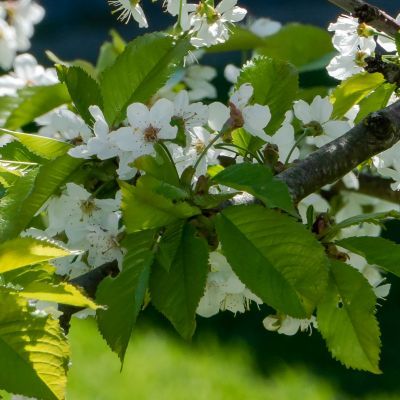
Prunus cerasus
In the city
The wild cherry is a very popular house and garden tree because of its large and conspicuous flowers. It is drought-tolerant, but sensitive to late frosts and soil compaction. This makes it a suitable park and garden tree, but rather unsuitable as a street tree. It is an important bird and bee nutrient tree and thus contributes to species richness in the city. Its potential for improving urban air quality by binding particulate matter is also discussed.
Fun Facts
The nectar from the glands at the leaf stalk is collected as food by ants. In return, the ants keep away pests from the tree.
If the trunk is injured, a resinous sap is secreted (gummosis) that hardens in contact with air.
Cherry stone cushions are used in replacement of hot-water bottles or as pillows for allergy sufferers.
It flowers from April to May.
The fruit ripening season is in July.
- Endangerment level Germany: not endangered
Wild cherry was likely introduced from Central Asia and has become naturalised in Europe.
The wild cherry is the parent form of commercial cultivars of edible cherry.
Sources
Blatt, Alice Kracht, CC BY-SA 4.0, https://offene-naturfuehrer.de/web/Datei:Prunus_avium_(14).JPG
.JPG)
Habitus, Jean-Pol GRANDMONT, CC BY-SA 3.0, https://commons.wikimedia.org/wiki/File:0_Prunus_avium_-_Havr%C3%A9_(1).JPG
.JPG)
Blüte, Alice Kracht, CC BY-SA 4.0, https://offene-naturfuehrer.de/web/Datei:Prunus_avium_(17)_-_Kopie.JPG
_-_Kopie.JPG)
Aas, G. & Riedmiller, A. (2002) Laubbäume. Bestimmen – Kennenlernen – Schützen, Bindlach: Gondrom Verlag.
Amann, G. & Richter, P. (1962) Bäume und Sträucher des Waldes, Melsungen: Verlag J. Neumann – Neudamm.
Forum DIE GRÜNE STADT (2013) Bäume und Pflanzen lassen Städte atmen. Schwerpunkt - Feinstaub, URL: https://www.die-gruene-stadt.de/baeume-und-pflanzen-lassen-staedte-atmen.pdfx (Accessed: 02.08.2018).
Böhlmann, D. (2015) Laubbäume temperierter Klimate mit ihrer Artenvielfalt, Berlin: Patzer Verlag.
Mitchell, A. (1975) Die Wald- und Parkbäume Europas. Ein Bestimmungsbuch, Hamburg und Berlin: Verlag Paul Parey.
Quartier, A. (1989) Bäume und Sträucher, München: BLV.
Roloff, A. (2013) Bäume in der Stadt. Besonderheiten - Funktion - Nutzen - Arten - Risiken, Stuttgart: Verlag Eugen Ulmer.
Page „Vogel-Kirsche“. : Wikipedia, The Free Encyclopedia. Date of last revision: 08.05.2016, 01:19 UTC. URL: https://de.wikipedia.org/w/index.php?title=Vogel-Kirsche&oldid=154184281 (Accessed: 13.05.2016).