
Short Description
The horse chestnut can grow up to 30 m tall and has an expansive, round, densely leaved crown.
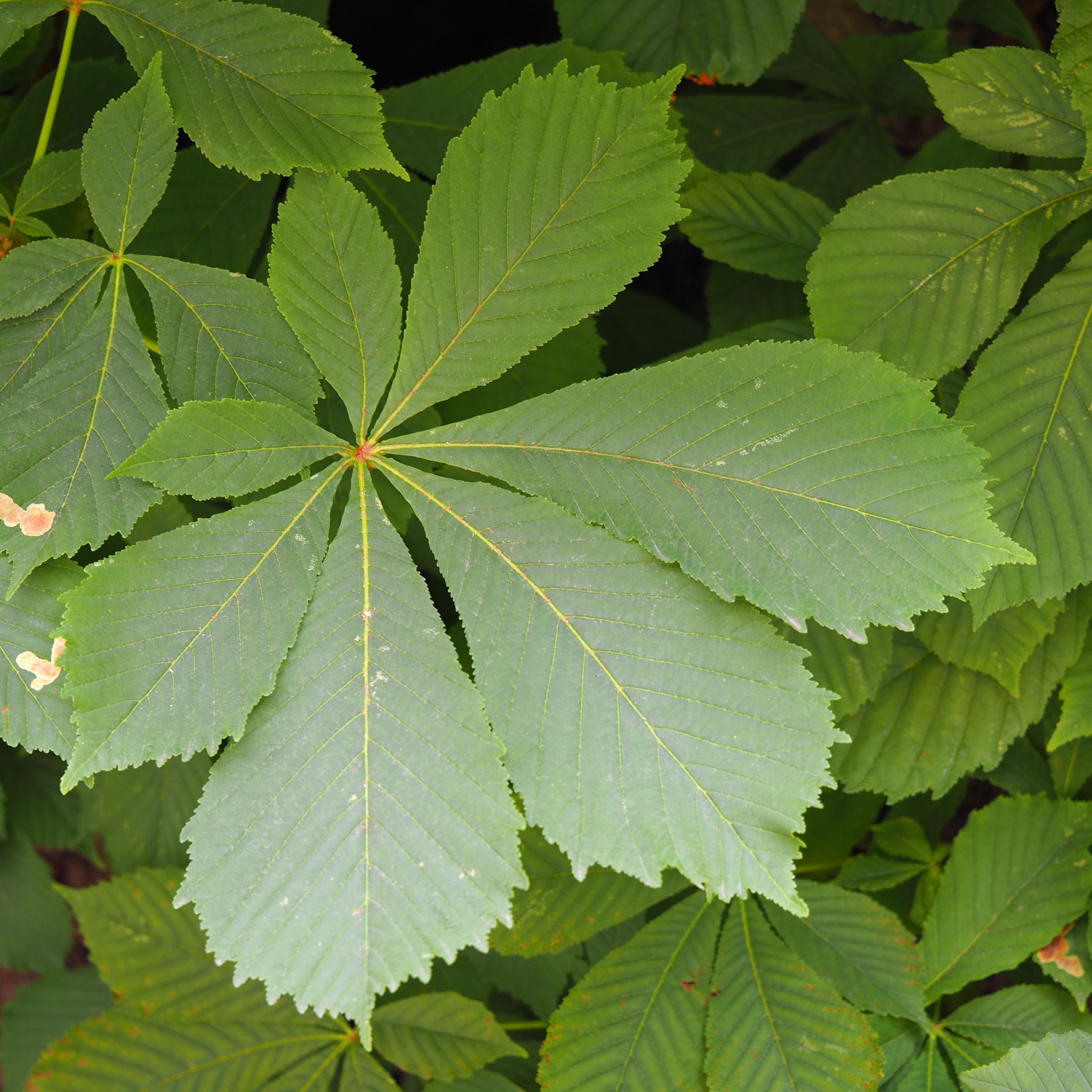
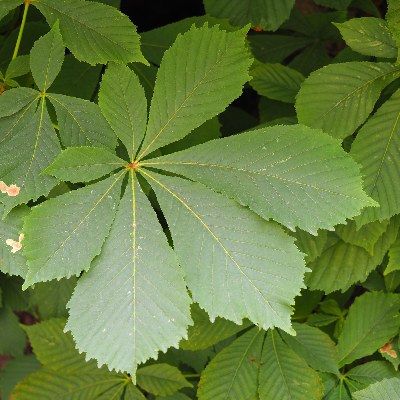
Leaves are opposite and have long stalks. A leaf consists of five to seven leaflets (pinna). They are obovate (narrower end at the base) with an irregular serrated margin.
The trunk always has a clockwise spiral grain. The bark is grey-brown and with a scaly bark.
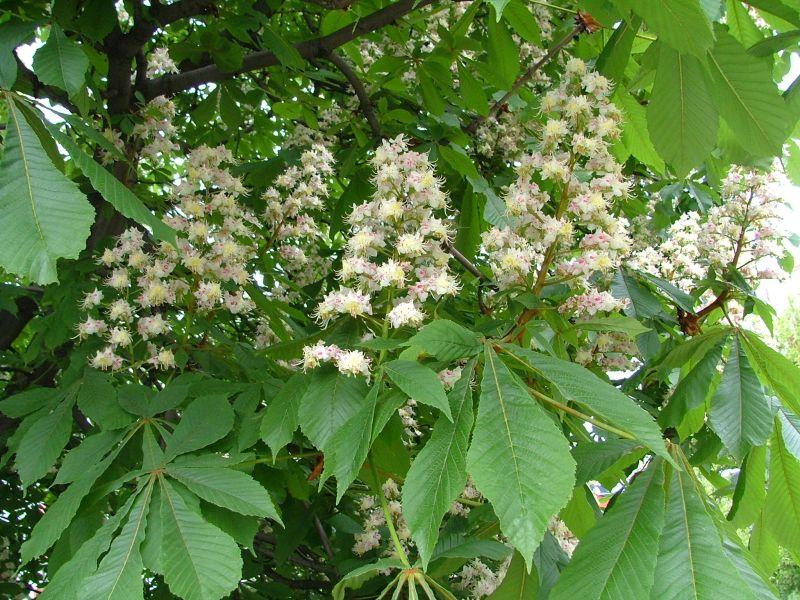
The flowers are white with a floral guide at the base that is initially yellow and later pink. They grow in large erect panicles (the flower heads).
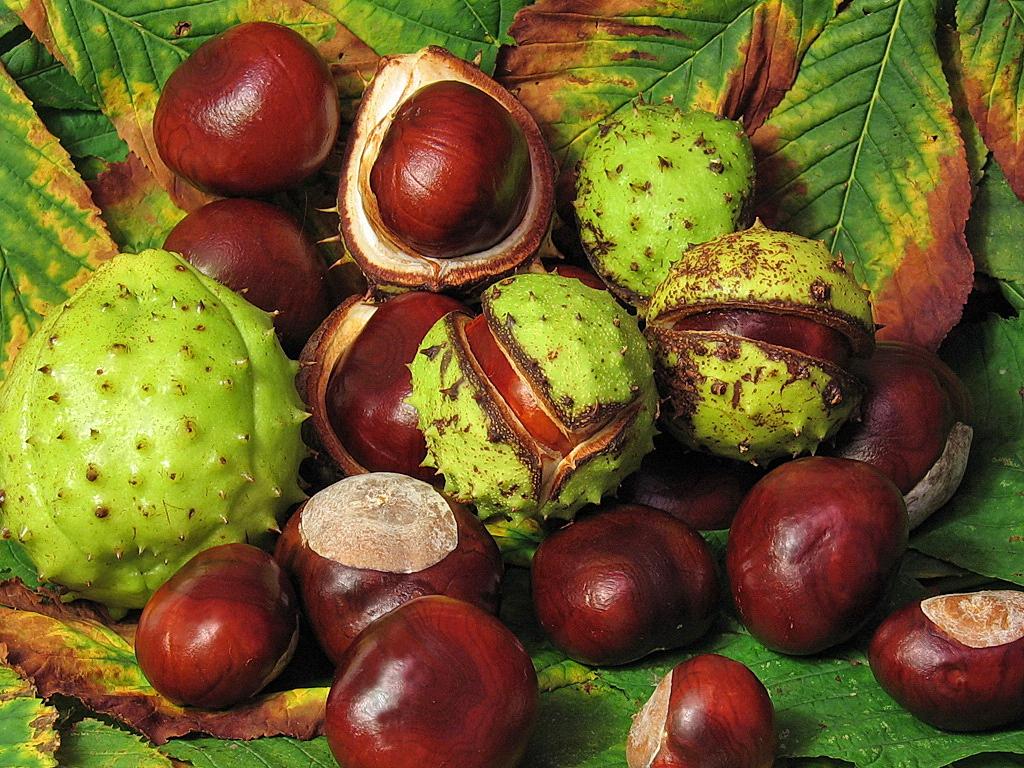
The fruits are spherical green capsules with a spiky shell. The up to three seeds inside (“conkers”) are glossy brown with a whitish patch at the base.
Features
Horse chestnut
Aesculus hippocastanum
very large leaves with five to seven leaflets
very large erect flower heads
large red-brown winter buds
Similar species
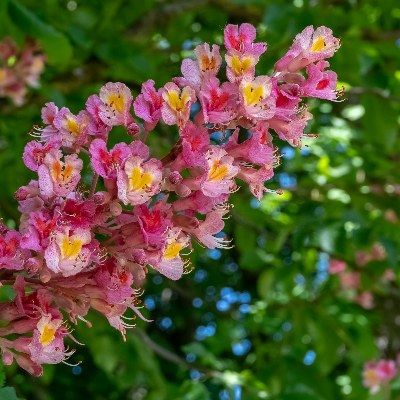
Aesculus × carnea
In the city
The horse chestnut is a popular urban tree, particularly because of its large leaves and flowers. Because of its low tolerance of salt and soil compaction, but also because of the large dropping fruits, it is not suitable for tree-lined roads or highways.
In autumn, children collect the seeds of the horse chestnut tree (“conkers”) and use them for playing or making things.
Fun Facts
Despite the similarity in name, horse chestnut and sweet chestnut are no close relations.
Horse chestnut trees are affected by the horse-chestnut leaf miner (Cameraria ohridella). This pest caused the leaves to drop prematurely, thus weakening the tree considerably.
The flowers of the horse chestnut are pollinated by bees and bumblebees. The initially yellow flowers change colour to pink after pollination as a floral guide to the pollinators not to head for the flower again.
In urban environments, the red horse chestnut (Aesculus × carnea) is increasingly planted as it is largely unaffected by the horse-chestnut leaf miner.
It flowers from April to June. The fruit ripening season is from September to October.
The fruits of the horse chestnut tree are only eaten by few animals in towns. One reason for this could be that the tree is not indigenous.
- Endangerment level Germany: not evaluated
- Usage:
Seeds, bark, leaves and flowers are used in the pharmaceutical industry.
The horse chestnut originates from the Balkan mountains. It was only reintroduced to central and western Europe from the 16th century onwards and is a non-indigenous plant (neophyte).
Unripe fruits and green seed coats are mildly poisonous. Its pollen is allergenic.
Sources
Blatt, Alice Kracht, CC BY-SA 4.0, https://offene-naturfuehrer.de/web/Datei:Aesculus_hippocastanum_(14).JPG
.JPG)
Blatt, Alina Zienowicz Ala z, CC BY-SA 3.0, https://commons.wikimedia.org/wiki/File:Kasztan_oo003.JPG

Frucht, Solipsist, CC BY-SA 2.0, https://commons.wikimedia.org/wiki/File:Aesculus_hippocastanum_fruit_(jha).jpg
.jpg)
Aas, G. & Riedmiller, A. (2002) Laubbäume. Bestimmen – Kennenlernen – Schützen, Bindlach: Gondrom Verlag.
Amann, G. & Richter, P. (1962) Bäume und Sträucher des Waldes, Melsungen: Verlag J. Neumann – Neudamm.
Kugler, H. (1970) Blütenökologie, Stuttgart: Gustav Fisher Verlag.
Roth, L., Daunderer, M. & Kormann, K. (2008) Giftpflanzen - Pflanzengifte. Vorkommen, Wirkung, Therapie. Allergische und phototoxische Reaktionen, Hamburg: Nikol Verlag.
Page „Gewöhnliche Rosskastanie“. : Wikipedia, The Free Encyclopedia. Date of last revision: 07.04.2016, 21:28 UTC. URL: https://de.wikipedia.org/w/index.php?title=Gew%C3%B6hnliche_Rosskastanie&oldid=153273993 (Accessed: 20.04.2016).