
Short Description
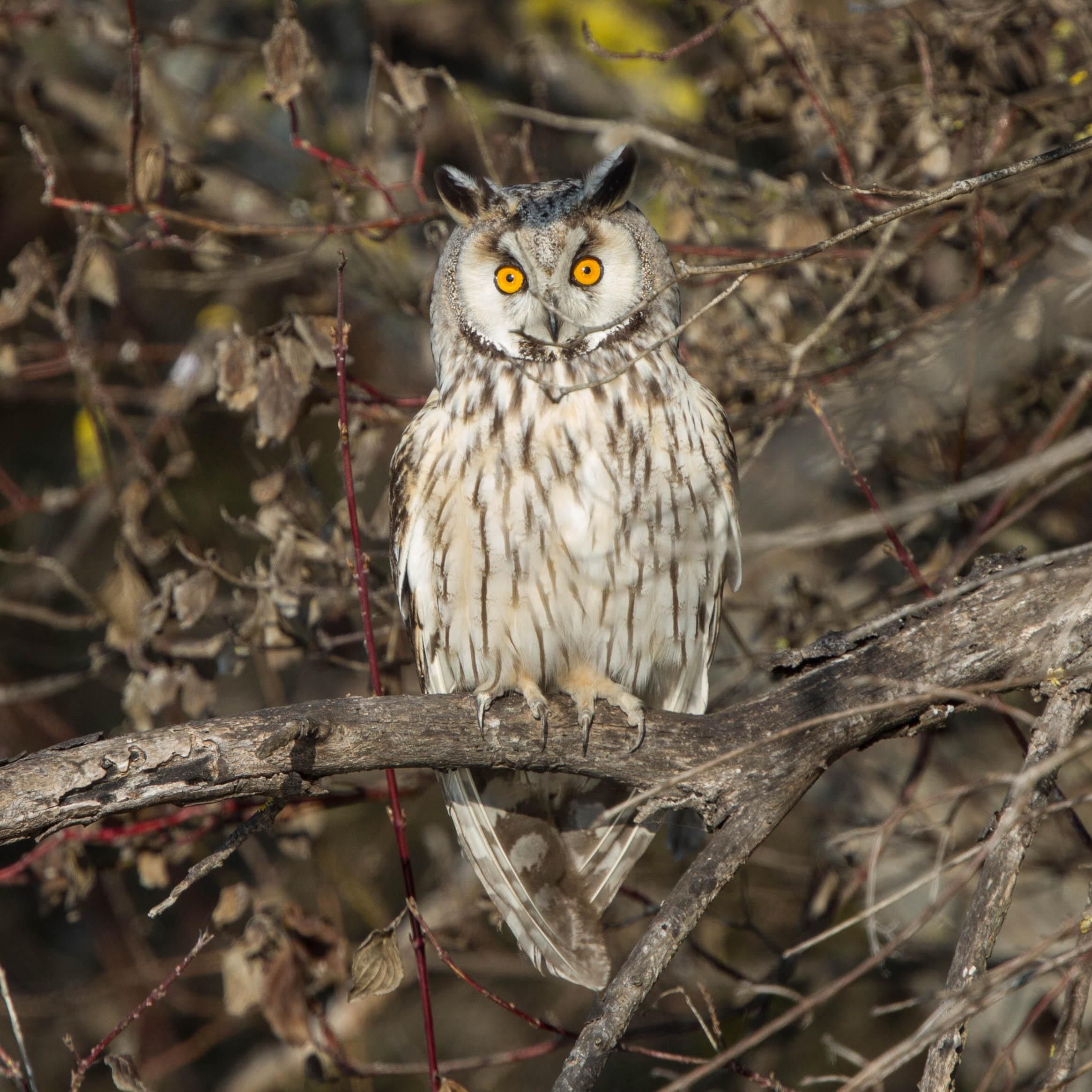
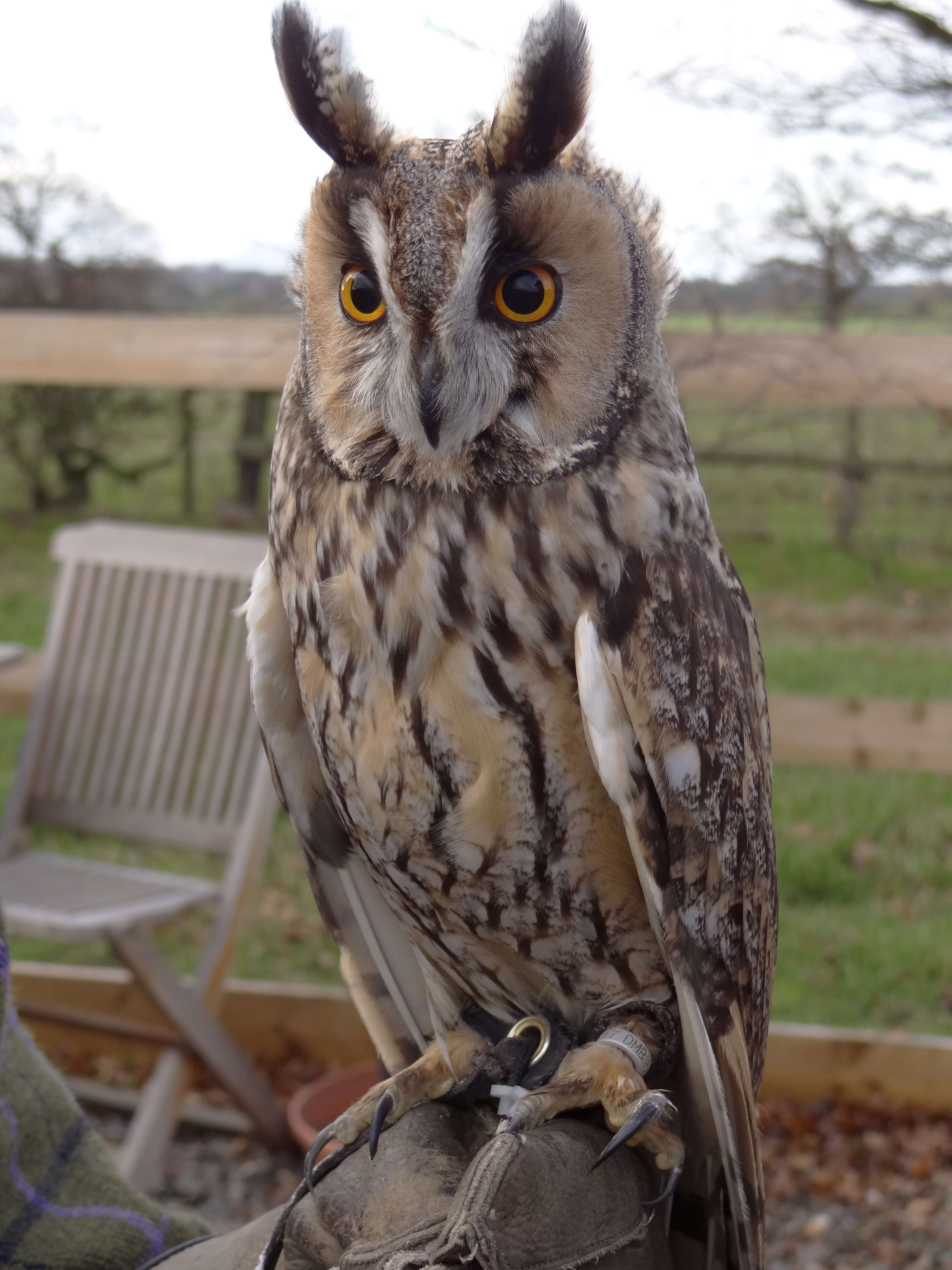
A distinctive feature of the long-eared owl are its striking, large ear tufts. The large-eared owl is light-brown to ochre-yellow with black-brown streaks or patches. The wings have obvious transverse stripes.
Males are mainly light-brown to cream-coloured.
Females tend to be darker with more rust-brown shades.
Features
Long-eared owl
Asio otus
large erect ear tufts
Gesang
Frommolt, CC BY-SA 3.0

In the city
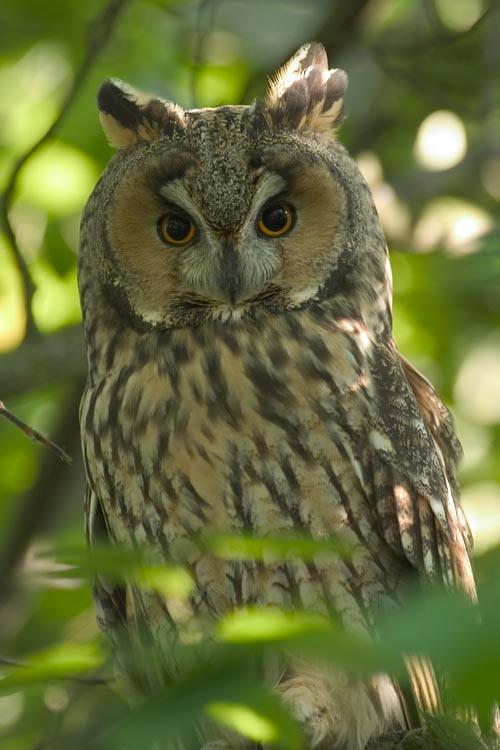
In urban environments, long-eared owls live in parks and large gardens. In winter, their daytime roosting places are in gardens or parks in areas of human habitation, in particularly severe winters, they may even roost right in the city centre.
Long-eared owls defend their nests against intruders and can also attack humans who come too close to their young. From May to August, the high-pitched peep of the young fledglings can be heard while they explore their surroundings (branching). At that stage, the parents still feed their young.
Fun Facts
Long-eared owls mainly breed in the nests of other birds such as magpies, common wood pigeons or grey herons.
Long-eared owls are active at dusk or at night. Their main prey are mice, but they also feed on smaller songbirds.
A characteristic feature of the long-eared owl is the formation of communal roosts: from late autumn onwards, the birds come together in groups for their day-time sleep.
Long-eared owls can be seen in Germany all year round.
Under their roosting trees, grey pellets can be found. They are the regurgitated indigestible parts of their food, e.g. the fur and bone of their prey.
- Endangerment level Germany: not endangered
Sources
Habitus , Ron Knight, CC BY-SA 2.0, https://commons.wikimedia.org/wiki/File:Long-eared_Owl_(Asio_otus)_(8520159521).jpg
_(8520159521).jpg)
Habitus , Sascha Rösner, CC BY-SA 3.0, https://commons.wikimedia.org/wiki/File:Waldohreule_in_freier_Wildbahn.jpg

Habitus , angusleonard, CC BY-SA 2.0, https://commons.wikimedia.org/wiki/File:Asio_otus_-Battlefield_Falconry_Centre,_Shrewsbury,_Shropshire,_England-8a.jpg

Witt, K. & Steiof, K. (2013) Rote Liste und Liste der Brutvögel von Berlin, 3. version, 15.11.2013. : Berliner Ornithologische Arbeitsgemeinschaft e.V. (eds.) Berliner Ornithologischer Bericht, volume 23, Berlin: Berliner Ornithologische Arbeitsgemeinschaft e.V., 1-23.
Page „Waldohreule“. : Wikipedia, The Free Encyclopedia. Date of last revision: 12.12.2015, 23:52 UTC. URL: https://de.wikipedia.org/w/index.php?title=Waldohreule&oldid=149004029 (Accessed: 18.02.2016).
Artenfinder (2016) Asio otus (Waldohreule), URL: https://arteninfo.net/elearning/voegel/speciesportrait/3023 (Accessed: 24.04.2016).
Wildtierportal Baden-Württemberg (n.d.) Greifvögel in Baden-Württemberg, URL: http://wildtiere-stadt.wildtiere-bw.de/tierarten/greifvoegel_in_baden_wuerttemberg/waldohreule.html (Accessed: 24.04.2016).
NABU Landesverband Schleswig-Holstein (2013) Heimliche Nachbarn gesucht! Aktion: Waldohreulen-Winterschlafplätze dem NABU melden, URL: https://schleswig-holstein.nabu.de/tiere-und-pflanzen/voegel/eulen/16414.html (Accessed: 24.04.2016).