
Short Description
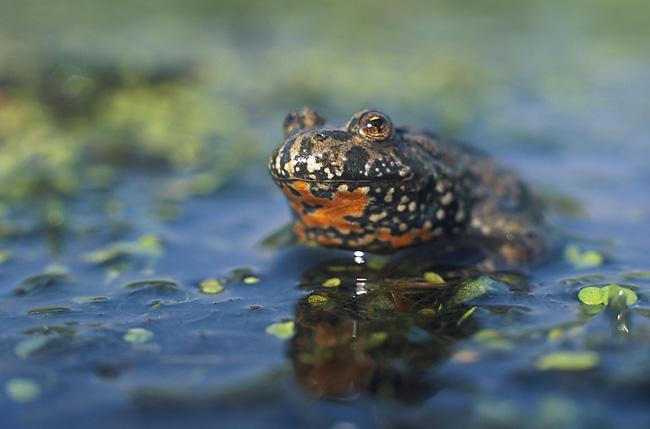
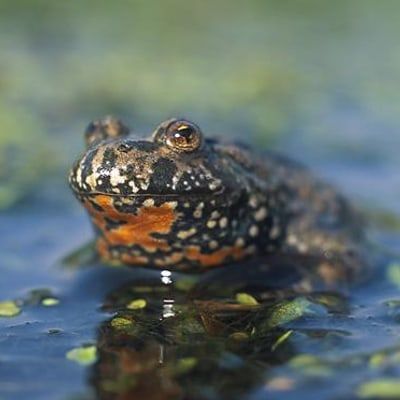
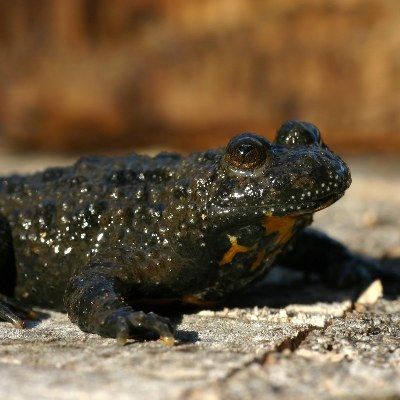
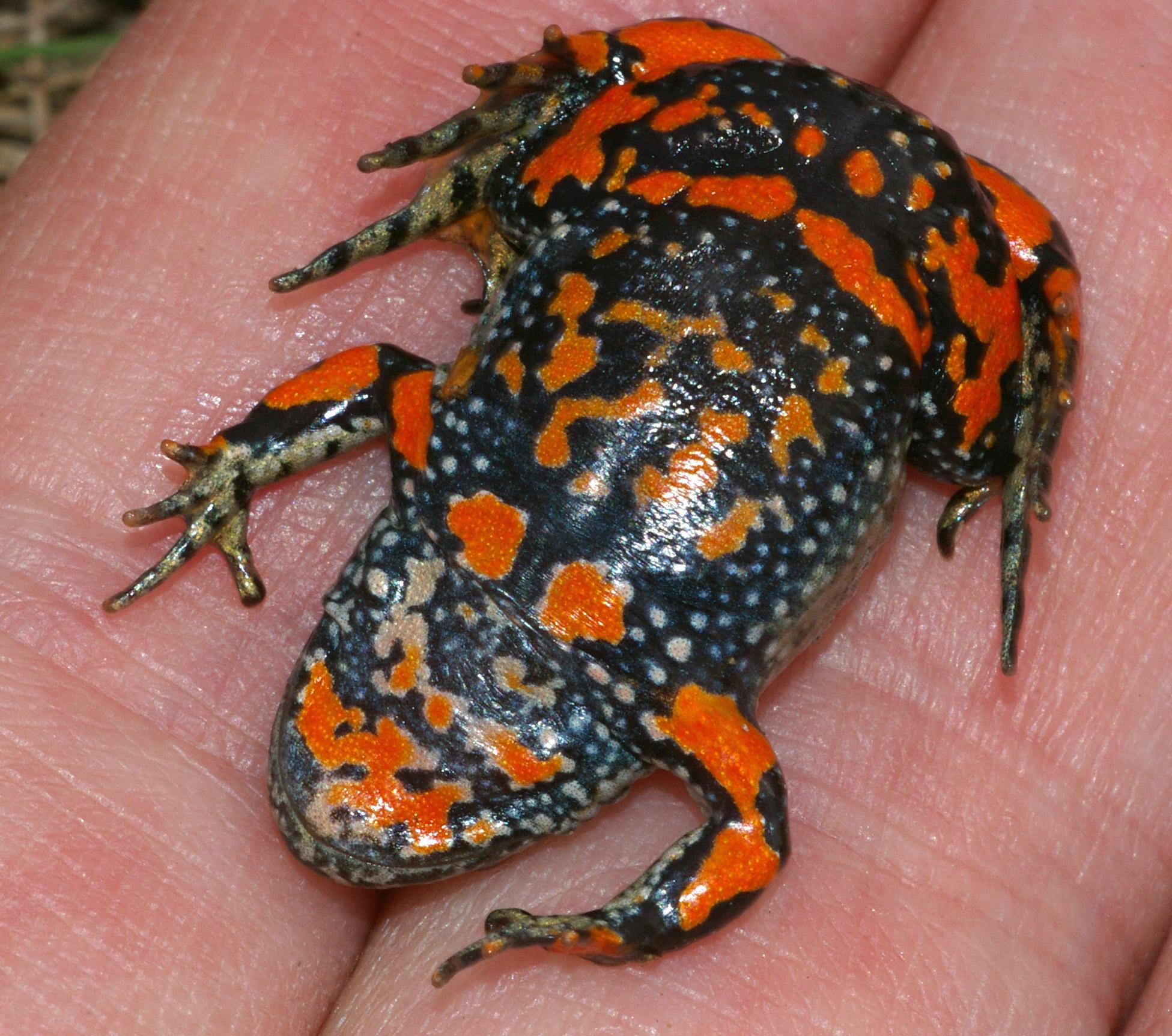
The European fire-bellied toad is pale to dark grey with flat warts. On the belly and the underside of the legs it has small, white spots and larger, orange-red spots. The heart-shaped pupils are also characteristic. The tips of the fingers and toes are dark grey to black. Depending on whether the background is light or dark, it can adapt its dorsal colouration.
During the mating season, males develop dark nuptial pads on the insides of their forelegs.
Features
European fire-bellied toad
Bombina bombina
orange-red patches on its belly
heart-shaped pupils
Balzrufe
Frommolt, CC BY-SA 3.0

In the city
The European fire-bellied toad lives in shallow waters rich in vegetation. It prefers nutrient-poo, shallow waters with a muddy bottom. For its hibernating sites it required dead wood and leaves.
It is particularly endangered by the regulation of water courses and the loss of habitats through human activity.
Fun Facts
European fire-bellied toads form small territories that are fiercely defended against intruders. Threatening calls are used to keep other males away at a distance of approx. 1.5 metres.
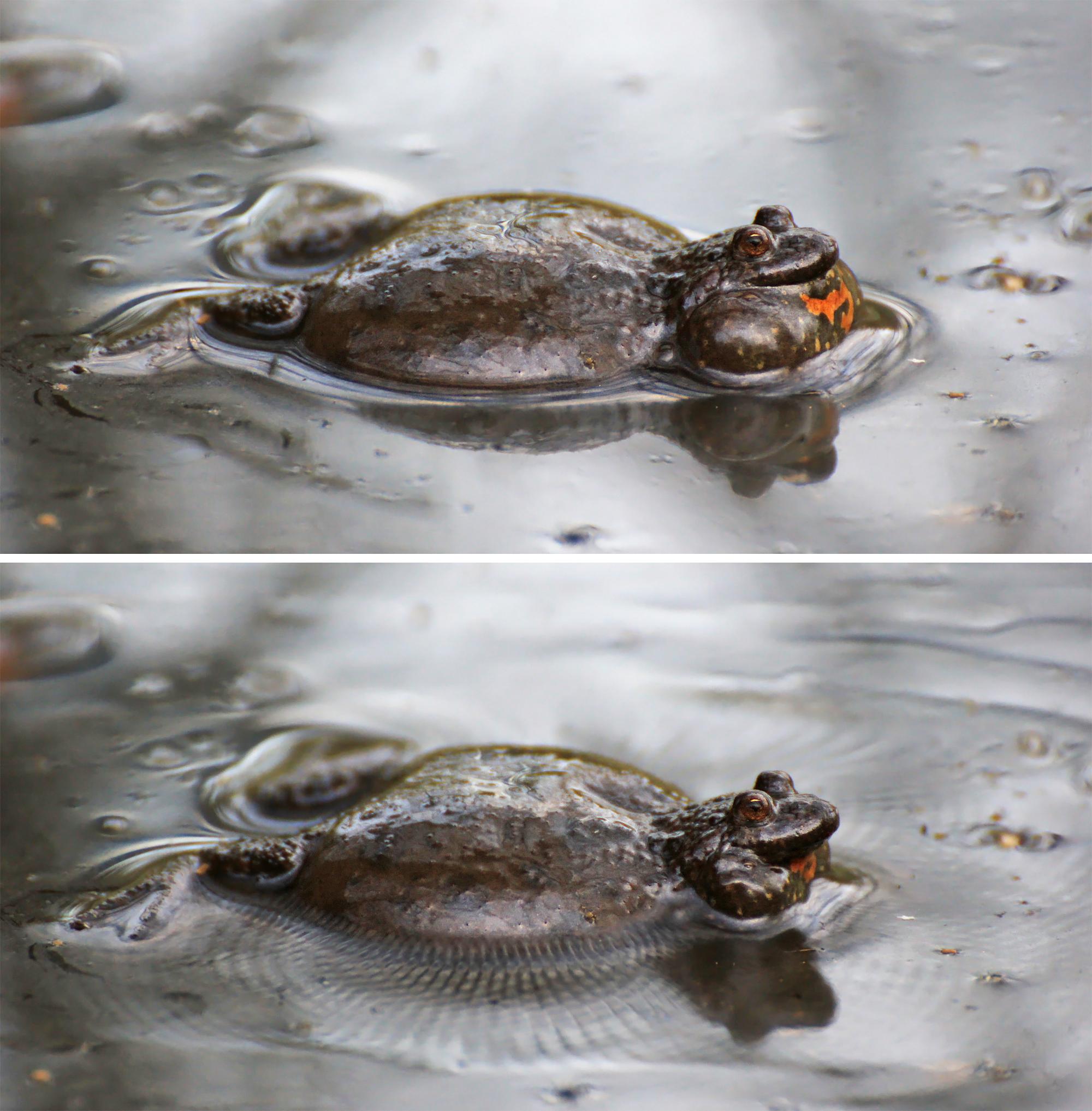
The males make their calls while drifting on the water, bloated like balloons.
The orange-red spotted underside is intended to signal toxicity to enemies and serves as a deterrent. When threatened, the fire-bellied toad forms a hollow back and bends its arms and legs upwards so that the spots become visible.
n the shared distribution area, interbreeding with yellow-bellied toads occurs. Their descendants display a mixture of the characteristic features (hybridisation).
Heart-shaped pupils are characteristic for the Bombina species.
All European amphibians are specially protected and must not be captured, injured or killed.
- Endangerment level Germany: severely endangered
The fluid secreted when threatened can cause mucous membrane irritations in humans.
Sources
Habitus , Marek Szczepanek, CC BY-SA 3.0, https://commons.wikimedia.org/wiki/File:Bombina_bombina_2_%28Marek_Szczepanek%29.jpg
.jpg)
Jungtier, Christian Fischer, CC BY-SA 3.0, https://de.wikipedia.org/wiki/Datei:BombinaBombinaJuv.jpg

Männchen , Christian Fischer, CC BY-SA 3.0, https://de.wikipedia.org/wiki/Datei:BombinaBombinaCallingMale.jpg

Page „Rotbauchunke“. : Wikipedia, The Free Encyclopedia. Date of last revision: 29.04.2016, 16:45 UTC. URL: https://de.wikipedia.org/w/index.php?title=Rotbauchunke&oldid=153947983 (Accessed: 10.05.2016).
Kwet, A. (2015) Reptilien und Amphibien Europas. 250 Arten mit Verbreitungskarten, Stuttgart: Franckh Kosmos Verlag.
Blab, J. & Vogel, H. (2002) Amphibien und Reptilien erkennen und schützen, München: BLV.
Glandt, D. (2008) Heimische Amphibien: Bestimmen – Beobachten – Schützen, Wiebelsheim: AULA-Verlag.
Glandt, D. (2015) Die Amphibien und Reptilien Europas, Wiebelsheim: Quelle & Meyer Verlag.
Bundesfachausschuss Feldherpetologie/Ichthyofaunistik im NABU (n.d.) Rote Listen, URL: http://www.amphibienschutz.de/schutz/artenschutz/roteliste/deutschland.htm (Accessed: 26.07.2016).
NABU – Naturschutzbund Deutschland e.V. (n.d.) Die heimischen Lurch-Arten im Porträt. Kröten, Frösche, Molche, Unken und Salamander, URL: https://www.nabu.de/tiere-und-pflanzen/amphibien-und-reptilien/amphibien/artenportraets/ (Accessed: 10.08.2016).
Schulte, U. (2013) Artensteckbrief Rotbauchunke (Bombina bombina), URL: https://feldherpetologie.de/heimische-amphibien-artensteckbrief/artensteckbrief-rotbauchunke-bombina-bombina/ (Accessed: 10.08.2016).