
Short Description
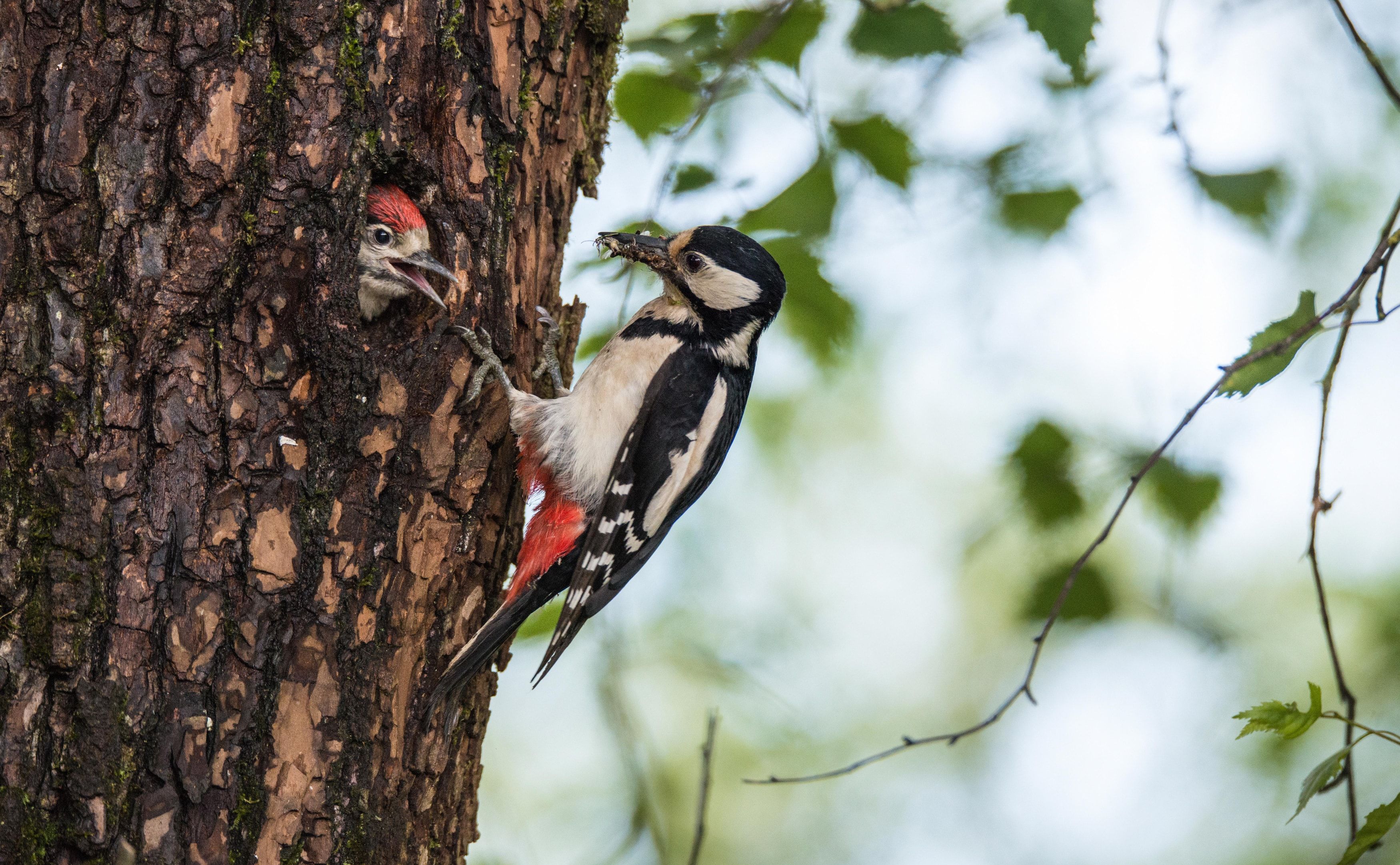
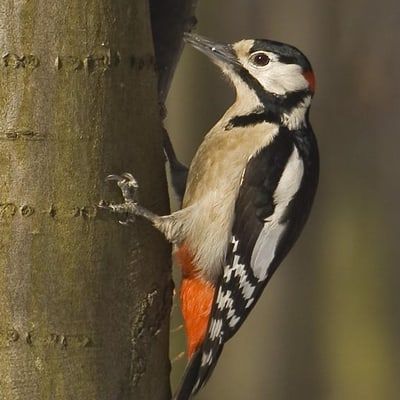
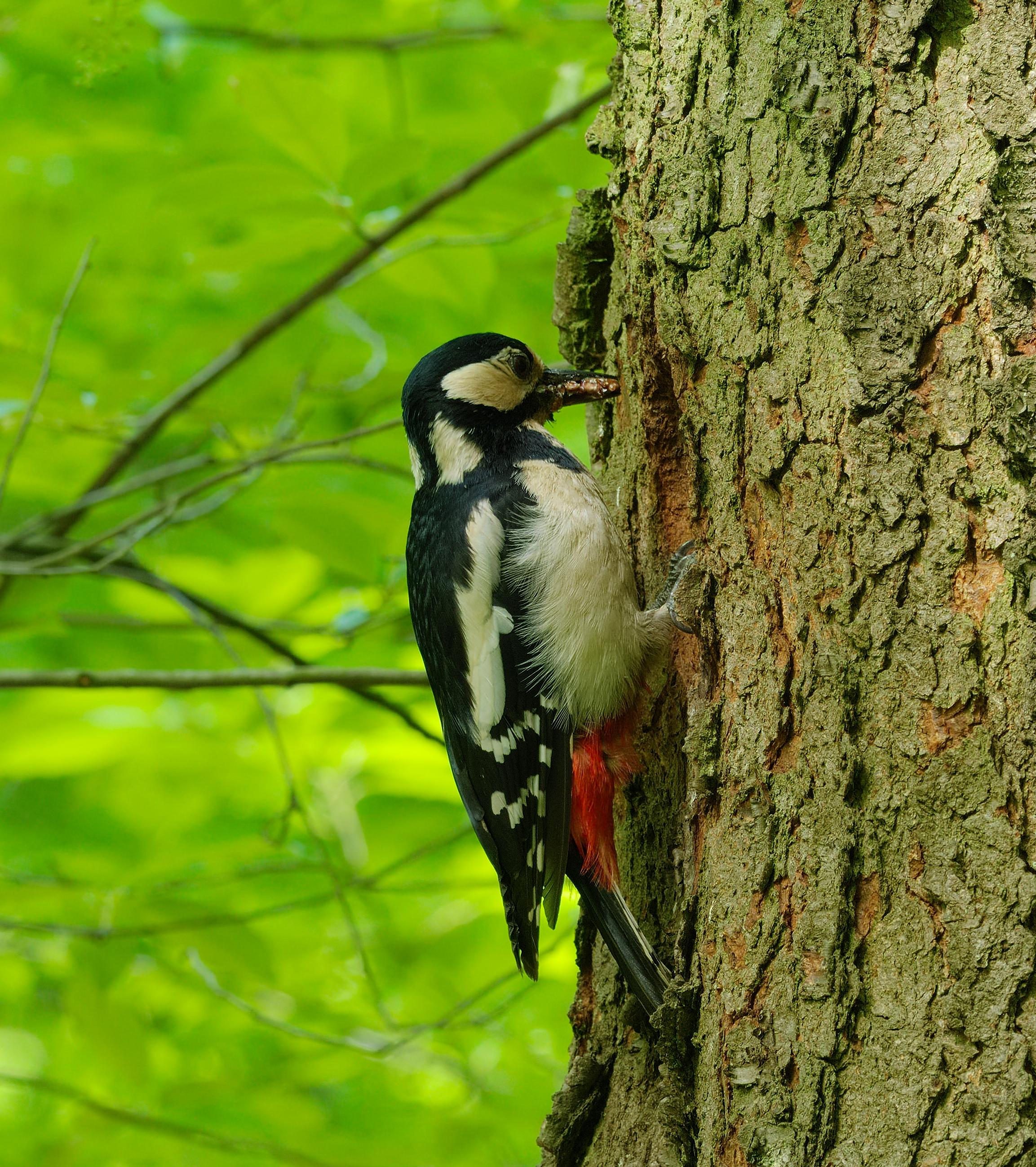
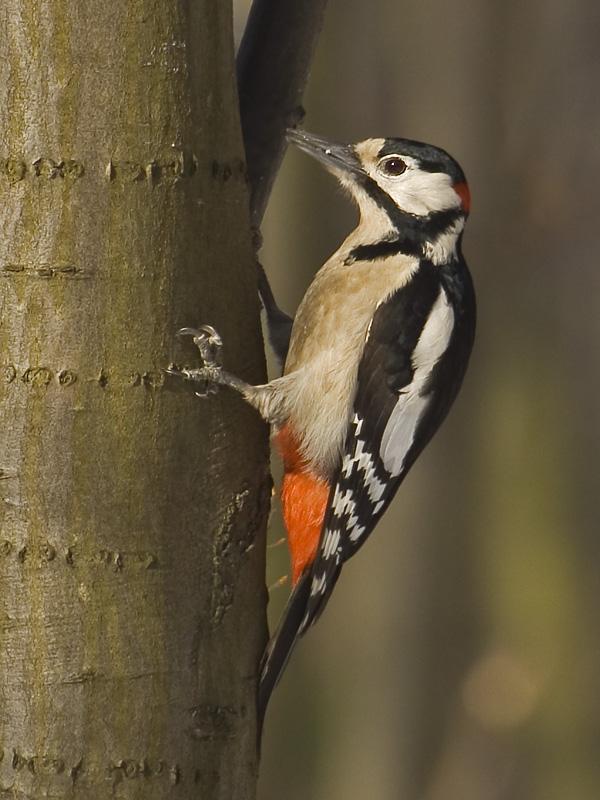
The plumage of the great spotted woodpecker is black, white and red. Black moustachial stripes run along the side of the neck. Most times, the woodpecker can be observed upright climbing a tree.
Male birds can be recognised from the red patch on their neck.
Young birds have a red crown.
Features
Great spotted woodpecker
Dendrocopos major
red patch on nape (males)
Rufe und Trommeln
Gnensch/Conrads, CC BY-SA 3.0

Similar species
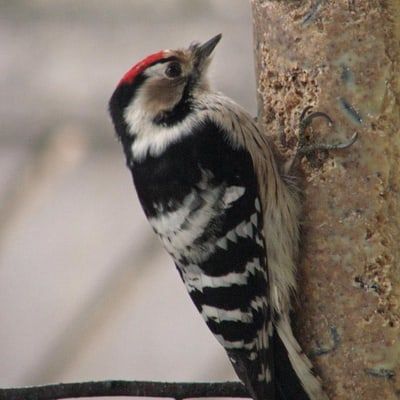
Lesser spotted woodpecker
Dryobates minor
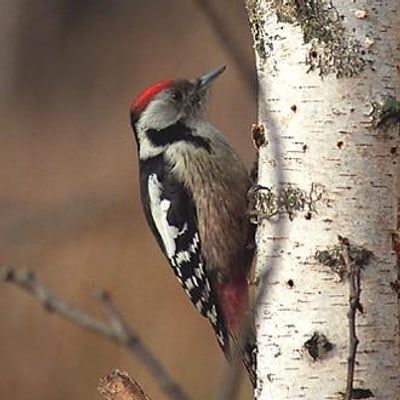
Middle spotted woodpecker
Dendrocoptes medius
In the city
In an urban environment, great spotted woodpeckers are mainly found in parks and gardens with old trees. They can sometimes also be seen in tree-lined roads and small groups of trees.
The great spotted woodpecker makes its nesting holes mainly in rotting wood. As branches breaking off constitute a danger to the public, such wood is often removed as a precaution. For that reason, great spotted woodpeckers sometimes move to urban buildings, making their nesting holes in thermal insulation of façades.
Fun Facts
Great spotted woodpeckers jam nuts or pine cones into bark crevices in order to peck them open gradually. Such sites are referred to as “anvils” or smithies”.
The great spotted woodpecker is the most common indigenous woodpecker.
Great spotted woodpeckers generally hibernate in Germany. However, in particularly harsh winters, some northern European populations migrate to central and western Europe.
- Endangerment level Germany: not endangered
Sources
Weibchen mit Jungtier, Böhringer Friedrich, CC BY-SA 3.0, https://commons.wikimedia.org/wiki/File:Buntspecht_%E2%99%80_Dendrocopos_major_beim_F%C3%BCttern.jpg

Weibchen, Andreas Eichler, CC BY-SA 4.0, https://commons.wikimedia.org/wiki/File:2015.05.08.-03-Kaefertaler_Wald-Mannheim--Buntspecht-Weibchen.jpg

Männchen, Sławomir Staszczuk, CC BY-SA 3.0, https://commons.wikimedia.org/wiki/File:DendrocoposMajor.jpg

Page „Buntspecht“. : Wikipedia, The Free Encyclopedia. Date of last revision: 08.02.2021, 08:21 UTC. URL: https://de.wikipedia.org/w/index.php?title=Buntspecht&oldid=208578742 (Accessed: 10.02.2021).
Witt, K. & Steiof, K. (2013) Rote Liste und Liste der Brutvögel von Berlin, 3. version, 15.11.2013. : Berliner Ornithologische Arbeitsgemeinschaft e.V. (eds.) Berliner Ornithologischer Bericht, volume 23, Berlin: Berliner Ornithologische Arbeitsgemeinschaft e.V., 1-23.
Fiedler, W. (2015) Die Vögel Mitteleuropas sicher bestimmen - Schlüssel zur Art-, Alters- und Geschlechtsbestimmung, Wiebelsheim: Quelle & Meyer Verlag.
Makatsch, W. (1989) Wir bestimmen die Vögel Europas, Leipzig: Neumann Verlag.
Voigt, A. (2006) Exkursionsbuch zum Studium der Vogelstimmen, Heidelberg: Quelle & Meyer Verlag.
Svensson, L. (2011) Der Kosmos Vogelführer - Alle Arten Europas, Nordafrikas und Vorderasiens, Stuttgart: Franckh Kosmos Verlag.
Harrison, C. (1975) Jungvögel, Eier und Nester aller Vögel Europas, Nordafrikas und des Mittleren Ostens - Ein Naturführer zur Fortpflanzungsbiologie, Hamburg und Berlin: Verlag Paul Parey.
Landesbund für Vogelschutz in Bayern e.V, Kreisgruppe München (2010) WER KLOPFT DENN DA? SPECHTE ALS FASSADENHACKER (Flyer), München: Landesbund für Vogelschutz in Bayern e.V, Kreisgruppe München.