
Short Description
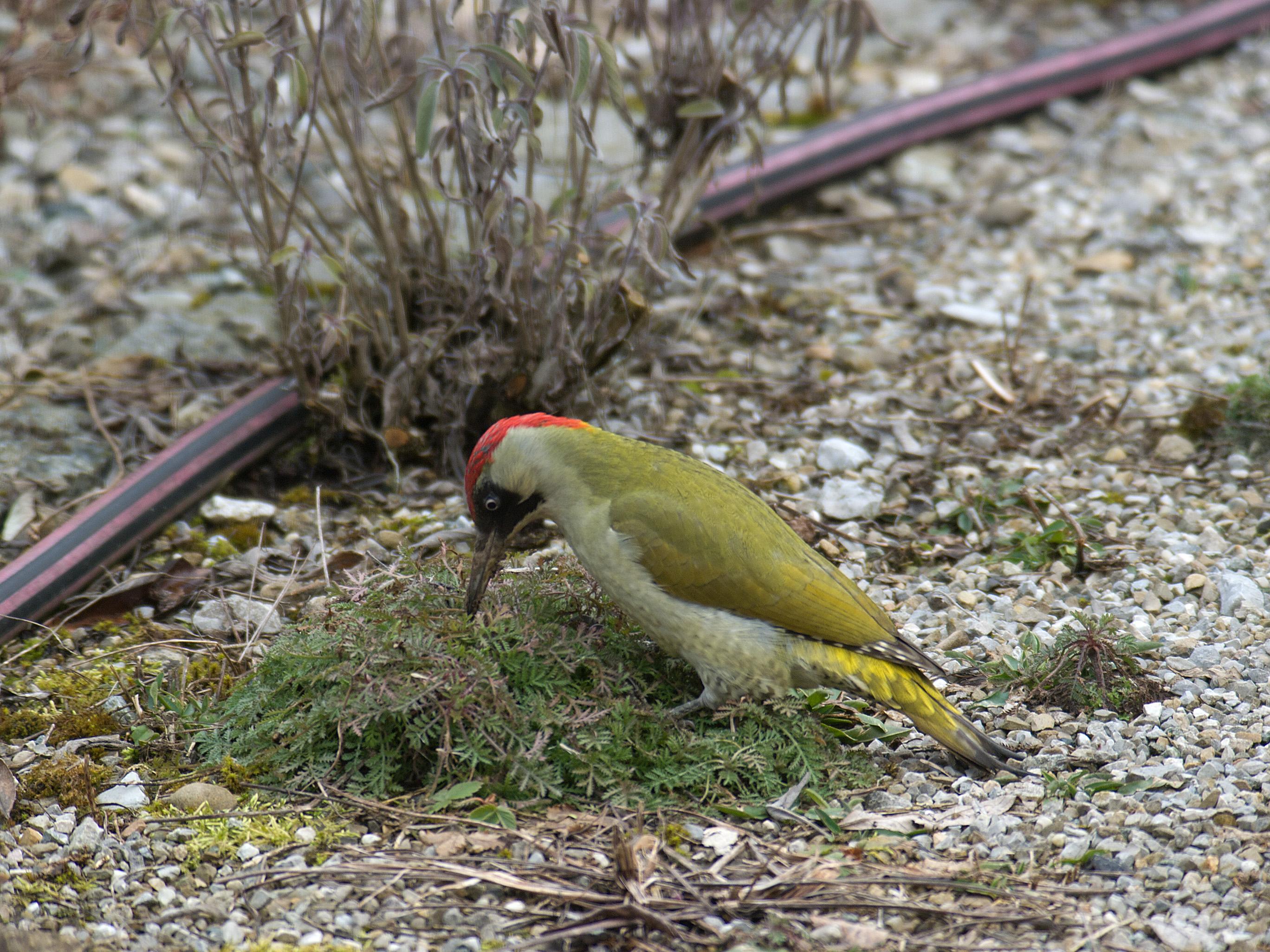
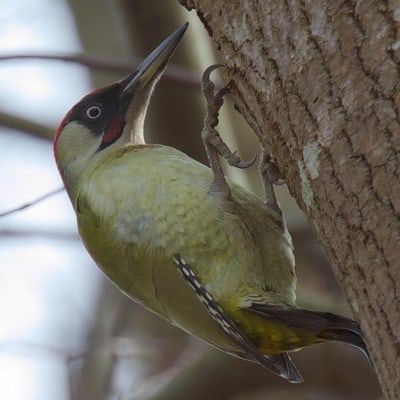
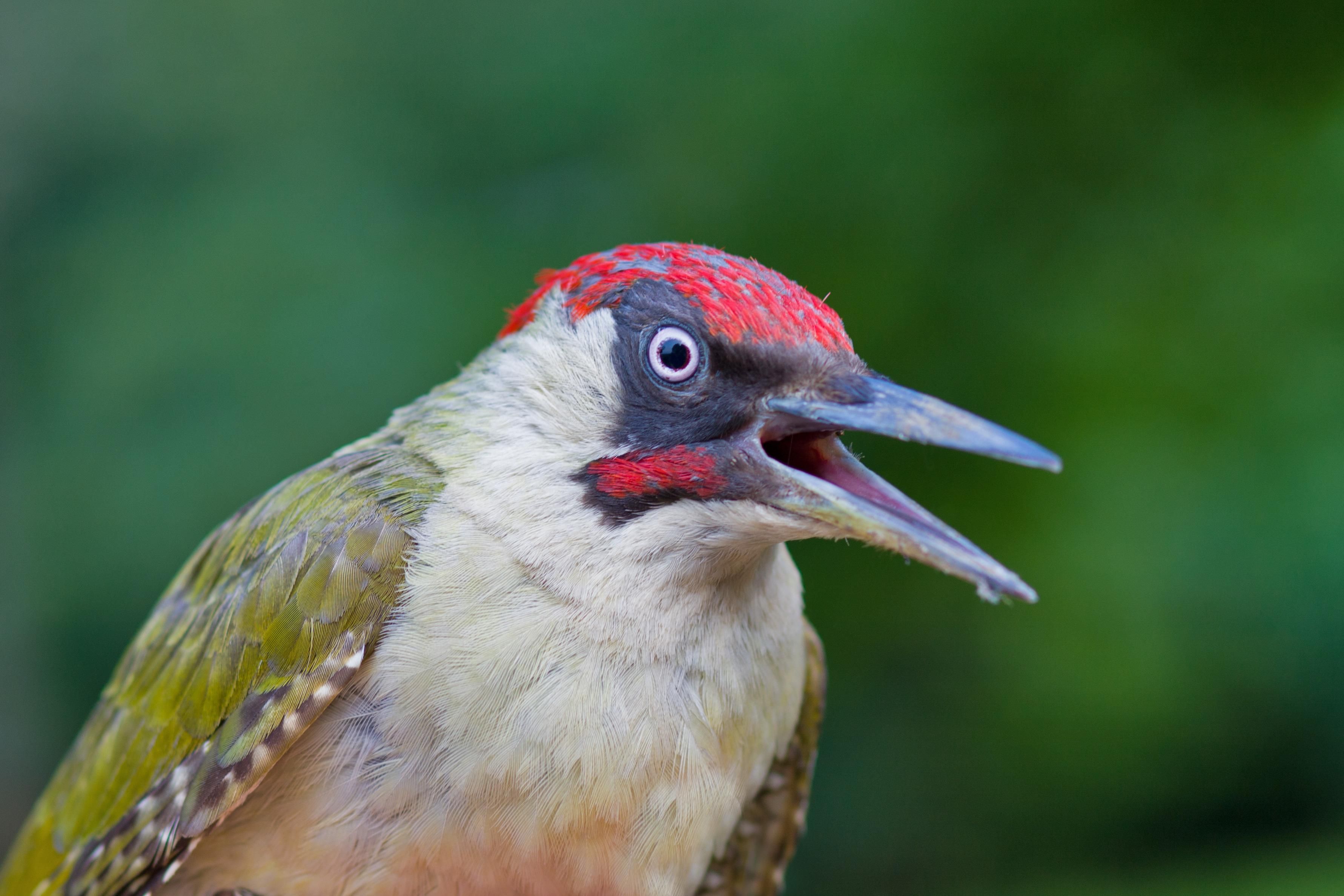
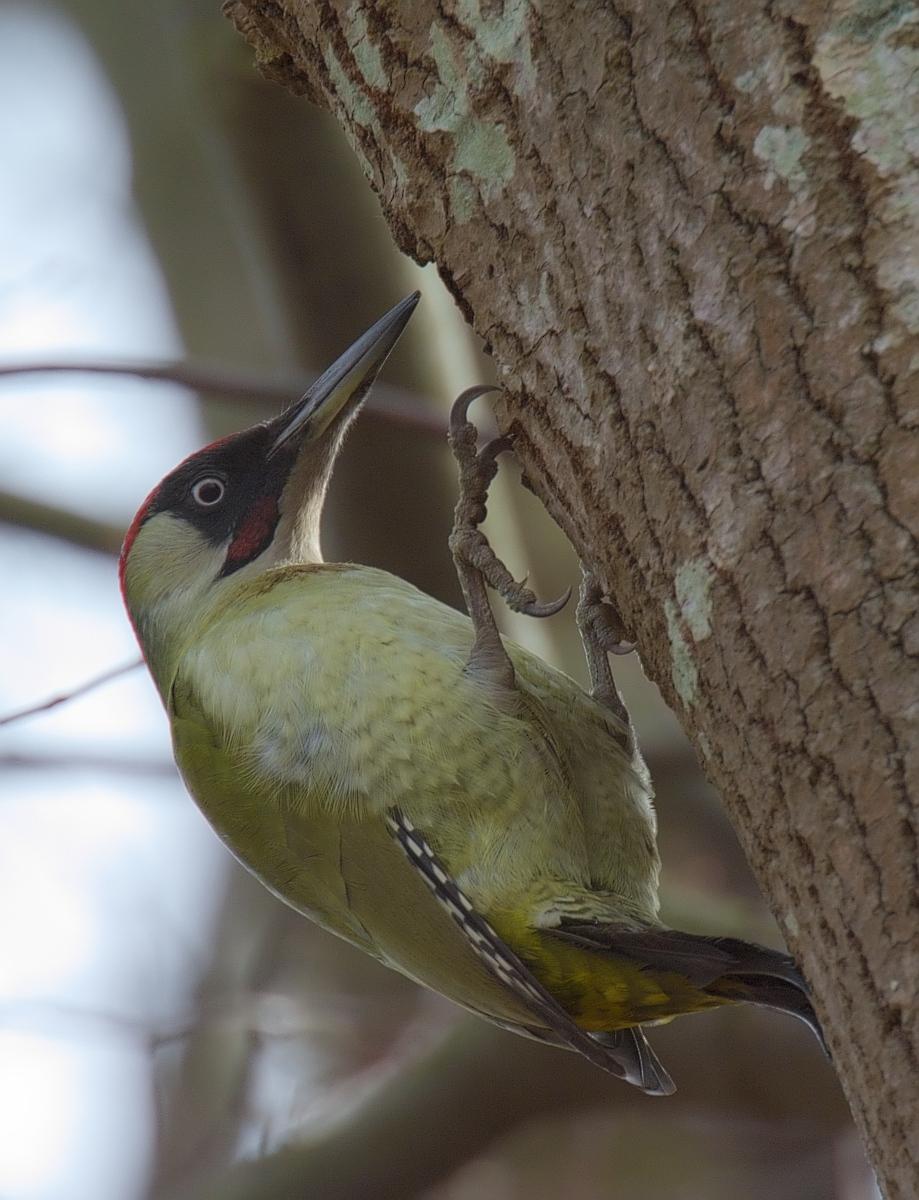
Thanks to its green back, the European green woodpecker is generally well camouflaged and often more heard than seen. The black mask extending from the bill to behind the eyes is its characteristic feature. Cap and nape are red.
Male birds can be recognised from the black-bordered red patch on their cheeks (chial stripe).
The chial stripe is solid black in females.
The plumage of young birds is notably duller. The red feathers on their heads are more inconspicuous and generally interspersed with grey patches. The upper sides of the body and wings have white spots.
Features
European green woodpecker
Picus viridis
green back
black face mask
Rufreihen
K. Frommolt, CC BY-SA 3.0

Similar species
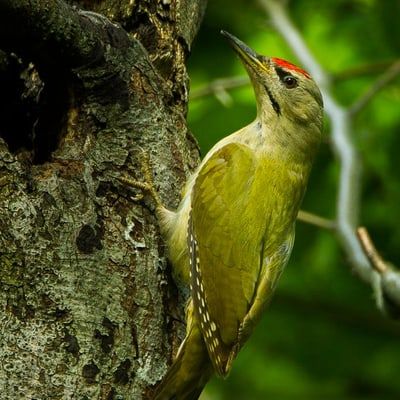
Grey-headed woodpecker
Picus canus
In the city
Because of the loss of its preferred rural habitats, increasing numbers of grey-headed woodpeckers move into urban settings. In cities, they find the old trees they require in parks, allotment colonies and cemeteries. Lawns, too, are full of ants, their preferred source of food.
n winter, they seek out bird feeders and can often be seen there.
Fun Facts
Because of its black mask, it is also known as the “flying Zoro”.
The European green woodpecker is also known ìn German as “Erdspecht“ [ground woodpecker] because it moves across the ground more frequently and dexterously than other woodpeckers.
The European green woodpecker is one of the most common species of woodpecker in Europe.
To ensure that the woodpecker’s brain can stand up to the constant gouging and pecking, bill and brain have sprung connections.
European green woodpeckers can be seen all year round.
It feeds mainly on ground-dwelling ants, thus pecking less than other woodpeckers.
- Endangerment level Germany: not endangered
Sources
Weibchen, OhWeh, CC BY-SA 2.5, https://commons.wikimedia.org/wiki/File:Gr%C3%BCnspecht_Picus_viridis_Weibchen-006.jpg

Männchen, Andreas Trepte, CC BY-SA 2.5, https://commons.wikimedia.org/wiki/File:European_Green_Woodpecker.jpg

Habitus , Stefan Berndtsson, CC BY 2.0, http://species-id.net/openmedia/File:Picus_viridis_Stefan_Berndtsson.jpg

Page „Grünspecht“. : Wikipedia, The Free Encyclopedia. Date of last revision: 10.02.2021, 17:45 UTC. URL: https://de.wikipedia.org/w/index.php?title=Gr%C3%BCnspecht&oldid=208667978 (Accessed: 11.02.2021).
Fiedler, W. (2015) Die Vögel Mitteleuropas sicher bestimmen - Schlüssel zur Art-, Alters- und Geschlechtsbestimmung, Wiebelsheim: Quelle & Meyer Verlag.
Makatsch, W. (1989) Wir bestimmen die Vögel Europas, Leipzig: Neumann Verlag.
Voigt, A. (2006) Exkursionsbuch zum Studium der Vogelstimmen, Heidelberg: Quelle & Meyer Verlag.
Svensson, L. (2011) Der Kosmos Vogelführer - Alle Arten Europas, Nordafrikas und Vorderasiens, Stuttgart: Franckh Kosmos Verlag.
Harrison, C. (1975) Jungvögel, Eier und Nester aller Vögel Europas, Nordafrikas und des Mittleren Ostens - Ein Naturführer zur Fortpflanzungsbiologie, Hamburg und Berlin: Verlag Paul Parey.
Artenfinder (2016) Picus viridis (Grünspecht), URL: https://arteninfo.net/elearning/voegel/speciesportrait/3044 (Accessed: 19.04.2016).
NABU – Naturschutzbund Deutschland e.V. (n.d.) Höhlenbau als Paarübung. Verhalten und Lebensweise des Grünspechts, URL: https://www.nabu.de/tiere-und-pflanzen/aktionen-und-projekte/vogel-des-jahres/2014-gruenspecht/16254.html (Accessed: 11.02.2021).
Witt, K. & Steiof, K. (2013) Rote Liste und Liste der Brutvögel von Berlin, 3. version, 15.11.2013. : Berliner Ornithologische Arbeitsgemeinschaft e.V. (eds.) Berliner Ornithologischer Bericht, volume 23, Berlin: Berliner Ornithologische Arbeitsgemeinschaft e.V., 1-23.
NABU – Naturschutzbund Deutschland e.V. (2016) Rote Liste der Brutvögel Deutschlands. 5. version, published August 2016, URL: https://www.nabu.de/tiere-und-pflanzen/voegel/artenschutz/rote-listen/10221.html (Accessed: 07.04.2017).