
Short Description
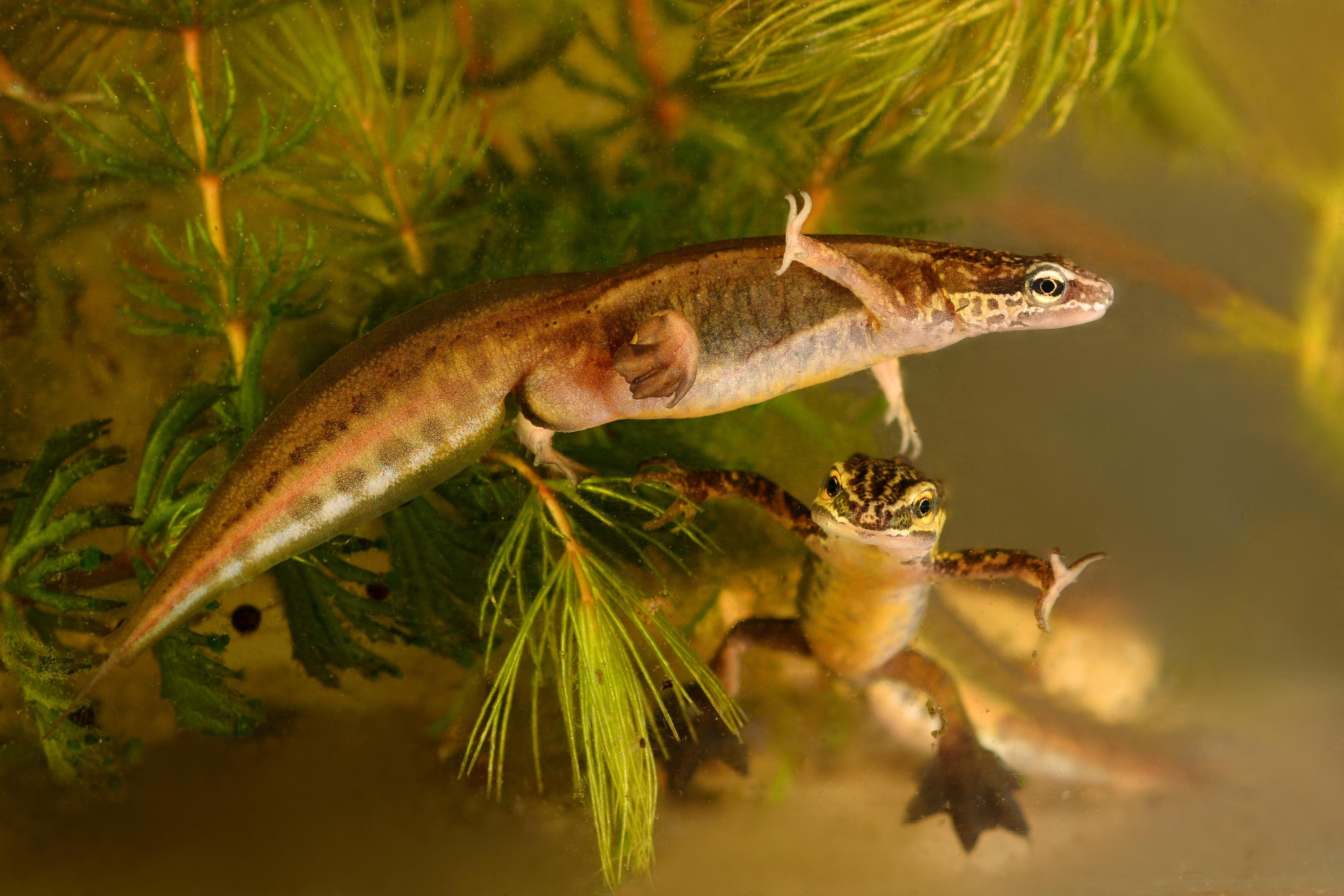
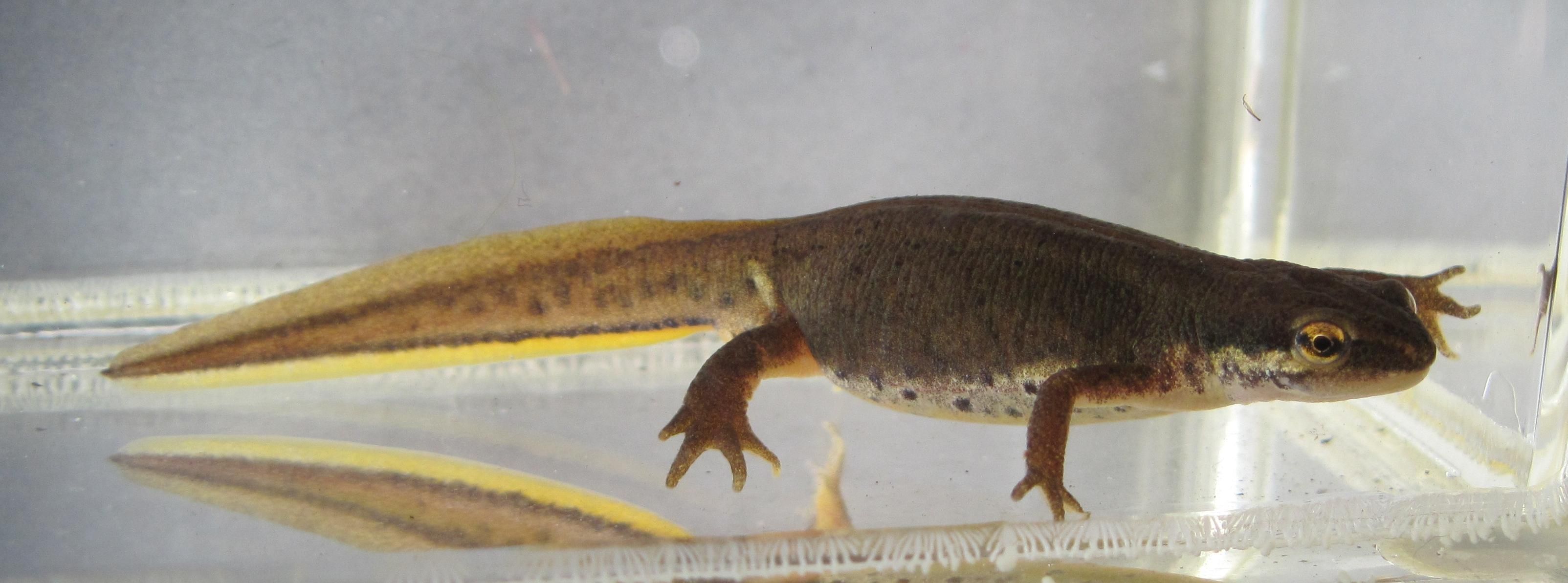
With a length of approx. 8.5 cm, the palmate newt is one of the smallest Central European newt species. Its upper side is yellowish-brown in colour, with dark spots or a slight marbling. The ventral side is faintly spotted, usually not at all, and yellowish-orange in the middle. The underside of the throat is white-pink and also unspotted.
During the mating season, the males have a filiform tail process and conspicuously large webbed hind feet.
Features
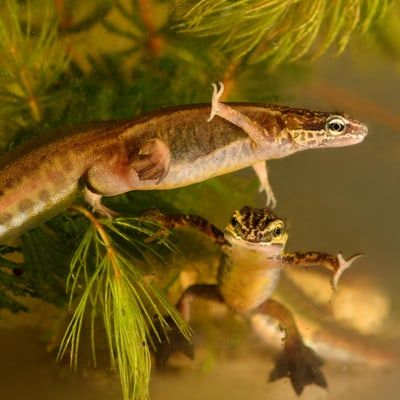
Palmate newt
Lissotriton helveticus
untainted throat
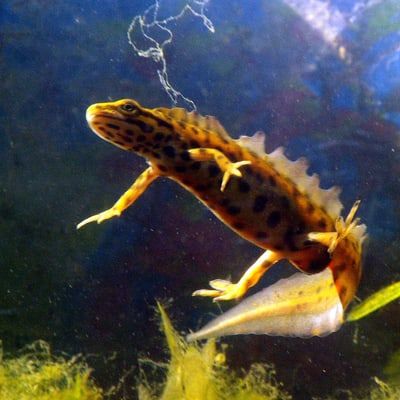
Male with filamentous attachment at the end of the tail during mating season
In the city
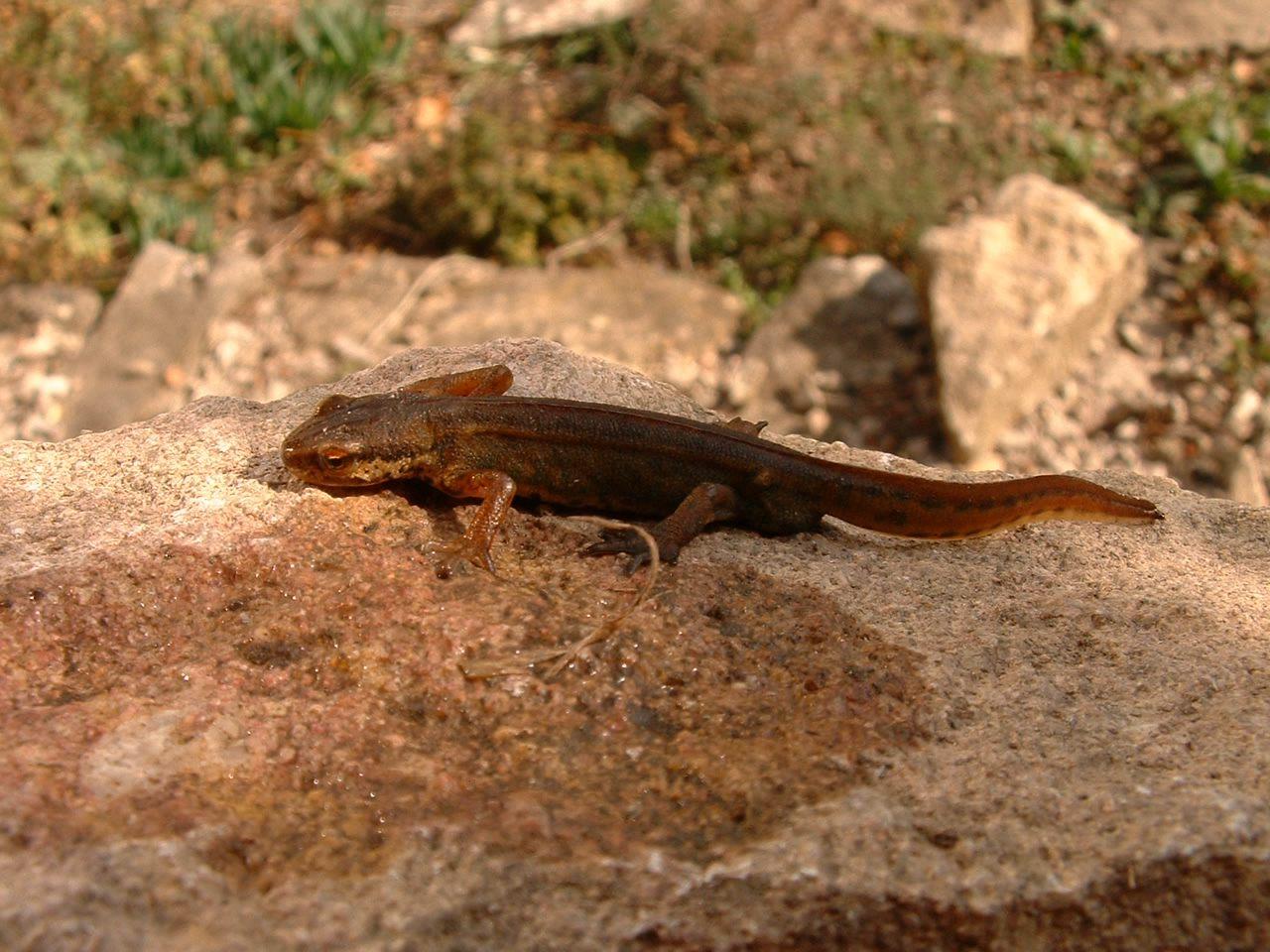
Due to its wide range of habitats, this newt can be found in the vicinity of very different bodies of water. These include, for example, wallows, spring ponds, streams near springs, small and large ponds, ponds and dams. Areas with open agricultural landscapes, on the other hand, are avoided.
Its populations suffer from the impairment and destruction of their habitats through filling or the introduction of fertilisers, environmental toxins and rubbish. The deliberate introduction of fish can also lead to a collapse of the amphibian populations, as their spawn and larvae are preyed upon by many fish.
Fun Facts
It belongs to the smallest Central European newt species.
Due to the close relationship, crossbreeding between the palmate newt and the pond newt can occur from time to time in the field. The animals then possess characteristics of both parent species, but are sterile themselves.
All European amphibians are specially protected and may not be captured, injured or killed.
- Endangerment level Germany: not endangered
The name is due to the thread-like appendage of the males in their nuptial dress.
Sources
Habitus , Gilles San Martin, CC BY-SA 2.0, https://commons.wikimedia.org/wiki/File:Lissotriton_helveticus_(18501796441).jpg
.jpg)
Männchen in Landtracht, Jeffdelonge, CC BY-SA 3.0, https://de.wikipedia.org/wiki/Datei:Triturus_vulgaris01.jpg

Weibchen, Christopher Schwerdt, CC BY-SA 3.0, https://de.wikipedia.org/wiki/Datei:Fadenmolchweibchen.jpg

Page „Fadenmolch“. : Wikipedia, The Free Encyclopedia. Date of last revision: 03.04.2017, 14:32 UTC. URL: https://de.wikipedia.org/w/index.php?title=Fadenmolch&oldid=164209472 (Accessed: 15.02.2018).
NABU – Naturschutzbund Deutschland e.V. (n.d.) An der Kehle gut zu erkennen. Der Fadenmolch (Lissotriton helveticus), URL: https://www.nabu.de/tiere-und-pflanzen/amphibien-und-reptilien/amphibien/artenportraets/10615.html (Accessed: 15.02.2018).
Schulte, U. (2013) Artensteckbrief Fadenmolch (Lissotriton helveticus), URL: https://feldherpetologie.de/heimische-amphibien-artensteckbrief/artensteckbrief-fadenmolch-lissotriton-helveticus/ (Accessed: 15.02.2018).
Gröschl, H. (2003-2017) Fadenmolch (Triturus helveticus), URL: http://www.naturspektrum.de/db/spezies.php?art=triturus_helveticus (Accessed: 15.02.2018).
Kwet, A. (2015) Reptilien und Amphibien Europas. 250 Arten mit Verbreitungskarten, Stuttgart: Franckh Kosmos Verlag.
Blab, J. & Vogel, H. (2002) Amphibien und Reptilien erkennen und schützen, München: BLV.
Glandt, D. (2008) Heimische Amphibien: Bestimmen – Beobachten – Schützen, Wiebelsheim: AULA-Verlag.
Glandt, D. (2015) Die Amphibien und Reptilien Europas, Wiebelsheim: Quelle & Meyer Verlag.
Matz, G. & Weber, D. (1983) Amphibien und Reptielien – Die 169 Arten Europas farbig abgebildet, München: BLV.