
Short Description
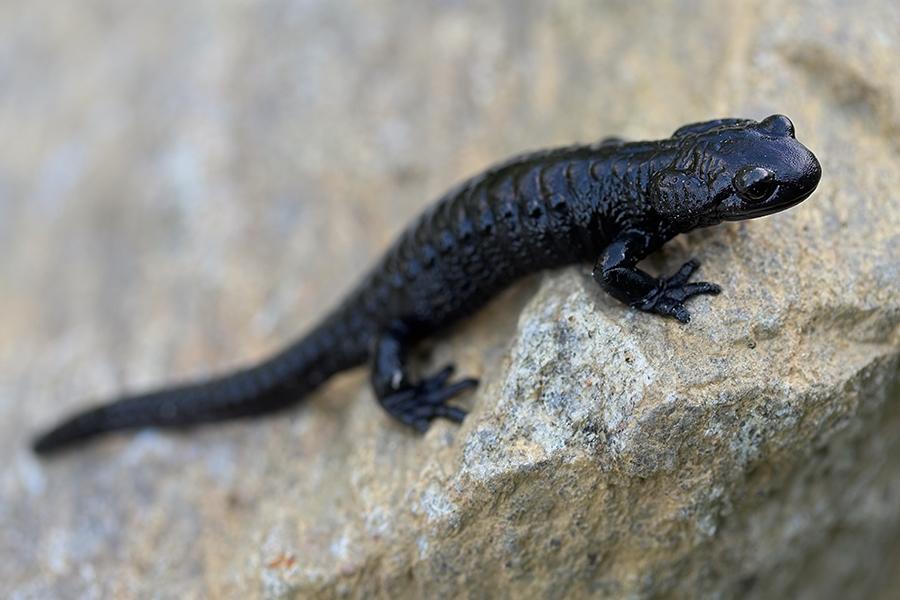
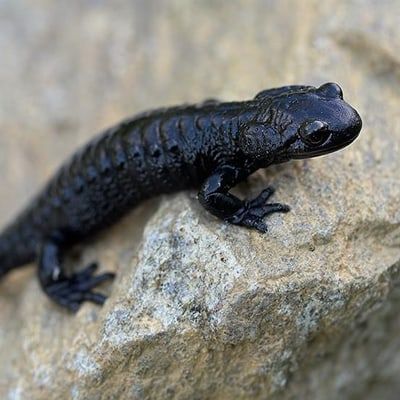
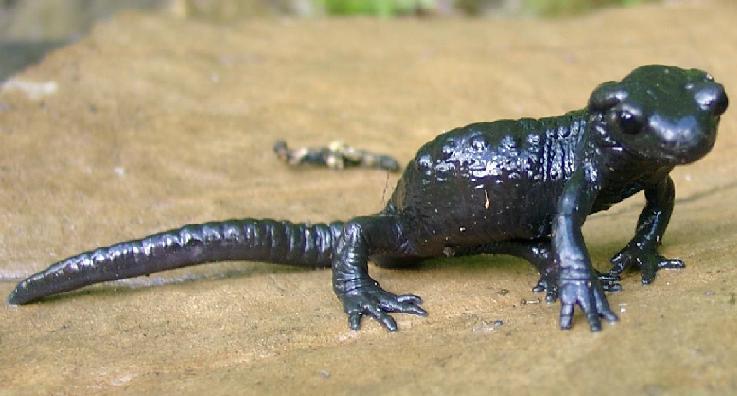
The alpine salamander is monochrome black. It has a slender body up to 15 cm long. Its skin is relatively smooth, but with clearly rounded tubercles on the transversely furrowed side of the trunk. The prominent crescent-shaped ear glands are conspicuous. The tail is round.
Features
Alpine salamander
Salamandra atra
transversely furrowed trunk side with warts
In the city
In Germany, cool deciduous forest valleys, moist mixed mountain forests and damp alpine pastures are colonised. Typically, the alpine salamander is found there in rubble and scree slopes, forest clearings and forest edges, but also along streamsides and roadsides.
First and foremost, the species is threatened by habitat destruction, such as the development of ski resorts or the intensification of forest use.
Fun Facts
During heavy rainfall they leave their hiding places and can sometimes appear in large numbers.
The alpine salamander is the only native amphibian species that has completely separated its reproductive mode from the aquatic habitat.
Live-bearing of fully developed young is considered an adaptation to the harsh climate of the mountains.
All European amphibians are specially protected and must not be captured, injured or killed.
- Endangerment level Germany: not endangered
The alpine salamander is endemic to Central Europe, i.e. it is found only here in the world. It is mainly found in the Alps.
To defend themselves, they secrete a poisonous skin secretion that protects them from predators. They take a threatening stance, raising their head and bending it backwards.
Sources
Habitus , Thomas Huntke, CC BY-SA 3.0, https://commons.wikimedia.org/wiki/File:Salamandra_atra-01-Kaernten-2008-Thomas_Huntke.jpg

Abwehrhaltung, Paul Bachhausen, CC BY-SA 3.0, https://commons.wikimedia.org/wiki/File:Alpensalamander_Maennchen_in_Abwehrhaltung,_Oesterreich,_Gross-Walsertal,_Raggal_(Paul_Bachhausen_s_a_a-m-abwehr1).jpg
.jpg)
Kwet, A. (2015) Reptilien und Amphibien Europas. 250 Arten mit Verbreitungskarten, Stuttgart: Franckh Kosmos Verlag.
Blab, J. & Vogel, H. (2002) Amphibien und Reptilien erkennen und schützen, München: BLV.
Glandt, D. (2008) Heimische Amphibien: Bestimmen – Beobachten – Schützen, Wiebelsheim: AULA-Verlag.
Glandt, D. (2015) Die Amphibien und Reptilien Europas, Wiebelsheim: Quelle & Meyer Verlag.
Matz, G. & Weber, D. (1983) Amphibien und Reptielien – Die 169 Arten Europas farbig abgebildet, München: BLV.
Page „Alpensalamander“. : Wikipedia, The Free Encyclopedia. Date of last revision: 19.08.2017, 13:19 UTC. URL: https://de.wikipedia.org/w/index.php?title=Alpensalamander&oldid=168283484 (Accessed: 01.02.2018).
Deutschlands Natur - Der Naturführer für Deutschland (n.d.) Alpensalamander (Salamandra atra), URL: http://www.deutschlands-natur.de/tierarten/amphibien-reptilien/alpensalamander/ (Accessed: 01.02.2018).
Schulte, U. & Veith, M. (2013) Artensteckbrief Alpensalamander (Salamandra atra), URL: https://feldherpetologie.de/heimische-amphibien-artensteckbrief/artensteckbrief-alpensalamander-salamandra-atra/ (Accessed: 01.02.2018).
Gebel, M. (2014) Alpensalamander (Salamandra atra), URL: http://www.amphibien-reptilien.com/info-alpensalamander.html (Accessed: 01.02.2018).
Meikl, M. (2014) Auf den Spuren von Bergnarr und Regenmandl: Alpen- und Feuersalamander als Indikatoren intakter Natur, ANLIEGENNATUR, 36(2), 75-81, URL: http://www.anl.bayern.de/publikationen/anliegen/doc/an36203meikl_2014_salamander.pdf (Accessed: 01.02.2018).