
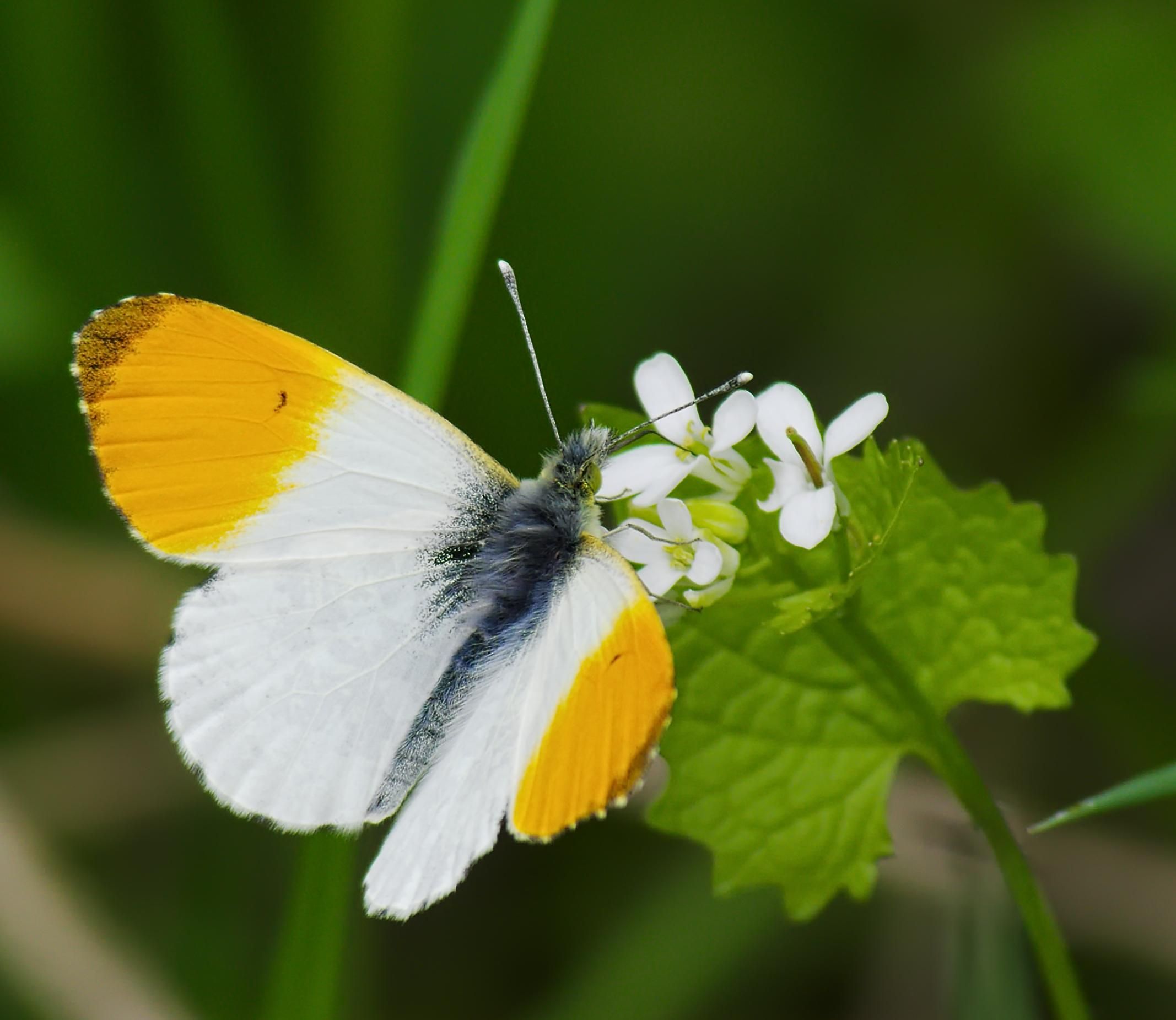
Short Description
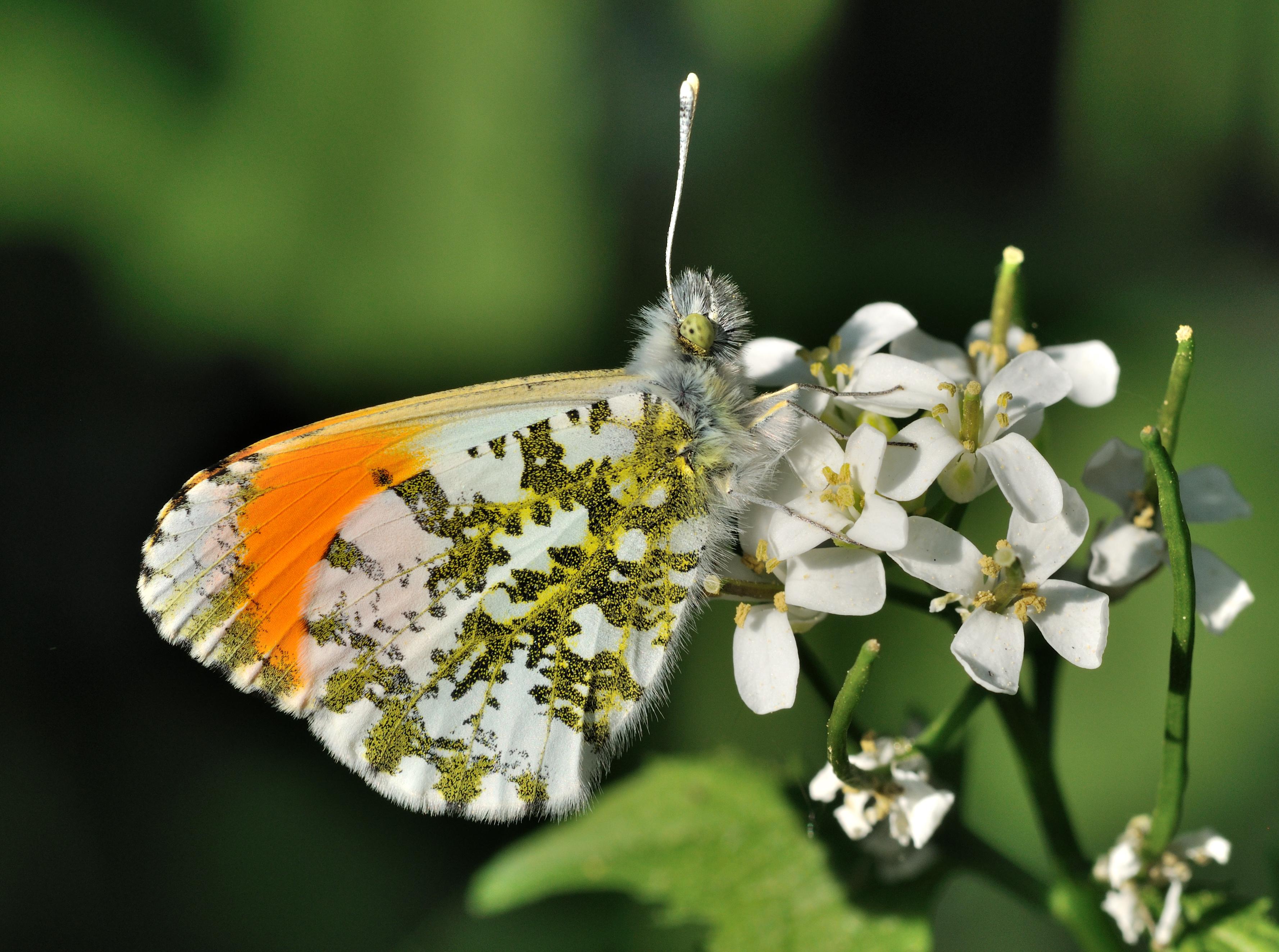
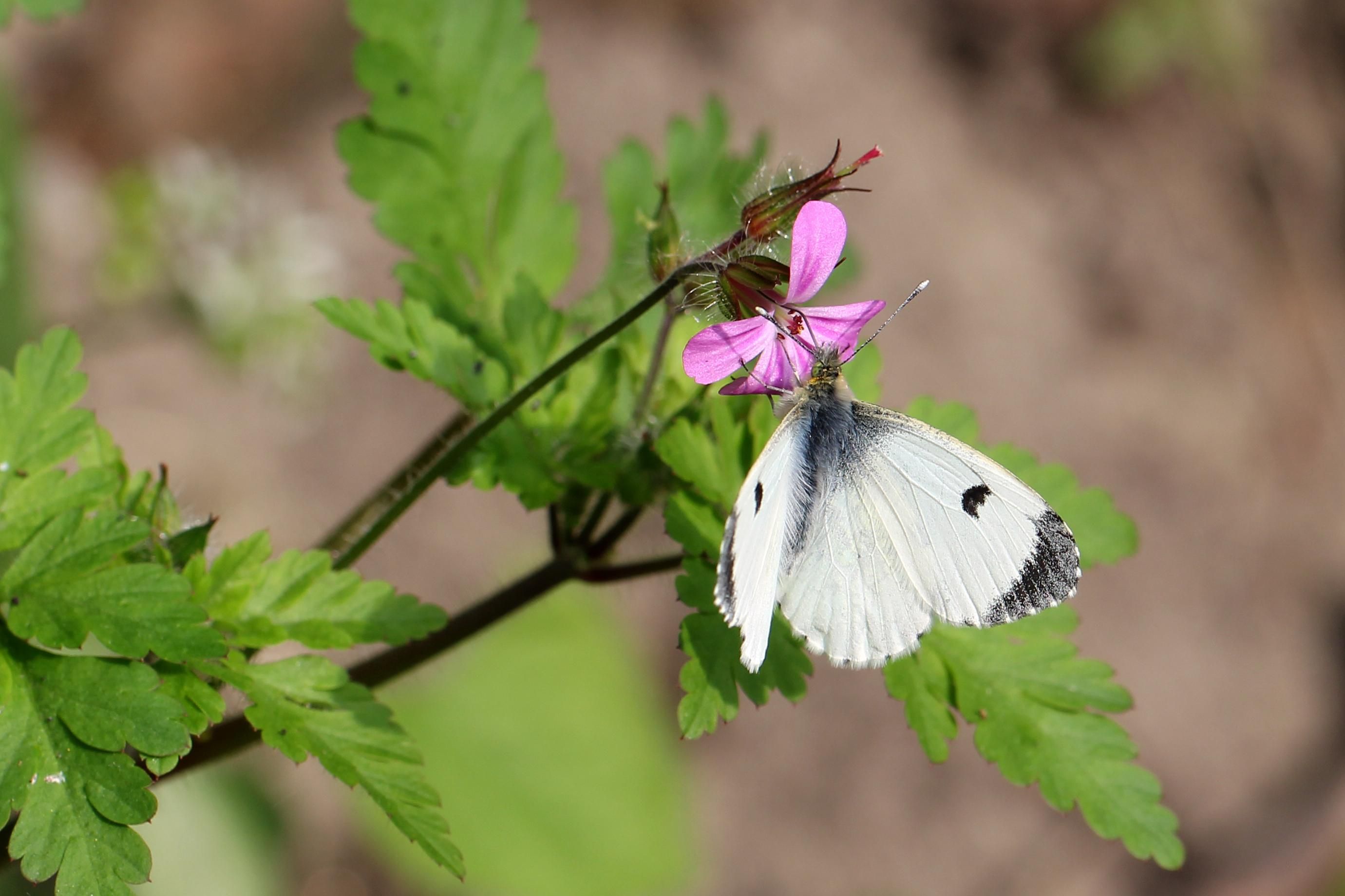
The orange tip is white with a black spot in the middle of the wing. The undersides of the forewings are paler in colour, and the underside of the hindwings are irregularly mottled olive-green.
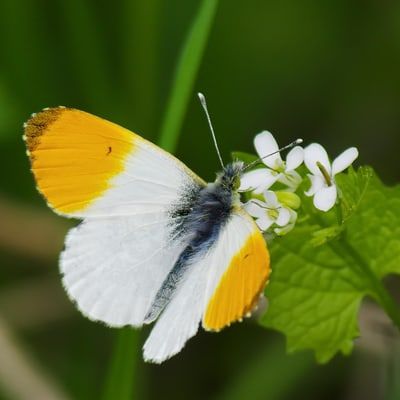
Males can be identified by the striking orange tips of their forewings.
Females have dark-grey forewing tips.
The caterpillar grows up to 3 cm in length and is mainly blue-green to white.
Features
Orange tip
Anthocharis cardamines
black dot on wing centre
orange tips of the male’s forewings
Similar species
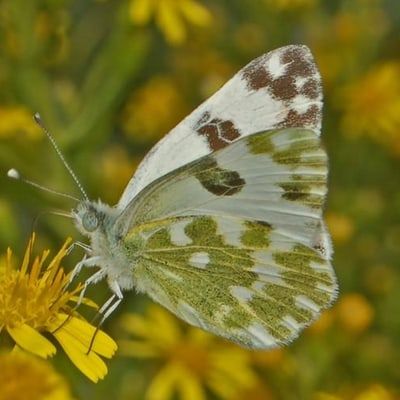
Pontia edusa
In the city
The natural habitat of the orange tip includes damp meadows, forest edges and mixed deciduous forests. In an urban environment, it can be mainly found in parks, meadows and the forest edges.
Fun Facts
Orange tip caterpillars are strictly solitary animals and avoid the company of other members of the same species.
The wood-like oblong pupa is formed on the stem of the host plant and looks similar to a thorn.
The scientific name of the species refers to the plant genus Cardamine, whose leaves are the main food of the caterpillars.
- Endangerment level Germany: not endangered
Sources
Männchen, Andreas Eichler, CC BY-SA 3.0, https://commons.wikimedia.org/wiki/File:2013.04.29.-13-Kuehkopf_Stockstadt-Aurorafalter-M%C3%A4nnchen.jpg

Unterseite (Männchen), Quartl, CC BY-SA 3.0, https://commons.wikimedia.org/wiki/File:Anthocharis_cardamines_qtl1.jpg

Weibchen, Haeferl, CC BY-SA 3.0, https://commons.wikimedia.org/wiki/File:Wien-Penzing_-_beim_Silbersee_-_Ruprechtskraut_(Geranium_robertianum)_mit_weiblichem_Aurorafalter.jpg
_mit_weiblichem_Aurorafalter.jpg)
Nuß, M. & Bauer, F. (2019) Aurorafalter (Anthocharis cardamines (Linnaeus, 1758)), URL: https://www.insekten-sachsen.de/Pages/TaxonomyBrowser.aspx?Id=440867 (Accessed: 24.03.2021).
Settele, J., Steiner, R., Reinhardt, R. & Feldmann, R. (2005) Schmetterlinge. Die Tagfalter Deutschlands, Stuttgart: Verlag Eugen Ulmer.
Kolligs, D. (2014) Schmetterlinge Norddeutschlands. 100 Tagfalter, Kiel: Wachholtz Verlag.
Seggewiße, E. & Wyman, H.-P. (2015) Schmetterlinge entdecken, beobachten, bestimmen: die 160 häufigsten tagaktiven Arten Mitteleuropas, Bern: Haupt Verlag.
Gerstmaier, R. (2003) Schmetterlinge. Sicher bestimmen mit Foto und Zeichnung, Stuttgart: Franckh Kosmos Verlag.
Page „Aurorafalter“. : Wikipedia, The Free Encyclopedia. Date of last revision: 27.03.2020, 07:01 UTC. URL: https://de.wikipedia.org/w/index.php?title=Aurorafalter&oldid=198150447 (Accessed: 19.10.2020).