
Short Description
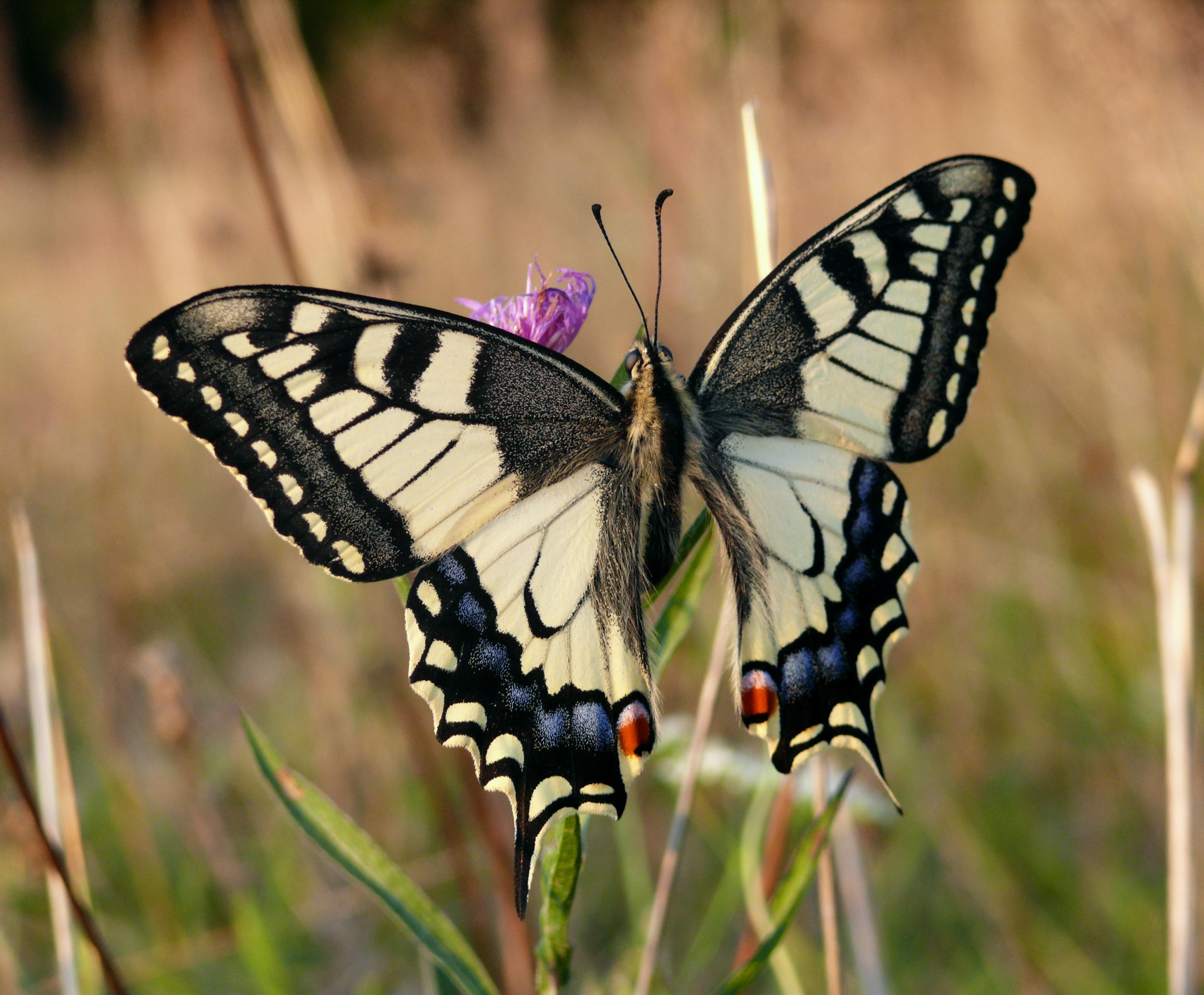
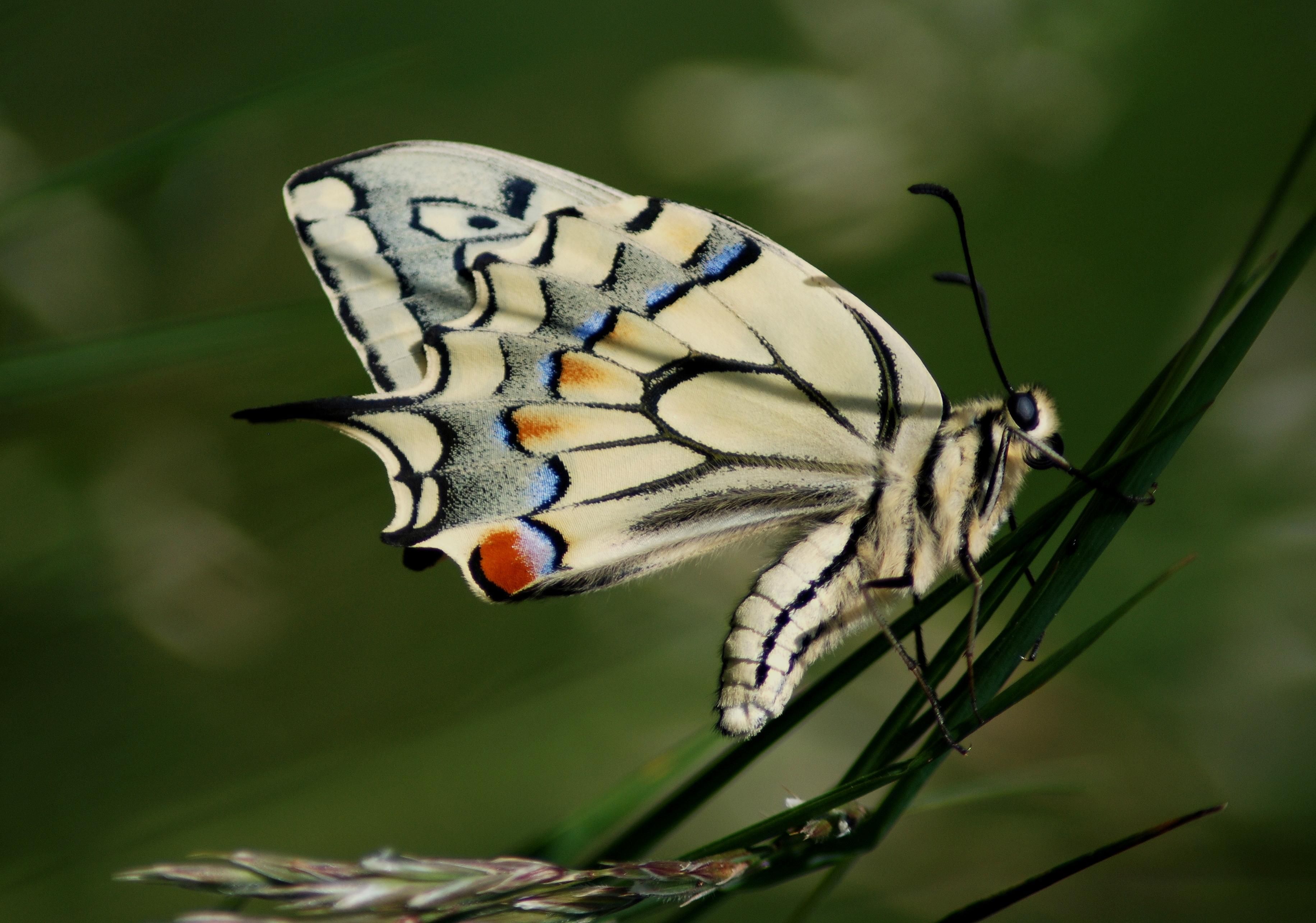
The swallowtail is whitish-yellow with distinctive black markings. Its hindwings have long protrusions reminiscent of a swallow’s tail feathers. The inside of the hindwings are marked with a small round red dot.
Caterpillars are initially black with a pale patch. Later, they become bright green with black, red-spotted transverse stripes.
Features
Swallowtail
Papilio machaon
long tail-like protrusion from the hindwings
In the city
Swallowtails prefer open spaces and meadows. Verge flowers such as thistles, red clover or dandelion provide swallowtails with ideal sources of nectar. To deposit its eggs, swallowtails also occasionally visit vegetable or herb gardens with umbellifers such as wild carrot or fennel.
Urban development and landscaping in parks and gardens result in an increasing loss of habitats.
Fun Facts
Swallowtails mainly feed on umbellifers such as wild carrot, fennel and ground elder.
The butterfly (imago) only lives for a few weeks and dies soon after the eggs have been laid.
In a reaction to disturbance or perceived danger, caterpillars extend retractable fleshy projections behind its head (osmaterium) to deter predators. These are covered in glands that can secrete a foul-smelling liquid containing butyric acid.
Swallowtails are good flyers, capable of covering large distances at great heights.
Males perform courtship flights over bare hilltops (known as hilltopping), with the strongest male claiming the highest territory.
Caterpillars are not limited to specific food plants.
- Endangerment level Germany: not endangered
- Usage:
The caterpillar season is from May to June and from August to September.
Sources
Oberseite, Bernd Haynold, CC BY-SA 3.0, https://commons.wikimedia.org/wiki/File:Papilio_machaon_170808.jpg

Unterseite, Boschfoto, CC BY-SA 3.0, https://commons.wikimedia.org/wiki/File:Andechs,_B%C3%A4ckerbichl_(Fauna)_HB-03.jpg
_HB-03.jpg)
Settele, J., Steiner, R., Reinhardt, R. & Feldmann, R. (2005) Schmetterlinge. Die Tagfalter Deutschlands, Stuttgart: Verlag Eugen Ulmer.
Kolligs, D. (2014) Schmetterlinge Norddeutschlands. 100 Tagfalter, Kiel: Wachholtz Verlag.
Seggewiße, E. & Wyman, H.-P. (2015) Schmetterlinge entdecken, beobachten, bestimmen: die 160 häufigsten tagaktiven Arten Mitteleuropas, Bern: Haupt Verlag.
Gerstmaier, R. (2003) Schmetterlinge. Sicher bestimmen mit Foto und Zeichnung, Stuttgart: Franckh Kosmos Verlag.
BUND e.V. (n.d.) Steckbrief des Schmetterlings: Schwalbenschwanz, URL: https://www.bund.net/themen/tiere-pflanzen/schmetterlinge/steckbriefe/tagfalter/schwalbenschwanz/ (Accessed: 26.07.2016).
Nuß, M. (n.d.) Schmetterlinge (Lepidoptera), URL: https://www.insekten-sachsen.de/Pages/TaxonomyBrowser.aspx?id=7 (Accessed: 26.07.2016).
Pollrich, S. (n.d.) Tagfalter in Sachsen, URL: http://www.tagfalter-sachsen.de/arten/ (Accessed: 26.07.2016).
Entomologische Gesellschaft ORION Berlin (n.d.) Schmetterlinge (Lepidoptera), URL: http://www.orion-berlin.de/schmetter/schmetter_gesamt.php (Accessed: 19.07.2016).