
Short Description
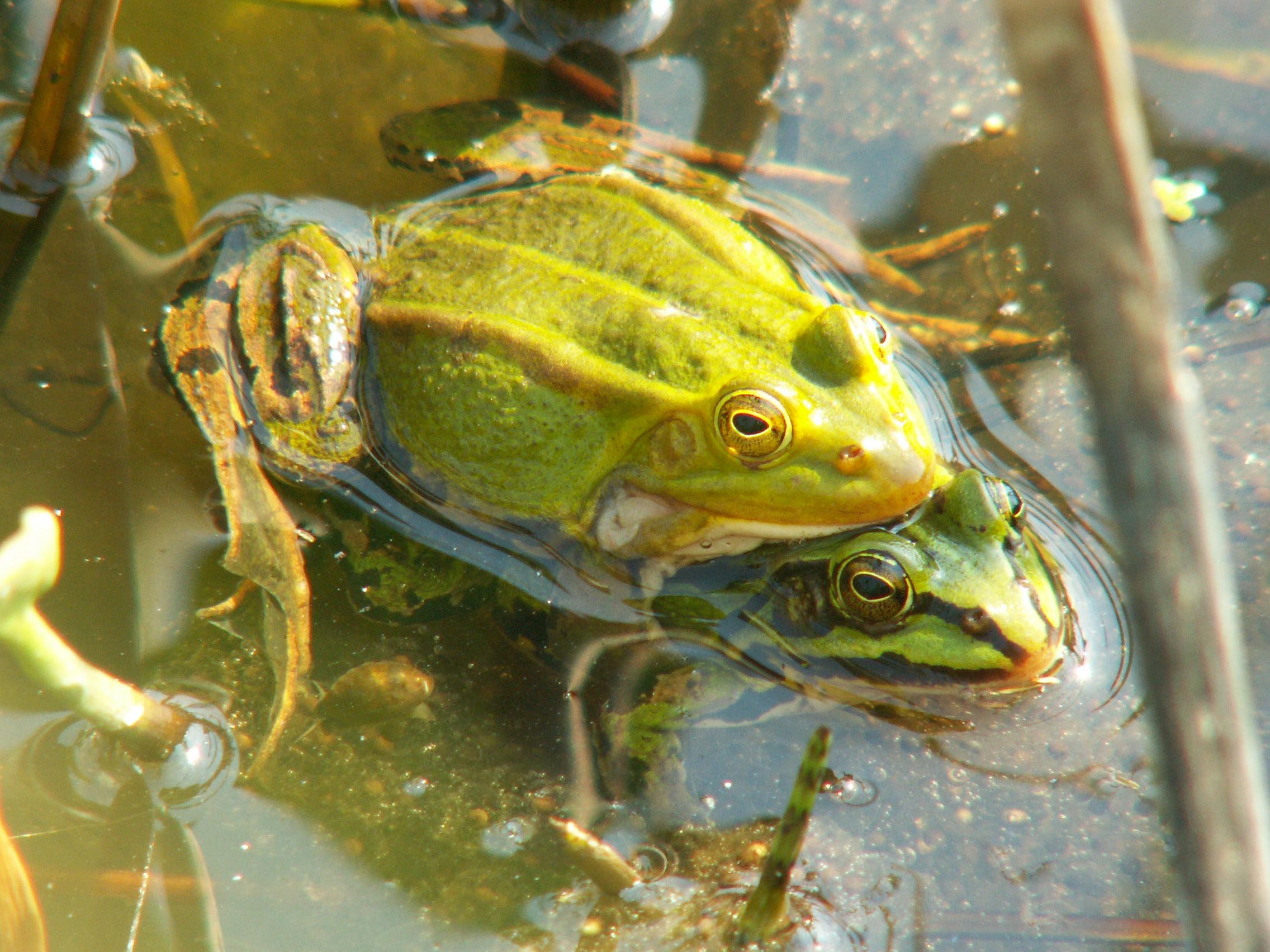
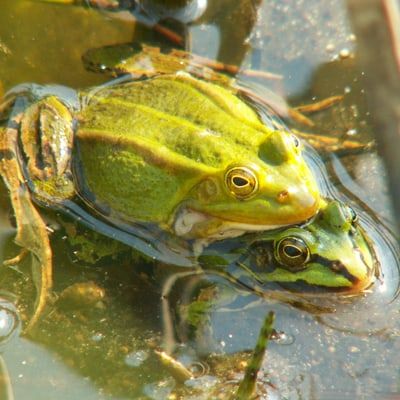
The pool frog is small and light to grass green in color. It has a light stripe on its back and particularly pronounced dark spots on its hind legs. Its belly is whitish to faintly spotted.
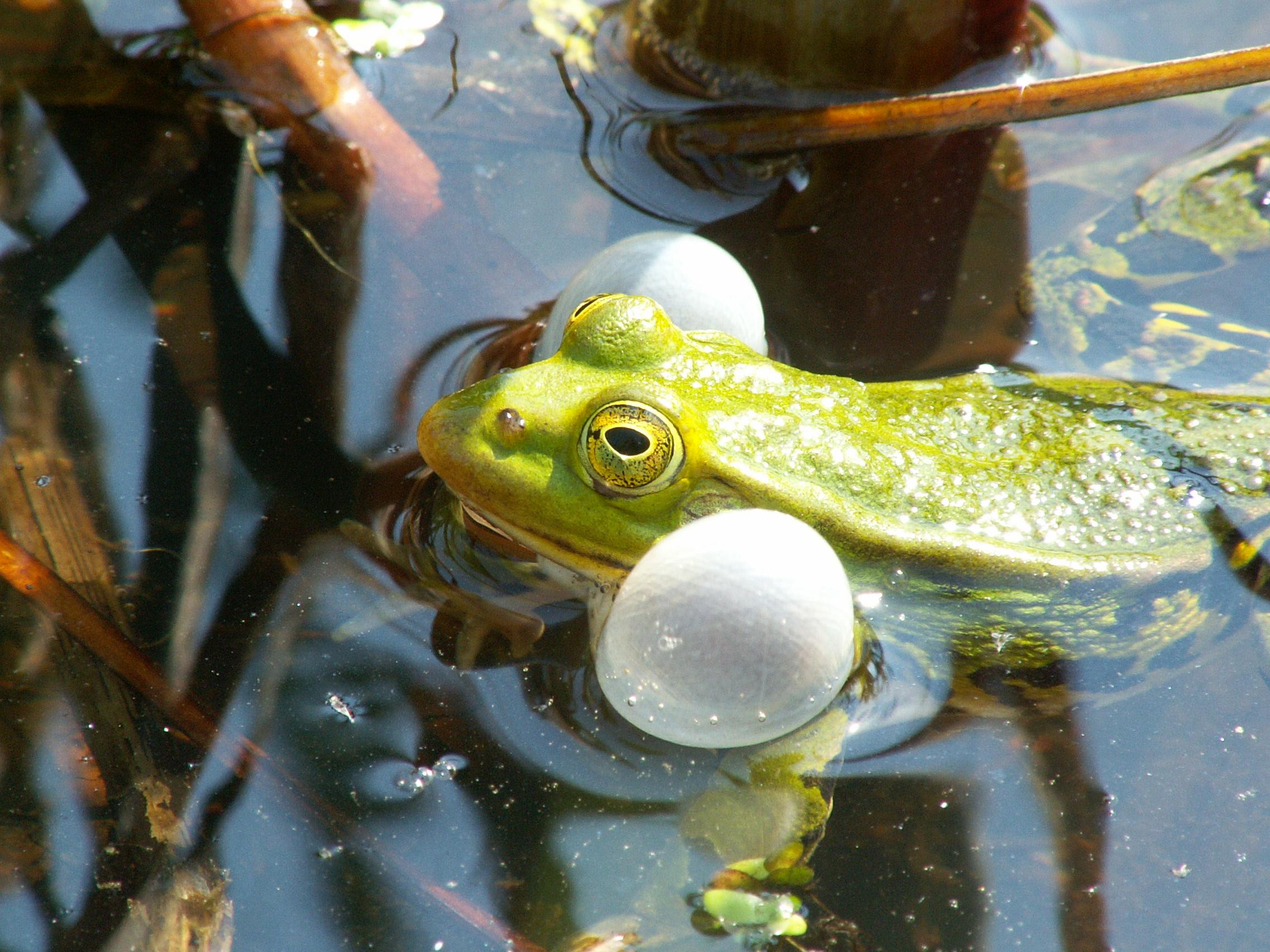
During the mating season, in particular, males are yellowish-green and generally without spot, but with bright white vocal sacs.
The colouring of the backs in females can vary, but often with brown patches.
Features
Pool frog
Pelophylax lessonae
white vocal sacs
Group: Calls
CC BY-SA 3.0

In the city
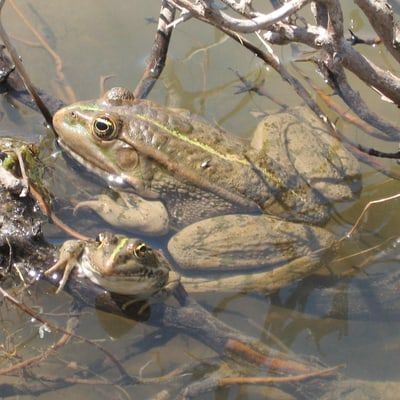
The pool frog is not a typical urban species. It prefers open spacious landscapes. It can be found in the vicinity of small, vegetation-rich, nutrient-poor pools and ditches. In cities, it is also found less frequently in artificial bodies of water such as garden and city park ponds and even swimming pools and concrete basins.
Fun Facts
The pool frog and the marsh frog are the parent species of the hybrid common water frog (Pelophylax esculentus). The common water frog exhibits characteristics and behavioral patterns (habitat, hibernation) of both species.
Because of its easy confusion with the common water frog, its distribution is not always clear. It is assumed to be endangered.
As a general rule, it occupies smaller territories that are defended against other males with special territorial calls, but also with actual fights.
All European amphibians are specially protected and must not be captured, injured or killed.
- Endangerment level Germany: endangerment unknown
Sources
Paar, Viridiflavus, CC BY-SA 3.0, https://commons.wikimedia.org/wiki/File:PelophylaxLessonaeAmplex.JPG

Männchen, Viridiflavus, CC BY-SA 3.0, https://de.wikipedia.org/wiki/Datei:RanaLessonaeCroacking.JPG

Kwet, A. (2015) Reptilien und Amphibien Europas. 250 Arten mit Verbreitungskarten, Stuttgart: Franckh Kosmos Verlag.
Blab, J. & Vogel, H. (2002) Amphibien und Reptilien erkennen und schützen, München: BLV.
Glandt, D. (2008) Heimische Amphibien: Bestimmen – Beobachten – Schützen, Wiebelsheim: AULA-Verlag.
Glandt, D. (2015) Die Amphibien und Reptilien Europas, Wiebelsheim: Quelle & Meyer Verlag.
Bundesfachausschuss Feldherpetologie/Ichthyofaunistik im NABU (n.d.) Rote Listen, URL: http://www.amphibienschutz.de/schutz/artenschutz/roteliste/deutschland.htm (Accessed: 26.07.2016).
Page „Kleiner Wasserfrosch“. : Wikipedia, The Free Encyclopedia. Date of last revision: 07.03.2016, 20:10 UTC. URL: https://de.wikipedia.org/w/index.php?title=Kleiner_Wasserfrosch&oldid=152280142 (Accessed: 10.05.2016).
Page „Teichfrosch“. : Wikipedia, The Free Encyclopedia. Date of last revision: 21.03.2016, 16:16 UTC. URL: https://de.wikipedia.org/w/index.php?title=Teichfrosch&oldid=152723923 (Accessed: 10.05.2016).