
Short Description
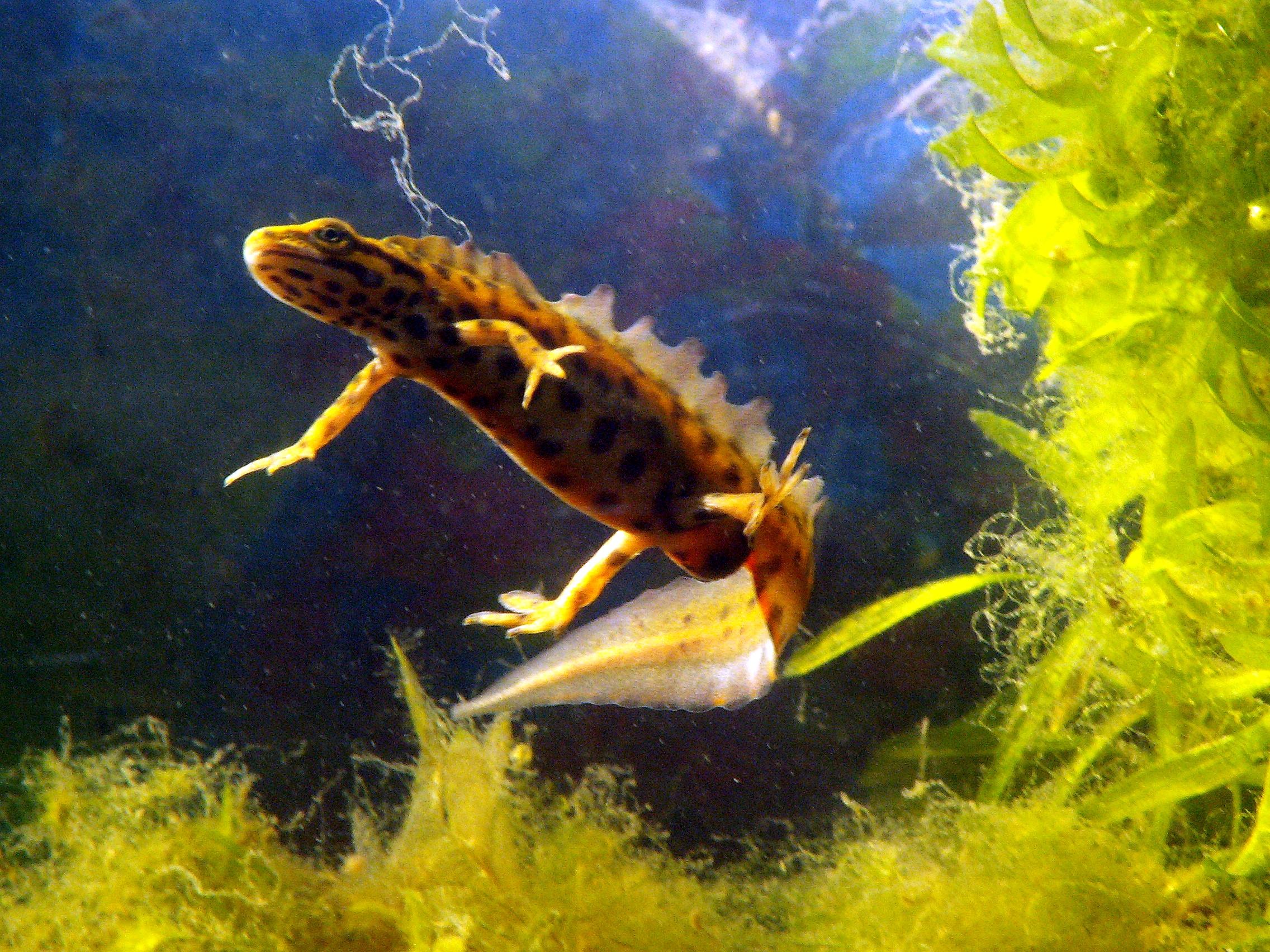
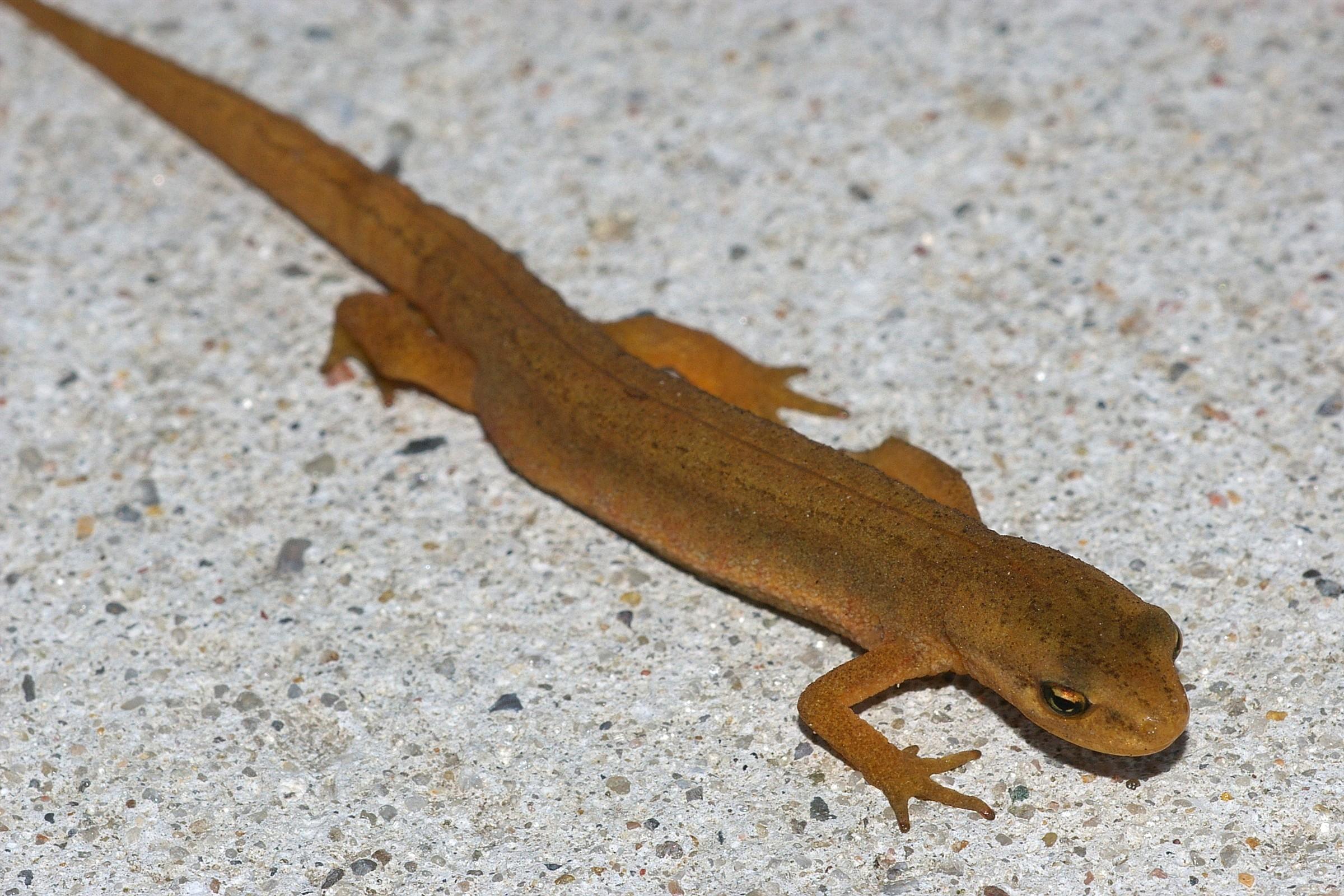
The smooth newt is brownish to grey in colour with dark patches on its belly. The laterally flattened tail is slightly blue at its lower seam. Both gender have light and dark longitudinal lines on their heads. The belly is orange in the middle, getting paler towards the sides, also with dark patches.
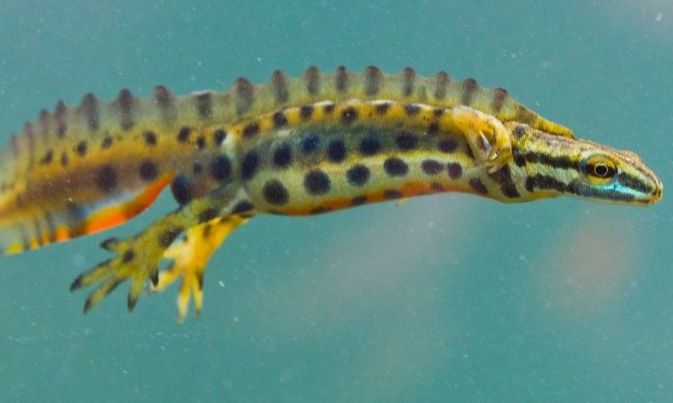
In water, males develop a tall wavy crest on their back and exhibit overall a more vivid colouration. The underside is covered in large dark patches.
The undersides of females are more delicately spotted.
Features
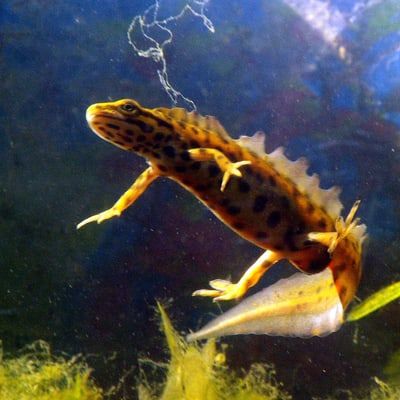
Smooth newt
Lissotriton vulgaris
large, dark patches on a pale belly
Similar species
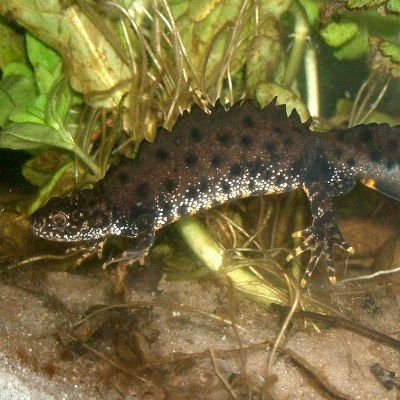
Great crested newt
Triturus cristatus
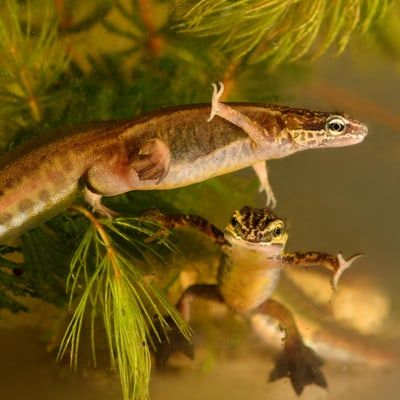
Palmate newt
Lissotriton helveticus
In the city
Smooth newts are very adaptable and often live close to humans. They can be found in near-natural gardens and parks. Newly built garden ponds are also often colonised. They prefer still, sunny waters with aquatic plants. During the day and in dry periods, smooth newts keep hidden under stones, dry leaves or roots.
Swimming pools with vertical walls can turn into death traps for smooth newts.
Fun Facts
The courtship dance of the male consists of vibrating, at times whip-like movements of its tail. In this way, it exposes the female to sexual pheromones.
The metamorphosis from the larval stage to the land-based animal takes two to three months. However, some animals spend their entire lives in the water and retain their aquatically adapted larval features such as their feathery gills.
Smooth newts are nocturnal and feed on insects, worms and other small animals.
All European amphibians are specially protected and must not be captured, injured or killed.
- Endangerment level Germany: not endangered
Sources
Smooth newt, Piet Spaans Viridiflavus, CC BY-SA 2.5, https://commons.wikimedia.org/wiki/File:LissotritonVulgarisMaleWater.JPG

Smooth newt, Christian Fischer, CC-BY-SA 3.0, https://de.wikipedia.org/wiki/Teichmolch#/media/Datei:TriturusVulgarisFemale.jpg

Smooth newt, Mark Hofstetter, CC-BY-SA 3.0, https://de.wikipedia.org/wiki/Teichmolch#/media/Datei:Teichmolch_maennchen_web.jpg

Page „Teichmolch“. : Wikipedia, The Free Encyclopedia. Date of last revision: 08.05.2016, 20:11 UTC. URL: https://de.wikipedia.org/w/index.php?title=Teichmolch&oldid=154206106 (Accessed: 11.05.2016).
NABU – Naturschutzbund Deutschland e.V. (n.d.) In fast jedem Teich zu finden. Der Teichmolch (Lissotriton vulgaris), URL: https://www.nabu.de/tiere-und-pflanzen/amphibien-und-reptilien/amphibien/artenportraets/10653.html (Accessed: 10.08.2016).
Kwet, A. (2015) Reptilien und Amphibien Europas. 250 Arten mit Verbreitungskarten, Stuttgart: Franckh Kosmos Verlag.
Blab, J. & Vogel, H. (2002) Amphibien und Reptilien erkennen und schützen, München: BLV.
Glandt, D. (2008) Heimische Amphibien: Bestimmen – Beobachten – Schützen, Wiebelsheim: AULA-Verlag.
Glandt, D. (2015) Die Amphibien und Reptilien Europas, Wiebelsheim: Quelle & Meyer Verlag.
Bundesfachausschuss Feldherpetologie/Ichthyofaunistik im NABU (n.d.) Rote Listen, URL: http://www.amphibienschutz.de/schutz/artenschutz/roteliste/deutschland.htm (Accessed: 26.07.2016).