
Short Description
The eastern white pine is a 30 to 50 metre tall evergreen conifer.
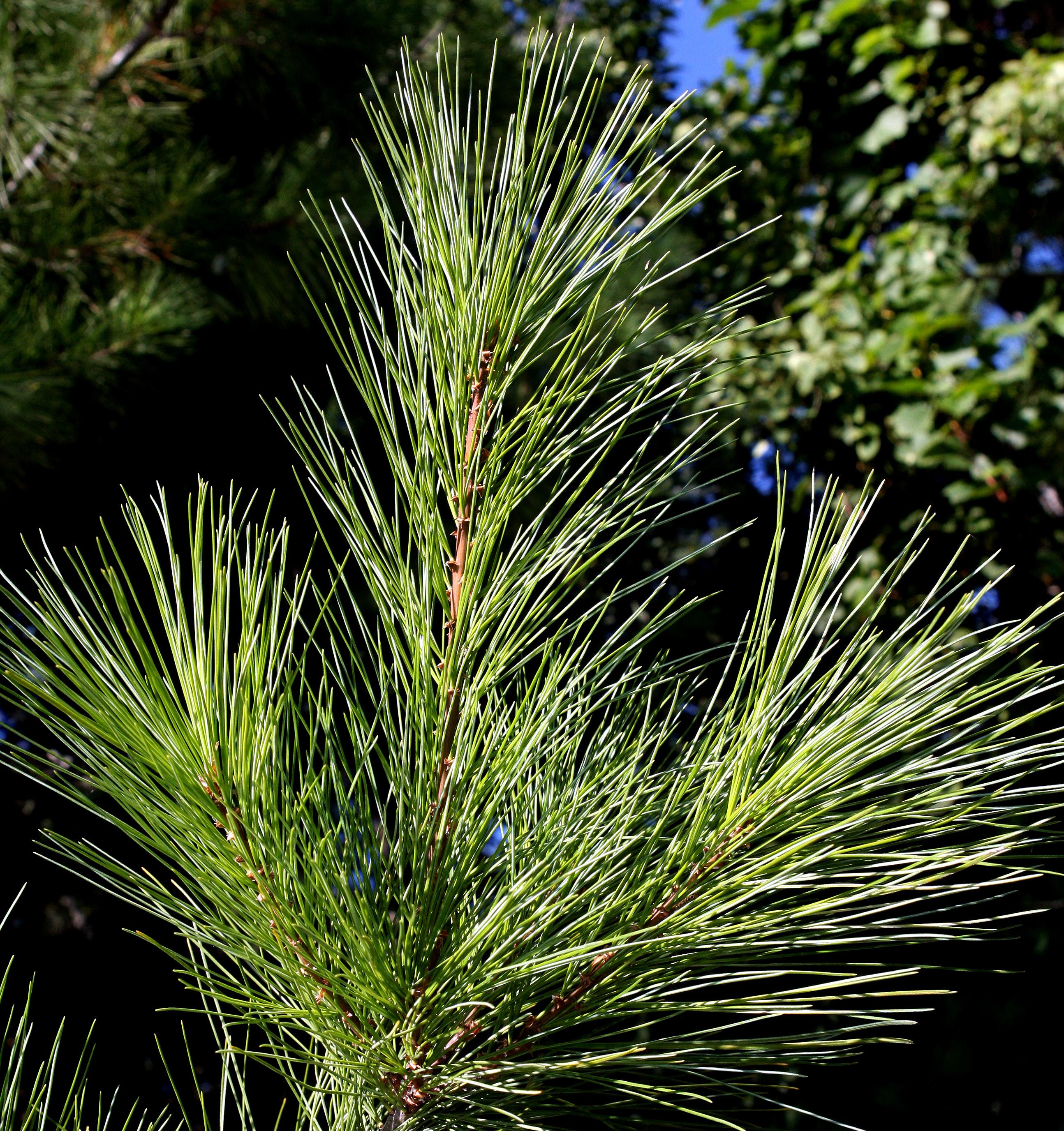
The needles are long, narrow and flexible. They are dark green with blue-white stripes on the inside and always grow together in five-needled clusters. Their cross-section is triangular.
Young trees have smooth and shiny bark. It is grey and often somewhat reddish. In older trees, shallow longitudinal cracks form.
There are male and female flowers. The light brown, male flower cones grow in the lower crown area. The female cones are pink and always grow together in groups of two to four. They are more likely to be found in the upper part of the crown.
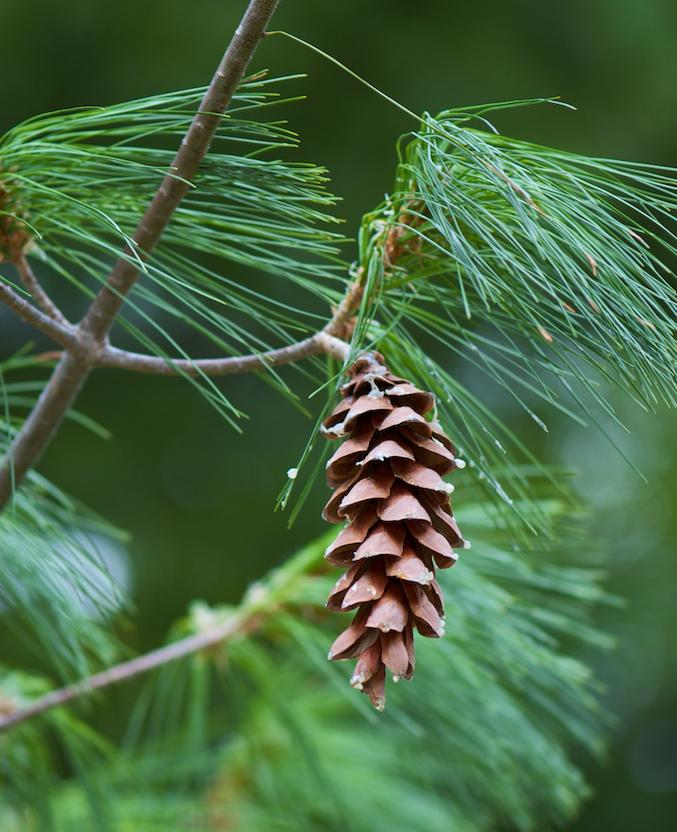
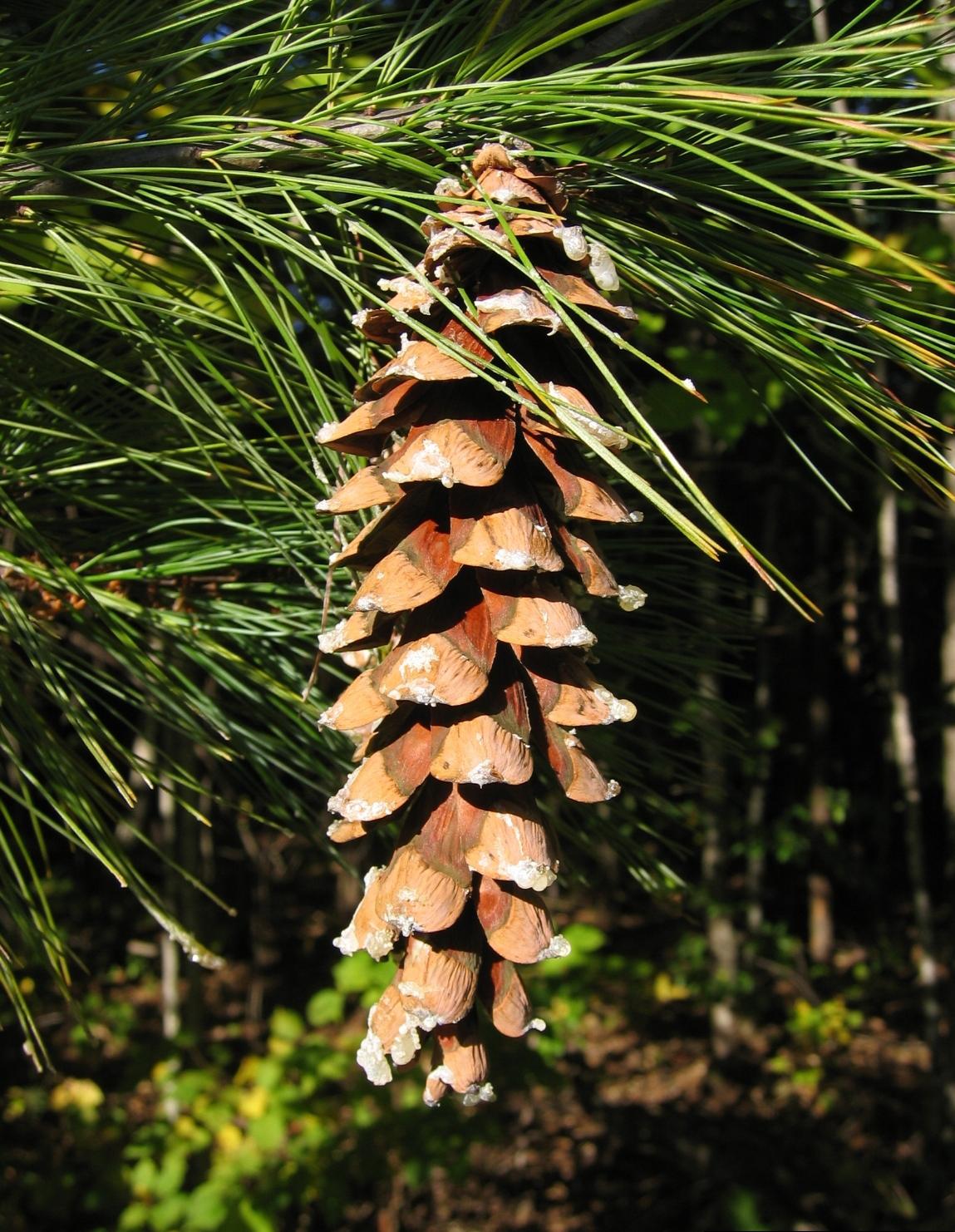
After pollination, the cones are initially narrow cylindrical, slightly curved and green. When ripe, they are brown and become wider due to the open cone scales. With a length of up to 20 centimetres, they are relatively long.
Features
Eastern white pine
Pinus strobus
always five needles together
large, pendulous cones
In the city
In the city, the eastern white pine is mainly used in parks and larger gardens. Dwarf forms are often used. Its fast growth and undemanding nature make it a good pioneer species for colonising open areas. On sites with better soil conditions it is weak in competition and is often displaced by deciduous trees.
Fun Facts
It is the central emblem of the flag of Montreal, representing the continual presence of the First Nations Indigenous peoples on the Canadian territories.
It flowers from May to June.
Eastern white pines brought into the Black Forest are preferred by wood sculptors for building cuckoo clocks because of the soft wood.
- Endangerment level Germany: not evaluated
The Weymouth pine originates from eastern North America and belongs to the non-native plants (neophytes) in Europe. It used to form huge stands there, but was intensively cleared because of its straight trunks. Nevertheless, it is still one of the most important forest trees there today.
It owes its British common name not to the English explorer and writer George Weymouth, who brought it to Europe in 1605, but to Lord Weymouth, who finally established it as a forest tree in England in the 18th century.
The Federal Agency for Nature Conservation in Germany assesses the eastern white pine as potentially dangerous for native tree species and has placed it on the management list of the invasive species blacklist.
Sources
Nadeln und Zapfen, sciondriver at Flickr, CC BY-SA 2.0, https://commons.wikimedia.org/wiki/File:Pinus_strobus_cone_sciondriver.jpg

Nadeln, –, PD, https://commons.wikimedia.org/wiki/File:Pinus_strobus_needles3.jpg

Zapfen, Keith Kanoti, CC BY-SA 3.0 , https://commons.wikimedia.org/wiki/File:Pinus_strobus_Cone.jpg

Spohn, M. & Spohn, R. (2011) Kosmos - Baumführer Europa. 680 Bäume, 2600 Zeichnungen, Stuttgart: Franckh Kosmos Verlag.
Godet, J.-D. (2007) Bäume und Sträucher. Bestimmen und nachschlagen, Stuttgart: Verlag Eugen Ulmer.
Mitchell, A. (1979) Die Wald- und Parkbäume Europas. Ein Bestimmungsbuch für Dendrologen und Naturfreunde, Hamburg und Berlin: Verlag Paul Parey.
Jacobi, F. (2006) Das Pflanzenbestimmungsbuch. Gehölze, Hamburg: Dr. Felix Büchner, Handwerk und Technik.
Page „Weymouth-Kiefer“. : Wikipedia, The Free Encyclopedia. Date of last revision: 25.10.2017, 08:59 UTC. URL: https://de.wikipedia.org/w/index.php?title=Weymouth-Kiefer&oldid=170307062 (Accessed: 16.11.2017).