
Short Description
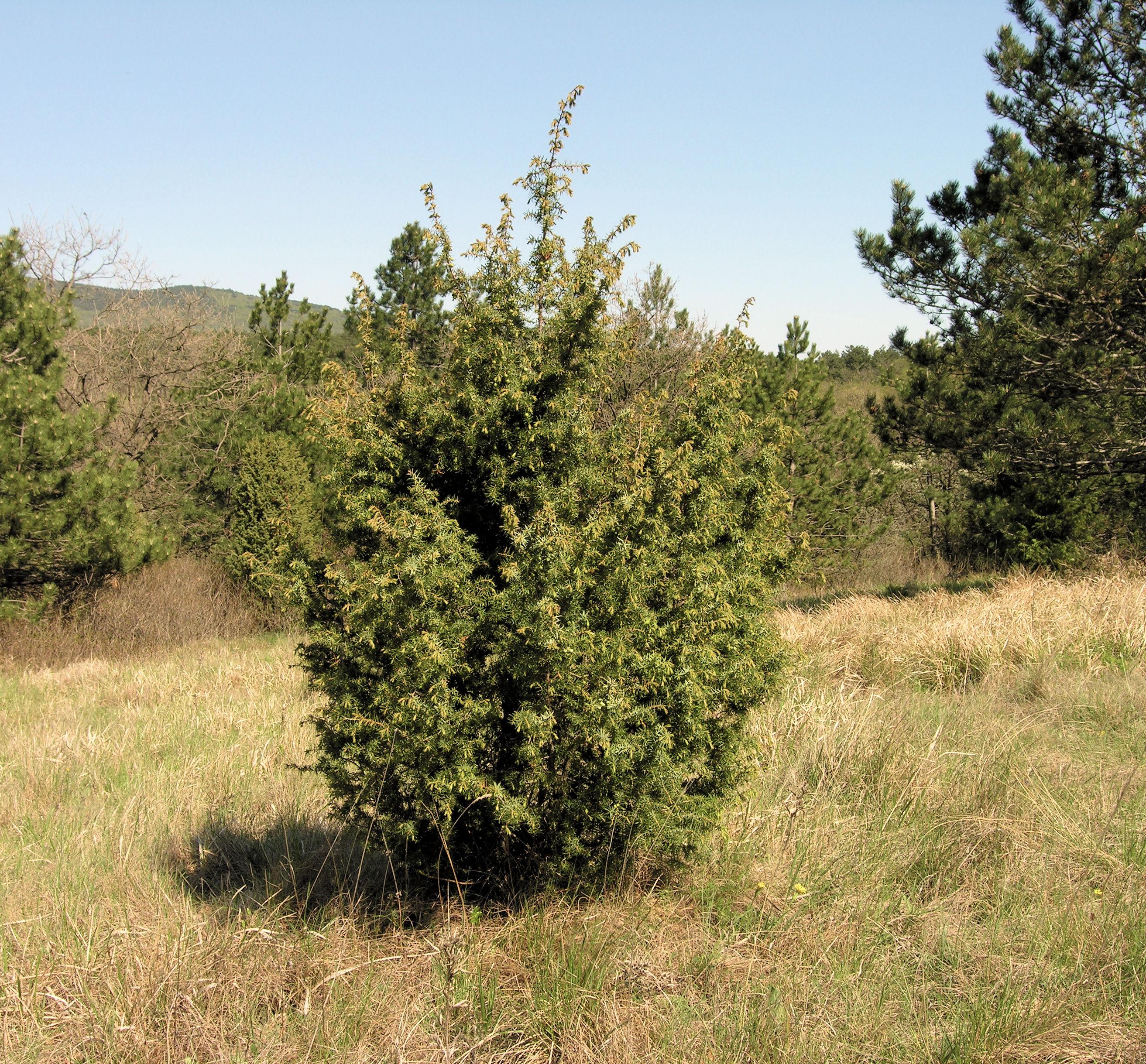
The common juniper is an evergreen shrub or small tree. It can reach a height of ten metres.
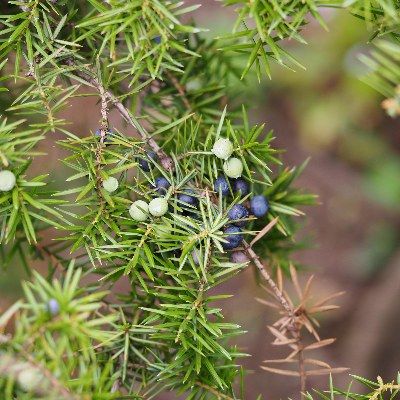
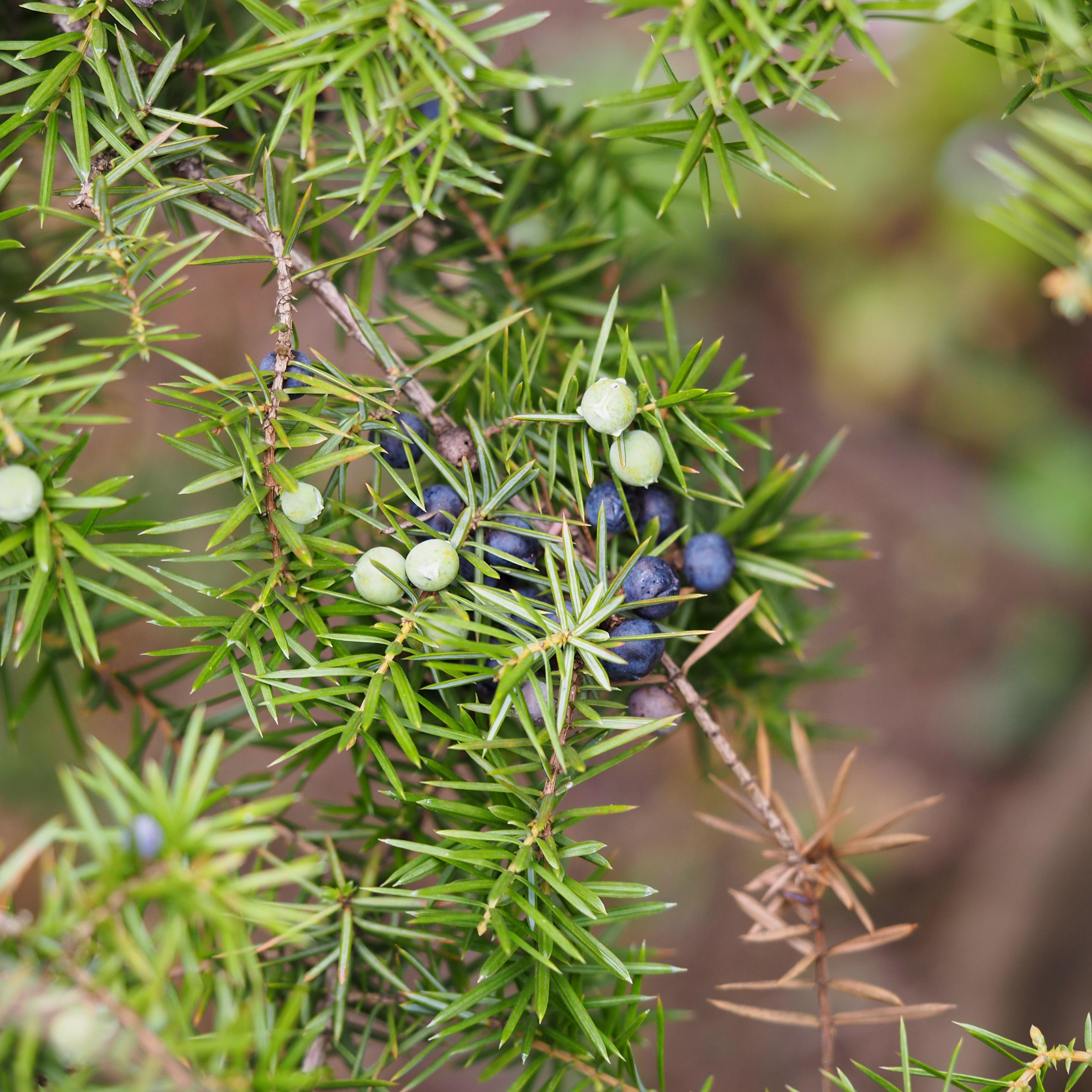
The sharply pointed needles are grey to blue and have a broad white band on top. There are always three needles together in a whorl.
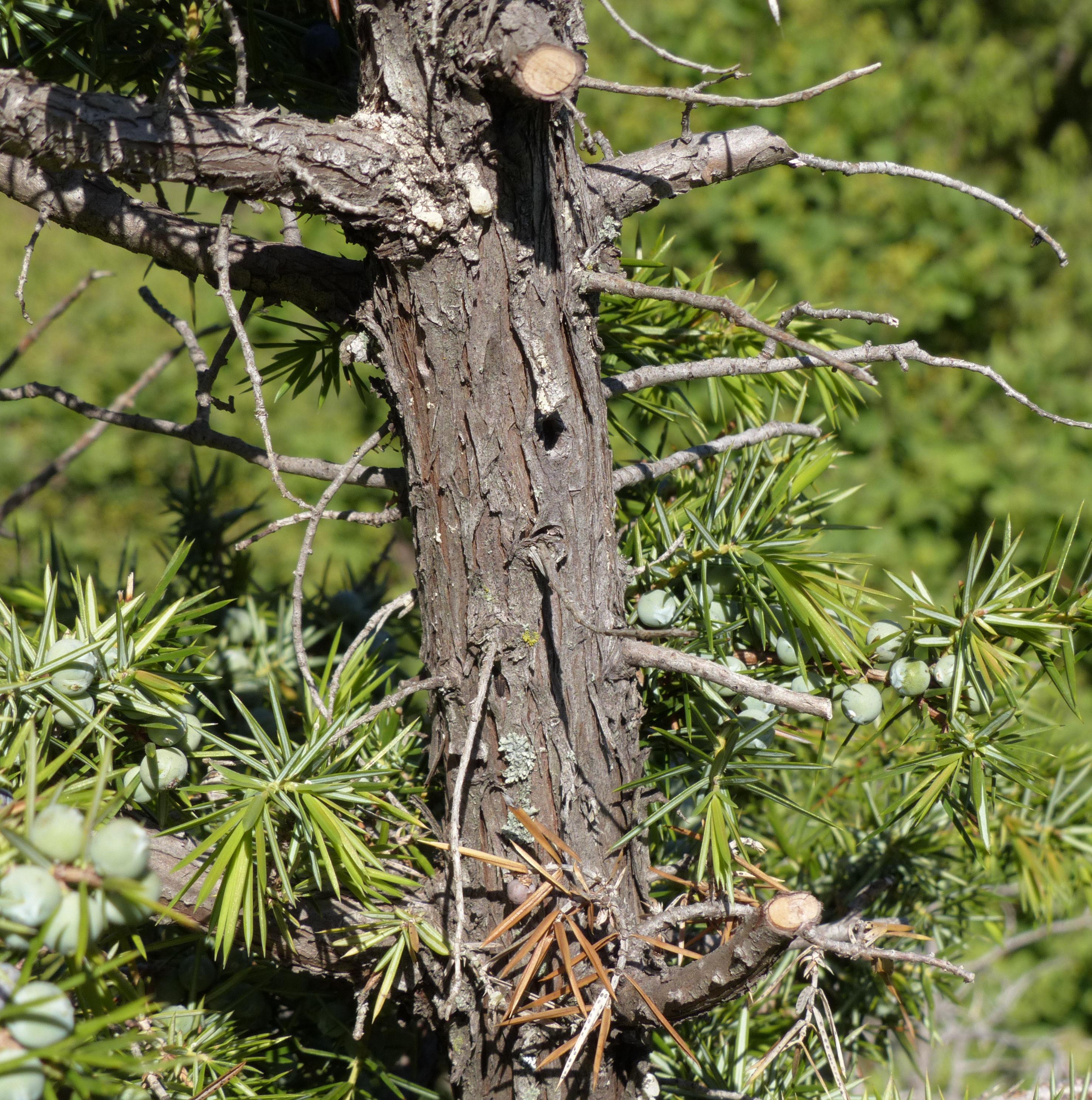
The bark is grey to reddish brown. It is smooth at first, but in later years parts of the bark may peel off.
It is usually dioecious, i.e. the male and female flowers are on different trees. The male flowers are yellowish and arranged as catkins. The female flowers have three cone scales and are inconspicuous green.
The fruits are berry-like cones. They are still green in the first year and become darker and darker from the second year until they are finally black-blue. When ripe, they have a very hard skin and are covered with a layer of wax.
Features
Common juniper
Juniperus communis
Needles with sharp point
always three needles together
In the city
The common juniper is often used as an ornamental shrub in cemeteries, gardens and parks. There are numerous garden forms that differ significantly in appearance. It prefers rather dry, nutrient-poor and base-rich sites with plenty of light. It is very weak in competition with other woody plants, so that it is often displaced to dry, sandy, stony sites.
Fun Facts
It is the most widespread conifer in the world.
Juniper twigs are traditionally used in Scandinavia to flavour and preserve beer.
It is spread by fieldfares, common blackbirds and black grouse. They eat the seeds, which are protected by a firm shell, and later excrete them again.
The flowering period is from April to June.
The berries are often used to flavour sauerkraut, meat dishes and spirits such as gin.
- Endangerment level Germany: Warning list
- Usage:
Juniper berries and their essential oil have a diuretic effect. They are therefore often used against kidney diseases. However, very large quantities can also irritate the kidneys.
The common juniper is widespread from Europe to North Asia and North Africa.
It is slightly poisonous and can irritate the skin.
Sources
Habitus, Andrea Moro 2009, CC BY-SA 3.0+, https://commons.wikimedia.org/wiki/File:Dryades_TSB64174.jpg

Nadeln und Früchte, Alice Kracht, CC BY-SA 4.0, https://species-id.net/openmedia/File:Juniperus_communis_(5).JPG
.JPG)
Rinde, Andrea Moro, CC BY-SA 3.0, https://commons.wikimedia.org/wiki/File:Dryades_TS154055.jpg

Roth, L., Daunderer, M. & Kormann, K. (2008) Giftpflanzen - Pflanzengifte. Vorkommen, Wirkung, Therapie. Allergische und phototoxische Reaktionen, Hamburg: Nikol Verlag.
Spohn, M. & Spohn, R. (2011) Kosmos - Baumführer Europa. 680 Bäume, 2600 Zeichnungen, Stuttgart: Franckh Kosmos Verlag.
Krüssmann, G. (1979) Die Nadelgehölze. Eine Nadelholzkunde für die Praxis, Hamburg und Berlin: Verlag Paul Parey.
Jacobi, F. (2006) Das Pflanzenbestimmungsbuch. Gehölze, Hamburg: Dr. Felix Büchner, Handwerk und Technik.
Mitchell, A. (1979) Die Wald- und Parkbäume Europas. Ein Bestimmungsbuch für Dendrologen und Naturfreunde, Hamburg und Berlin: Verlag Paul Parey.
Page „Gemeiner Wacholder“. : Wikipedia, The Free Encyclopedia. Date of last revision: 27.08.2017, 19:15 UTC. URL: https://de.wikipedia.org/w/index.php?title=Gemeiner_Wacholder&oldid=168537466 (Accessed: 02.11.2017).