
Short Description
The jimsonweed can grow over a metre tall.
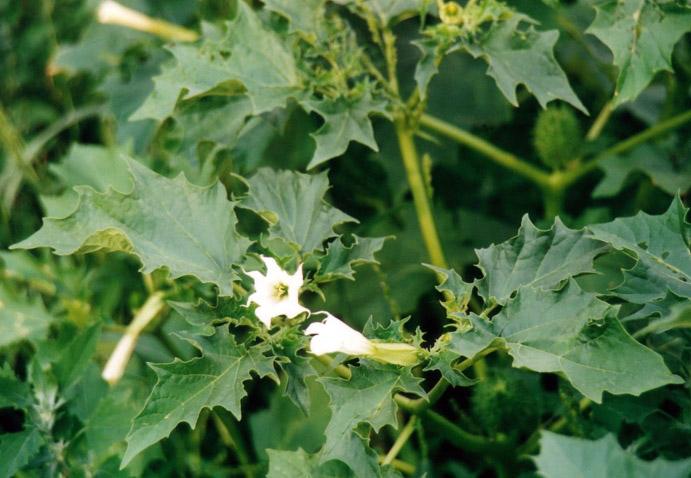
The leaves are ovate, toothed, soft and about the size of a hand. The upper surface is dark green and the lower surface grey-green. Their smell resembles that of cooked chickpeas and many people find it unpleasant.
The stems grow erect and simple or branched. They are blunt-edged and glabrous.
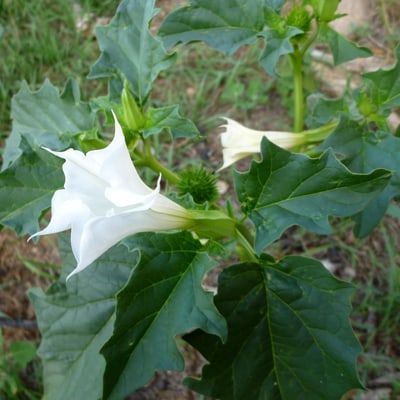
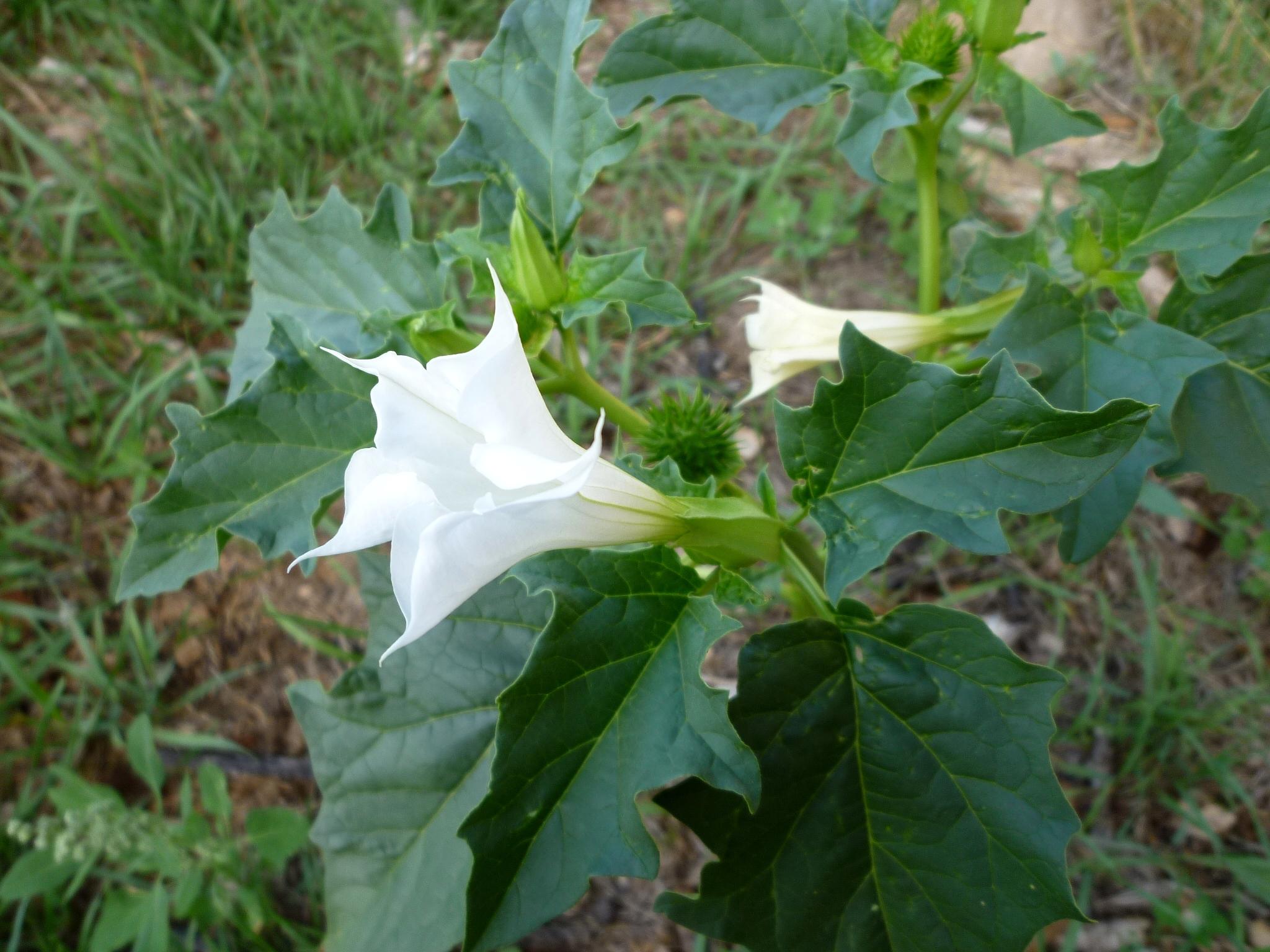
The flowers are white, yellowish or purple and have a funnel-like shape. They can grow up to ten centimetres long.
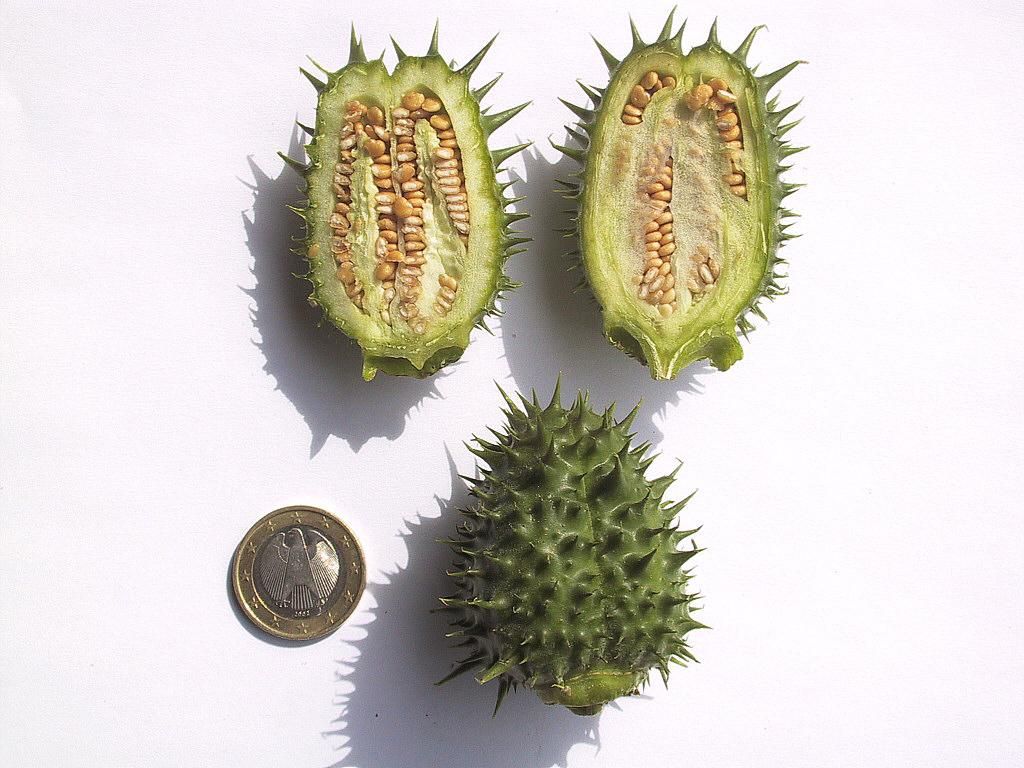
The jimsonweed forms ovoid, mostly spiny capsule fruits that open at the tip.
Features
Jimsonweed
Datura stramonium
strongly poisonous
unpleasant odour
large, funnel-shaped flowers
In the city
The jimsonweed prefers fallow land that receives direct sunlight and has no other shady plants. It often grows on nitrogen-rich soils such as rubble and refuse sites and roadsides. It tolerates salt.
Fun Facts
The flowers open in the evening between 7 and 8 pm and close again after about a day. They have a particularly strong sweet smell at night.
It is an alternative host for a number of insect pests and thus also a reservoir from which, for example, crops such as tomatoes can be attacked again and again.
The flowering period is from June to October.
It is an annual plant, i.e. it only flowers for one summer and dies after the seeds have ripened.
- Endangerment level Germany: not evaluated
- Usage:
In the past, the leaves were used to make "asthma cigarettes" to relieve bronchial spasms. As exact dosage was difficult, poisoning occurred time and again.
The jimsonweed originates from Central America and was probably introduced to Europe at the end of the 16th century. It therefore belongs to the non-native plants (neophytes).
Attention: Strongly poisonous! All parts of the plant are poisonous, but especially the roots and seeds. Even small amounts can lead to symptoms such as nausea, sensory disturbances and respiratory paralysis.
Sources
Habitus, bdk, CC BY-SA 3.0, https://commons.wikimedia.org/wiki/File:Datura_stramonium_2000.jpg

Habitus, Isidre blanc, CC BY-SA 3.0, https://commons.wikimedia.org/wiki/File:DATURA_STRAMONIUM_-_GUIXERS_-_IB-615.JPG

Früchte, Gero Brandenburg, CC BY-SA 3.0, https://commons.wikimedia.org/wiki/File:Datura_Stramonium_Samenkapsel.jpg

Hofmeister, H. & Garve, E. (2006) Lebensraum Acker, Remagen: Verlag N. Kessel.
Garcke, A. (1972) Illustrierte Flora. Deutschland und angrenzende Gebiete, Hamburg und Berlin: Verlag Paul Parey.
Schauer, T., Caspari, C. & Caspari, S. (2015) Der illustrierte BLV-Pflanzenführer für unterwegs. 1150 Blumen, Gräser, Bäume und Sträucher, München: BLV.
Senghas, K. & Seybold, S. (eds.) (2003) Schmeil - Fitschen. Flora von Deutschland und angrenzender Länder. Ein Buch zum Bestimmen aller wildwachsenden und häufig kultivierten Gefäßpflanzen, Wiebelsheim: Quelle & Meyer Verlag.
Spohn, M., Golte-Bechtle, M. & Spohn, R. (2015) Was blüht denn da? Stuttgart: Franckh Kosmos Verlag.
Page „Gemeiner Stechapfel“. : Wikipedia, The Free Encyclopedia. Date of last revision: 12.07.2018, 21:16 UTC. URL: https://de.wikipedia.org/w/index.php?title=Gemeiner_Stechapfel&oldid=179105386 (Accessed: 17.07.2018).
Seitz, B., Ristow, M., Meißner, J., Machatzi, B. & Sukopp, H. (2018) Rote Liste und Gesamtartenliste der etablierten Farn- und Blütenpflanzen von Berlin. : Der Landesbeauftragte für Naturschutz und Landschaftspflege / Senatsverwaltung für Umwelt, Klima und Verkehr (eds.) Rote Listen der gefährdeten Pflanzen, Pilze und Tiere von Berlin, URL: https://www.berlin.de/sen/uvk/natur-und-gruen/naturschutz/artenschutz/artenlisten-rote-listen/farn-und-bluetenpflanzen/ (Accessed: 26.03.2021).