
Short Description
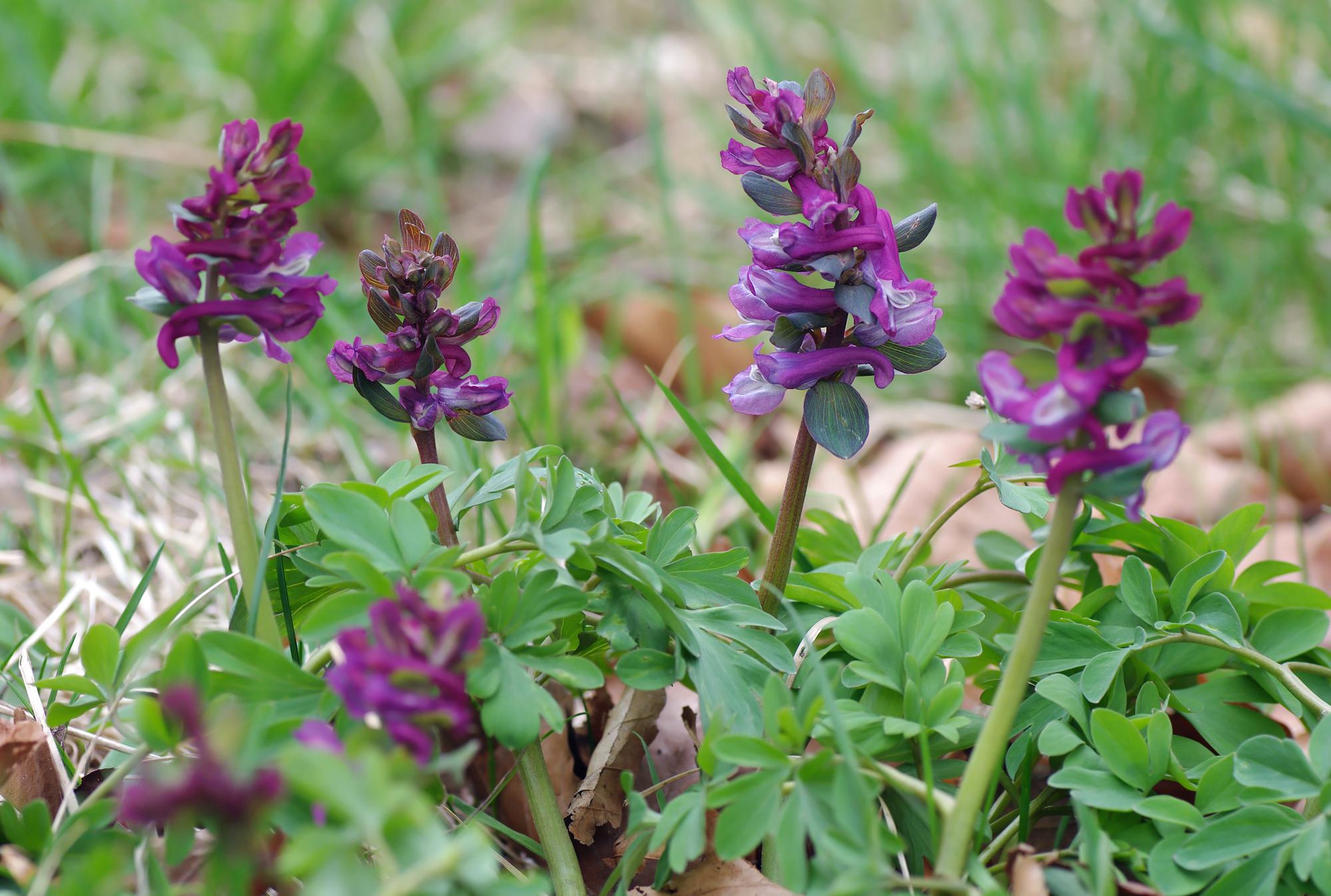
The hollowroot can grow up to 35 cm high.
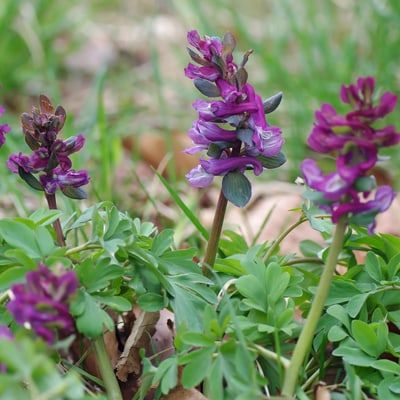
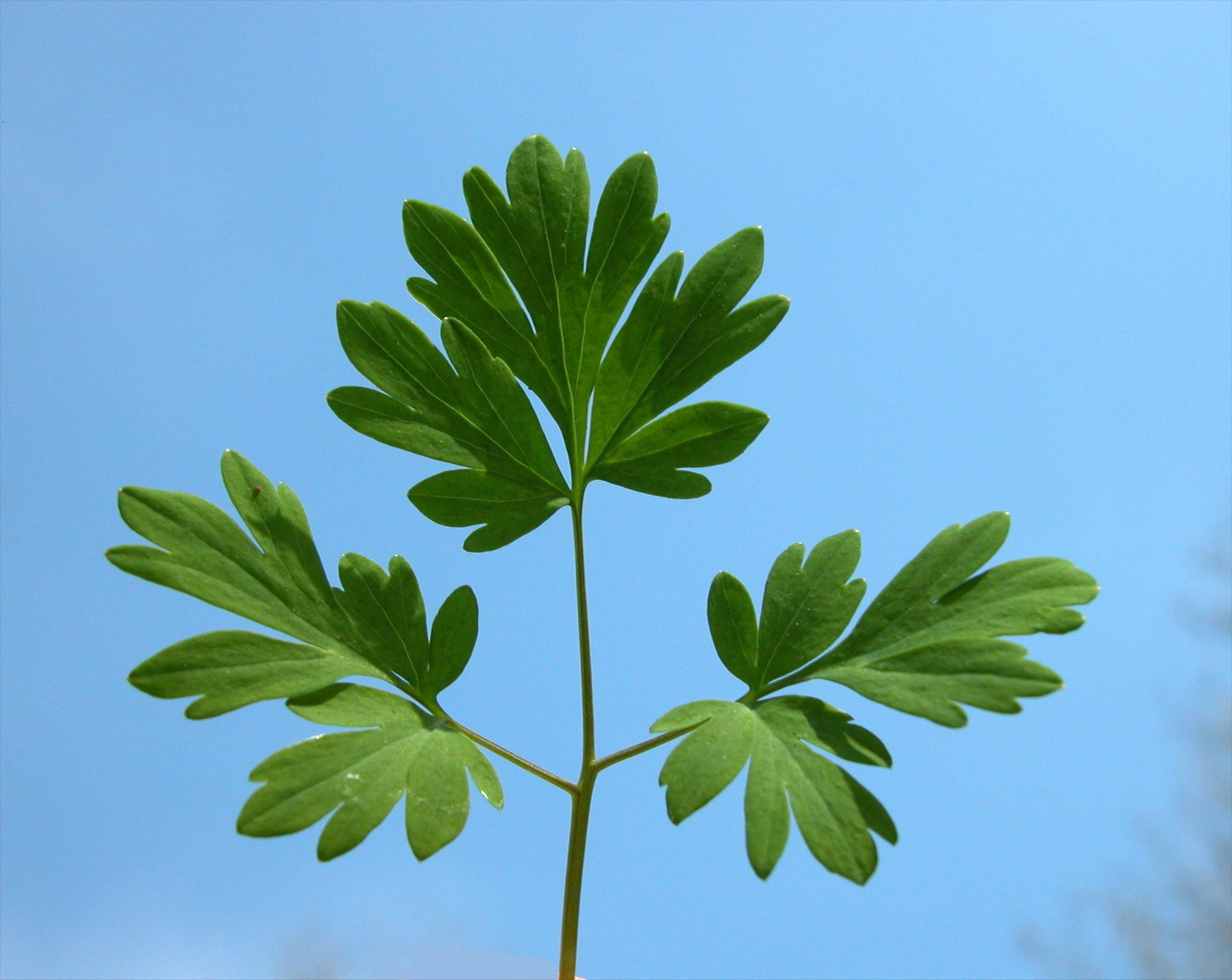
The leaves are solitary and alternate on the stem. They are double tripartite and blue-green. The bracts below the flowers are ovate and have entire margins.
The stem is erect and not branched.
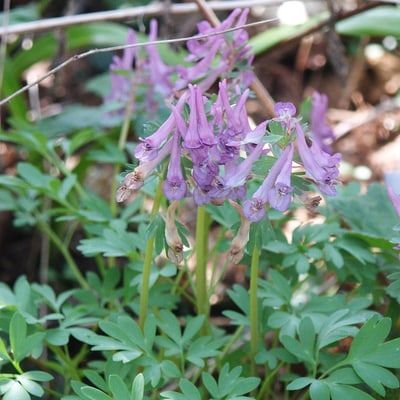
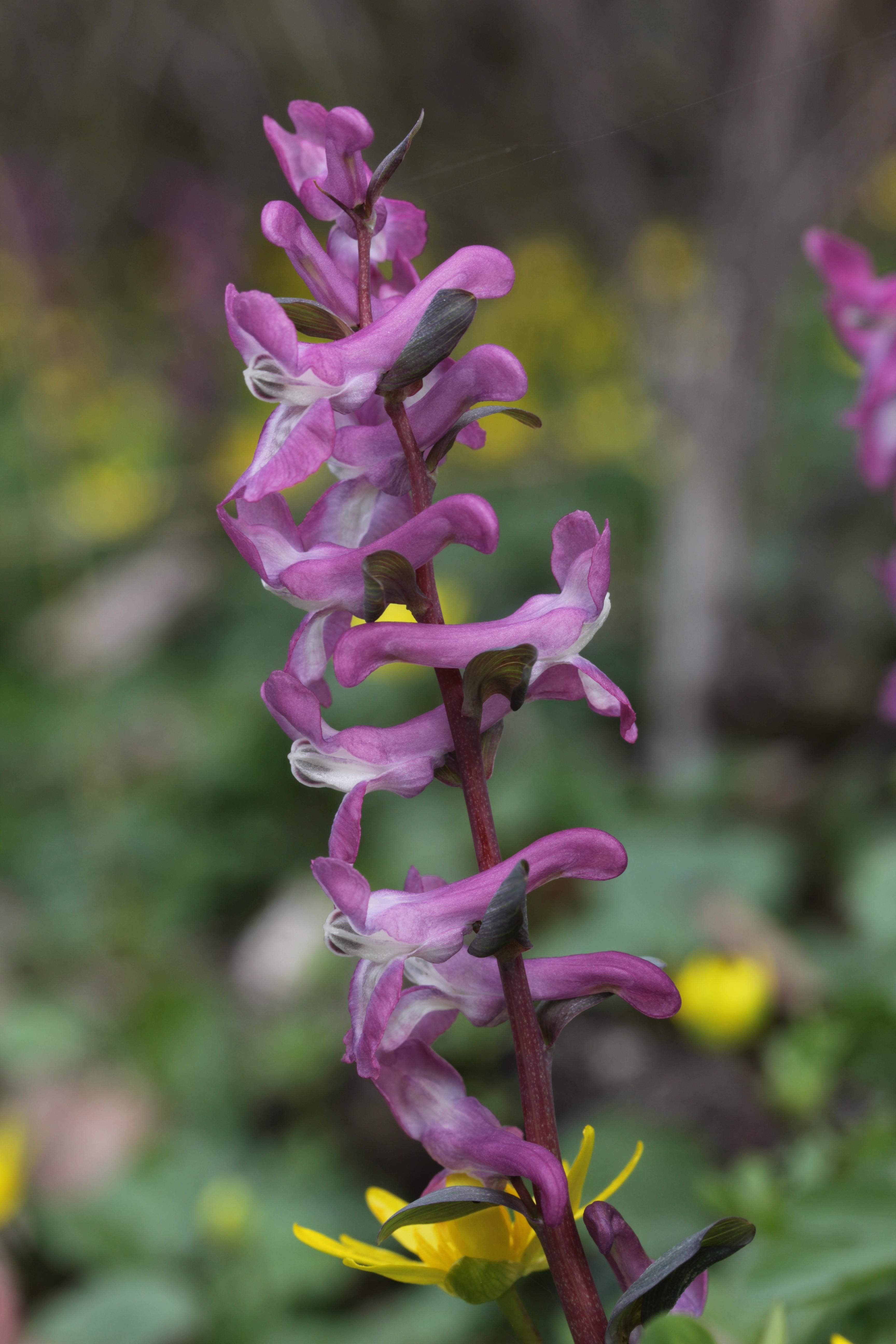
The flowers usually have purple or white petals that are fused into a tube. They have a single mirror axis (zygomorphic). They are arranged in groups of up to 20 flowers in a racemose inflorescence. There are entire bracts under the flowers.
The plant forms elongated capsule fruits.
Features
Hollowroot
Corydalis cava
poisonous
up to 20 flowers in one raceme
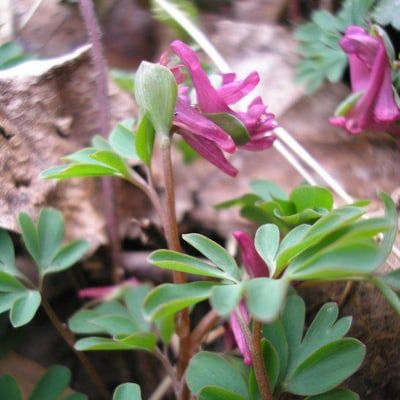
entire bract
In the city
Hollowroot grows mainly in beech forests, alluvial forests and orchards. It prefers moist, loose, mulch-rich, humous and nutrient-rich loamy soils. It is also planted as an ornamental plant in semi-natural gardens.
Fun Facts
The seeds are spread by ants, which drag them into their burrow and eat the oil body of the seeds. Afterwards, the seeds are removed from the burrow again and can germinate if conditions are favourable.
It is a spring-flowering plant whose above-ground parts wither early and are no longer present in summer. This behaviour is an adaptation of the plant to the heat and light regime of the deciduous forest.
Usually violet and white-flowered plants occur side by side. In the violet-flowered forms, the flowers are often rotated by 90°. They are therefore known as "intelligent flowers", in which only pollinators with a capacity for learning are able to find and open the unusual entrance to the flower.
The leaves are an important food source for the caterpillars of the endangered clouded Apollo butterfly.
The flowering period is from March to May.
It lives for several years and generally flowers and fruits annually (perennial plant).
- Endangerment level Germany: not endangered
The hollowroot is native to Central Europe. It occurs throughout Germany, but is rare in the north-west.
The species name cava is derived from the Latin word cavus for hollow and, as the common name hollowroot, refers to the hollow root tubers.
The tubers in particular contain poisonous alkaloids that cause seizures.
Sources
Habitus, Christian Fischer, CC BY-SA 3.0, https://commons.wikimedia.org/wiki/File:CorydalisCava.jpg

Blatt, Andrea Moro, CC BY-SA 4.0, https://commons.wikimedia.org/wiki/File:Corydalis_cava_leaf_(09).jpg
.jpg)
Blütenstand, Björn S., CC BY-SA 3.0, https://commons.wikimedia.org/wiki/File:Corydalis_cava_-_panoramio_(4).jpg
.jpg)
Spohn, M., Golte-Bechtle, M. & Spohn, R. (2015) Was blüht denn da? Stuttgart: Franckh Kosmos Verlag.
Seitz, B., Ristow, M., Meißner, J., Machatzi, B. & Sukopp, H. (2018) Rote Liste und Gesamtartenliste der etablierten Farn- und Blütenpflanzen von Berlin. : Der Landesbeauftragte für Naturschutz und Landschaftspflege / Senatsverwaltung für Umwelt, Klima und Verkehr (eds.) Rote Listen der gefährdeten Pflanzen, Pilze und Tiere von Berlin, URL: https://www.berlin.de/sen/uvk/natur-und-gruen/naturschutz/artenschutz/artenlisten-rote-listen/farn-und-bluetenpflanzen/ (Accessed: 26.03.2021).
Page „Hohler Lerchensporn“. : Wikipedia, The Free Encyclopedia. Date of last revision: 17.06.2018, 12:14 UTC. URL: https://de.wikipedia.org/w/index.php?title=Hohler_Lerchensporn&oldid=178391264 (Accessed: 17.07.2018).