
Short Description
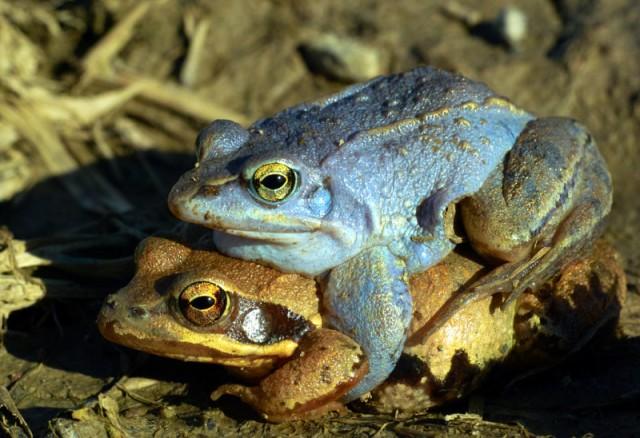
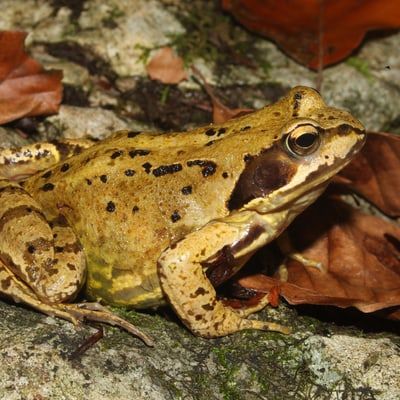
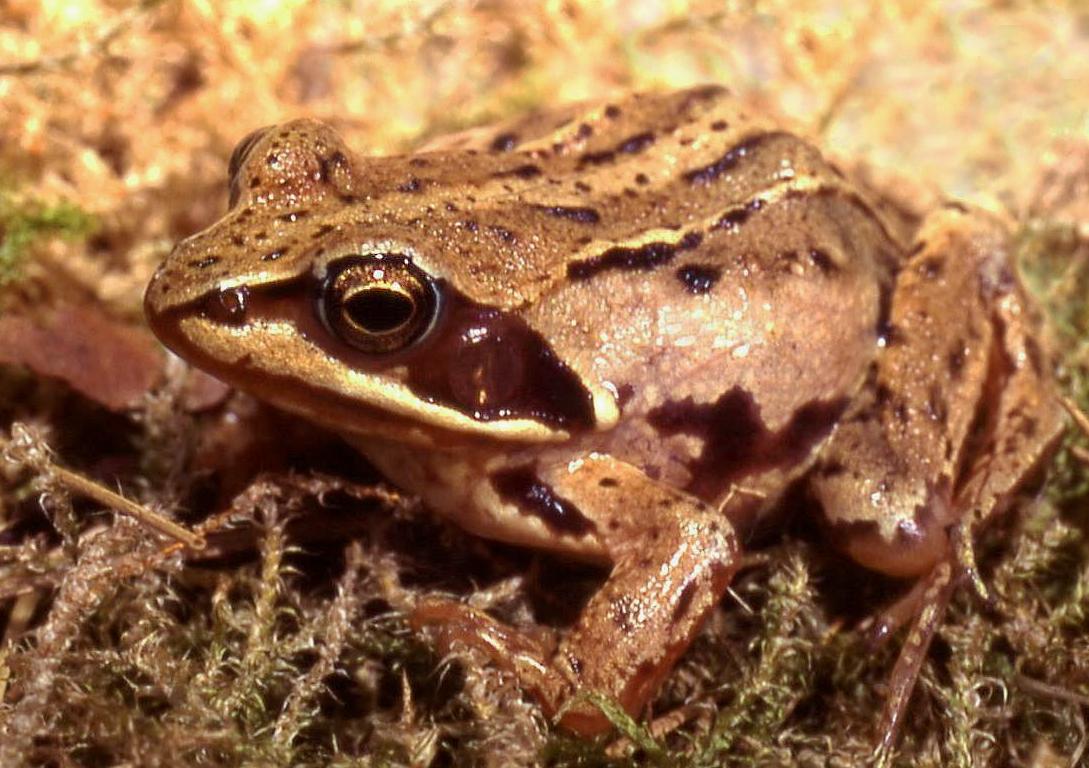
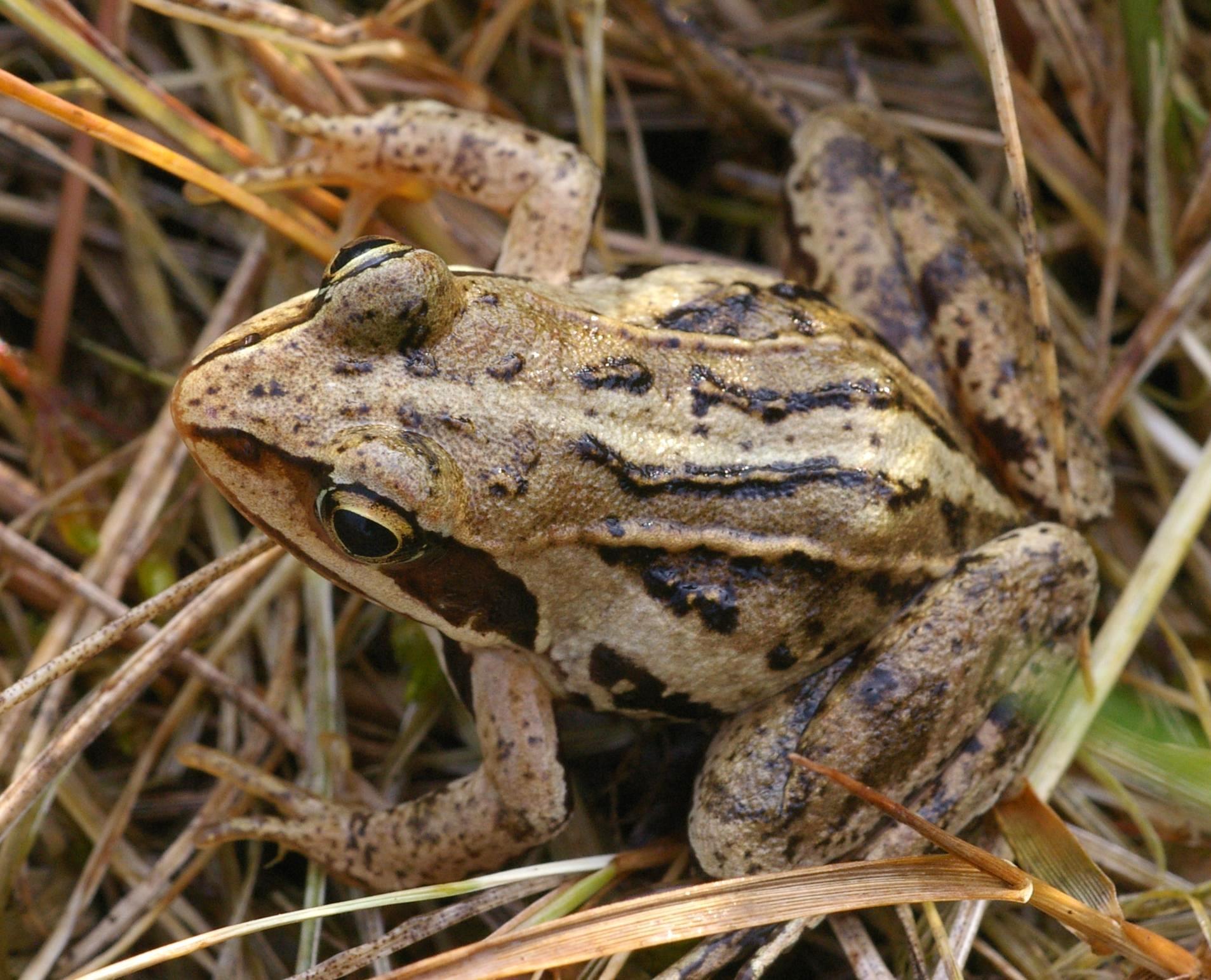
The moor frog has a rather dainty appearance with a more tapered head. It is light- to dark-brown with dark patches. Both sides of its head are marked with large dark temple spots. Many animals have a pale stripe down the centre of their backs, delineated by small raised ridges. The underparts are pale and generally without patches.
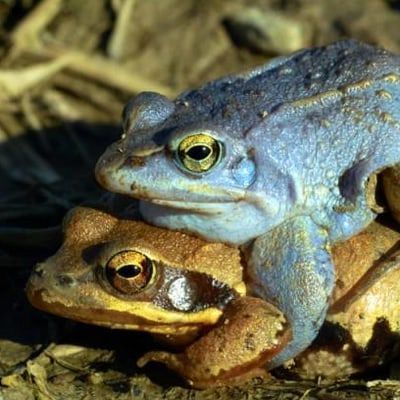
During the mating season, males turn a distinctive blue or purple.
Features
Moor frog
Rana arvalis
males are blue or purple in the mating season
Männchen: Paarungsrufe (im Hintergrund: Blessralle, Reiherente, Tafelente, Schnatterente, Stockente, Krickente, Knäkente, Graugans)
Frommolt, CC BY-SA 3.0

In the city
The moor frog is no typical urban species. It can be found in wet habitats such as swampy areas on the urban fringes. Its spawning waters are backwaters and ponds, ditches and little used fishponds.
Moor frogs are very shy and avoid encounters with humans. To observe them, binoculars and a very cautious approach are definitely recommended.
Fun Facts
Despite its name, the moor frog avoids actual moors, because the high acid content is toxic to its spawn.
The blue colouration of the males during the mating season is unique amongst brown frogs (Rana). It is not quite clear whether its purpose is to attract females or deter male rivals.
Temple patches are typical for brown frogs.
All European amphibians are specially protected and must not be captured, injured or killed.
- Endangerment level Germany: endangered
Sources
Habitus (Paarungszeit), Staffan Kyrk, CC BY-SA 3.0, https://commons.wikimedia.org/wiki/File:Rana_arvalis2.jpg

Weibchen, Christian Fischer., CC BY-SA 3.0, https://commons.wikimedia.org/wiki/File:RanaArvalisFemale.jpg

Jungtier, Christian Fischer, CC BY-SA 3.0, https://de.wikipedia.org/wiki/Datei:RanaArvalisJuv.jpg

Kwet, A. (2015) Reptilien und Amphibien Europas. 250 Arten mit Verbreitungskarten, Stuttgart: Franckh Kosmos Verlag.
Blab, J. & Vogel, H. (2002) Amphibien und Reptilien erkennen und schützen, München: BLV.
Glandt, D. (2008) Heimische Amphibien: Bestimmen – Beobachten – Schützen, Wiebelsheim: AULA-Verlag.
Glandt, D. (2015) Die Amphibien und Reptilien Europas, Wiebelsheim: Quelle & Meyer Verlag.
NABU – Naturschutzbund Deutschland e.V. (n.d.) Im Frühjahr gerne mal in Blau. Der Moorfrosch (Rana arvalis), URL: https://www.nabu.de/tiere-und-pflanzen/amphibien-und-reptilien/amphibien/artenportraets/10690.html (Accessed: 05.08.2016).
Bundesfachausschuss Feldherpetologie/Ichthyofaunistik im NABU (n.d.) Rote Listen, URL: http://www.amphibienschutz.de/schutz/artenschutz/roteliste/deutschland.htm (Accessed: 26.07.2016).
Page „Moorfrosch“. : Wikipedia, The Free Encyclopedia. Date of last revision: 03.04.2016, 12:59 UTC. URL: https://de.wikipedia.org/w/index.php?title=Moorfrosch&oldid=153129283 (Accessed: 12.05.2016).