
Short Description
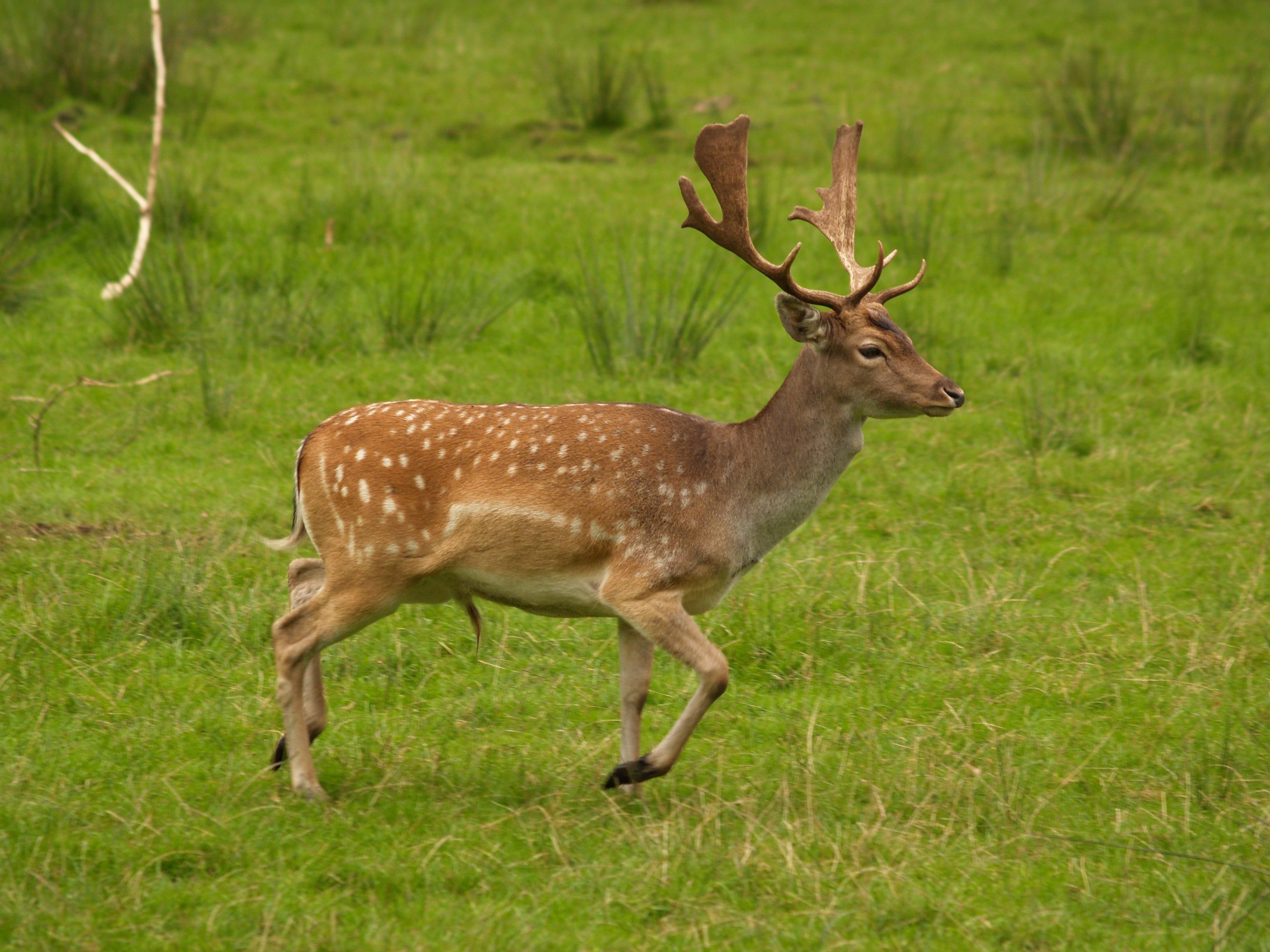
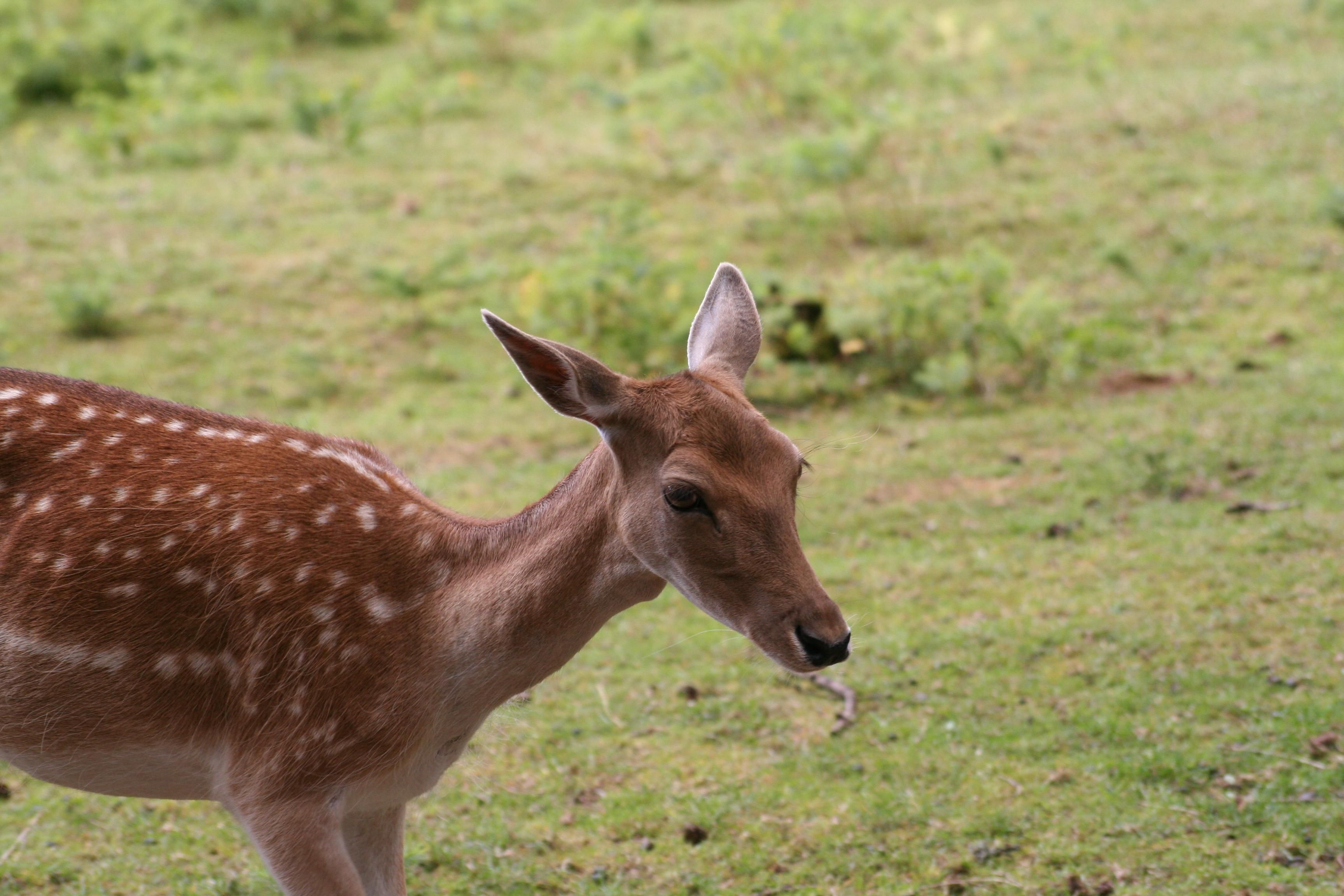
The fallow deer is a medium-sized deer. Its summer coat is red-brown with obvious white spots. In winter, it appears dark to ash-grey. Tracks of a fallow deer can be identified from the impressions of its two long paired cleaves (toes). The rounded heel accounts for about half of the impression.
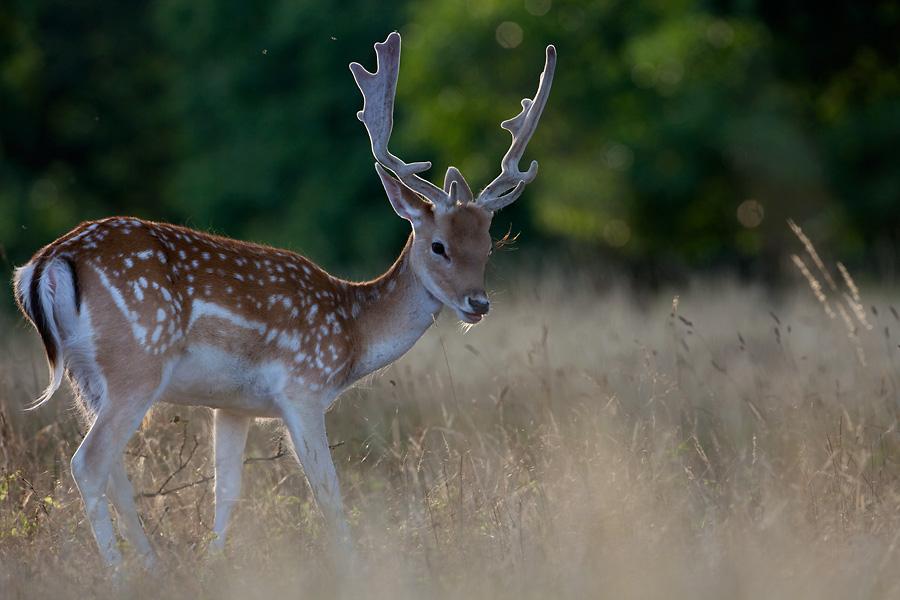
Males are easily recognised from their broad, laterally flattened antlers.
Females are overall more slender in appearance. They have a more graceful walk and a long tail.
Features
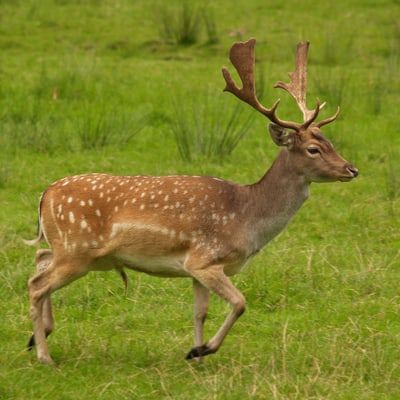
Fallow deer
Dama dama
shovel-shaped antlers in males
reddish-brown coat with white spots
Similar species
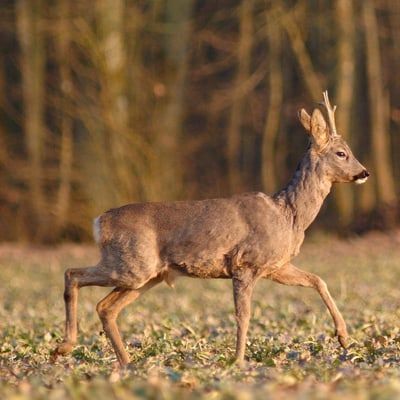
Roe deer
Capreolus capreolus
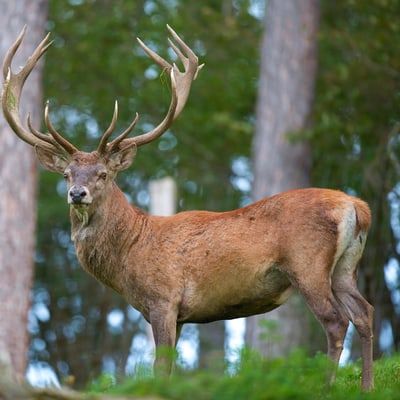
Red deer
Cervus elaphus
In the city
Fallow deer prefer comparatively sparse forests and open spaces. This habitat can for example be found in parklands with pastures. They can also live in small forests and can thus also be found near human habitation.
Fun Facts
Young fallow deer recognise their mothers by their individual calls. These sound like a loud bark. Fawns call with a squeak.
Fallow deer are the closest relations to the extinct giant deer.
During the rutting season, a male loses up to a third of its weight.
Pure white to pure black colour anomalies are quite common in fallow deer. They are probably the result of their long domestication.
There are two subspecies: the European and the Persian fallow deer. The latter can be observed in Berlin Zoo.
- Endangerment level Germany: not evaluated
The fallow deer originates from the Middle East. Populations in Germany were introduced from Denmark in the 16th century.
Sources
Männchen , Johann-Nikolaus Andreae, CC BY-SA 2.0, https://commons.wikimedia.org/wiki/File:Fallow_deer_in_field.jpg

Weibchen, Traroth, CC BY-SA 3.0, https://commons.wikimedia.org/wiki/File:Silz_daim11.jpg

Jungtier, Marek Szczepanek, CC BY-SA 4.0, https://commons.wikimedia.org/wiki/File:Dama_dama_(Marek_Szczepanek).jpg
.jpg)
Masseti, M. & Mertzanidou, D. (2008) Dama dama. The IUCN Red List of Threatened Species, URL: http://www.iucnredlist.org/details/42188/0 (Accessed: 01.01.2017).
Dewald, U. (2005) Riesenhafte Verwandtschaft, URL: http://www.wissenschaft.de/home/-/journal_content/56/12054/1033244/ (Accessed: 01.01.2017).
Schöbi, K. (2006) Vergebliche Rufe nach der Mutter, URL: http://www.wissenschaft.de/home/-/journal_content/56/12054/1023353/ (Accessed: 01.01.2017).
Sielmanns Natur-Ranger Deutschland e.V. (n.d.) Damwild, URL: http://www.natur-ranger.de/de/wissen/tierkunde/Damwild.php (Accessed: 01.01.2017).
Dein Natur- & Jagdportal (n.d.) Damwild Steckbrief, URL: https://auf-jagd.de/haarwild/damwild-steckbrief/ (Accessed: 01.01.2017).
Deutscher Jagdverband e.V. (2005) Fährten und Spuren: Bestimmungshilfe für Naturfreunde, URL: https://www.jagdverband.de/sites/default/files/Faehrten-und-Spuren_2015_RZ-vs.pdf (Accessed: 30.03.2021).
Wildnisschule Wildniswissen (n.d.) Herzlich willkommen auf Spurenjagd.de! URL: http://www.spurenjagd.de/ (Accessed: 01.12.2016).
Kirchner Süderwalsede (2007) Fährten und Spuren. Bestimmungshilfe für Naturfreunde, URL: http://www.kirchner-raddestorf.de/jikirchner/jagd/brauchtm/faehrten.htm (Accessed: 16.02.2017).
Page „Damhirsch“. : Wikipedia, The Free Encyclopedia. Date of last revision: 04.01.2017, 12:32 UTC. URL: https://de.wikipedia.org/w/index.php?title=Damhirsch&oldid=161269361 (Accessed: 16.02.2017).
NABU Landesverband Nordrhein-Westfalen (n.d.) Der Damhirsch. Dama dama, URL: https://nrw.nabu.de/natur-und-landschaft/landnutzung/jagd/jagdbare-arten/weitere-saeugetiere/06784.html (Accessed: 16.02.2017).
Haupt, H., Ludwig, G., Gruttke, H., Binot-Hafke, M., Otto C. & Pauly, A. (2009) Rote Liste gefährdeter Tiere, Pflanzen und Pilze Deutschlands. volume 1: Wirbeltiere, Bonn-Bad Godesberg: Bundesamt für Naturschutz.
Klawitter, J., Altenkamp, R., Kallasch, C., Köhler, D., Krauß, M., Rosenau, S. & Teige, T. (2005) Rote Liste und Gesamtartenliste der Säugetiere (Mammalia) von Berlin. : Der Landesbeauftragte für Naturschutz und Landschaftspflege / Senatsverwaltung für Stadtentwicklung (eds.) Rote Listen der gefährdeten Pflanzen und Tiere von Berlin, URL: https://www.berlin.de/sen/uvk/natur-und-gruen/naturschutz/artenschutz/artenlisten-rote-listen/saeugetiere/ (Accessed: 30.03.2021).