
Short Description
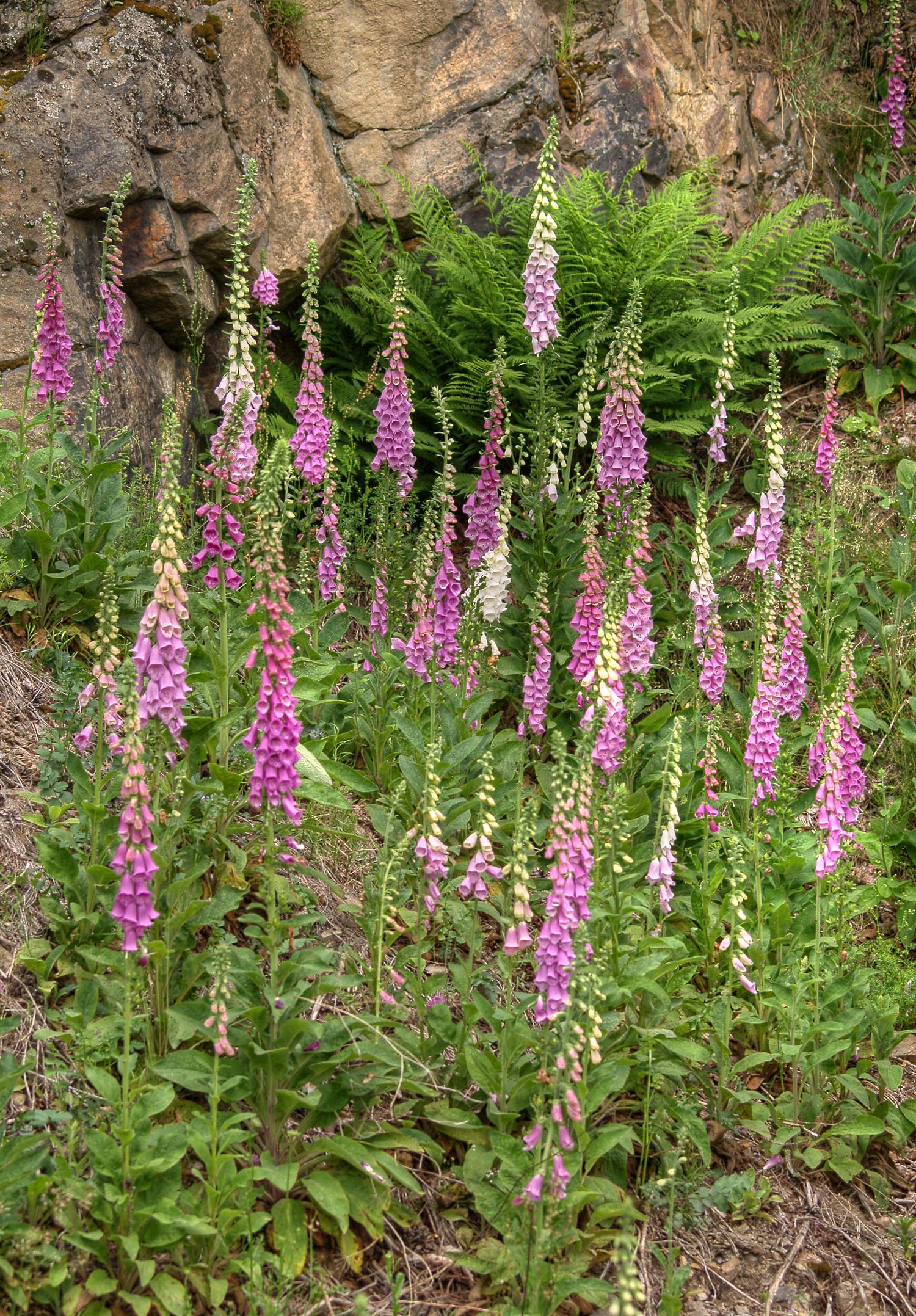
Foxglove can grow to a height of two metres.
The leaves are in a leaf rosette near the ground. They grow spirally on the stem. They are oval and pointed. They have a grey felty underside. The leaf margin is notched.
The stem is upright and rarely branched.
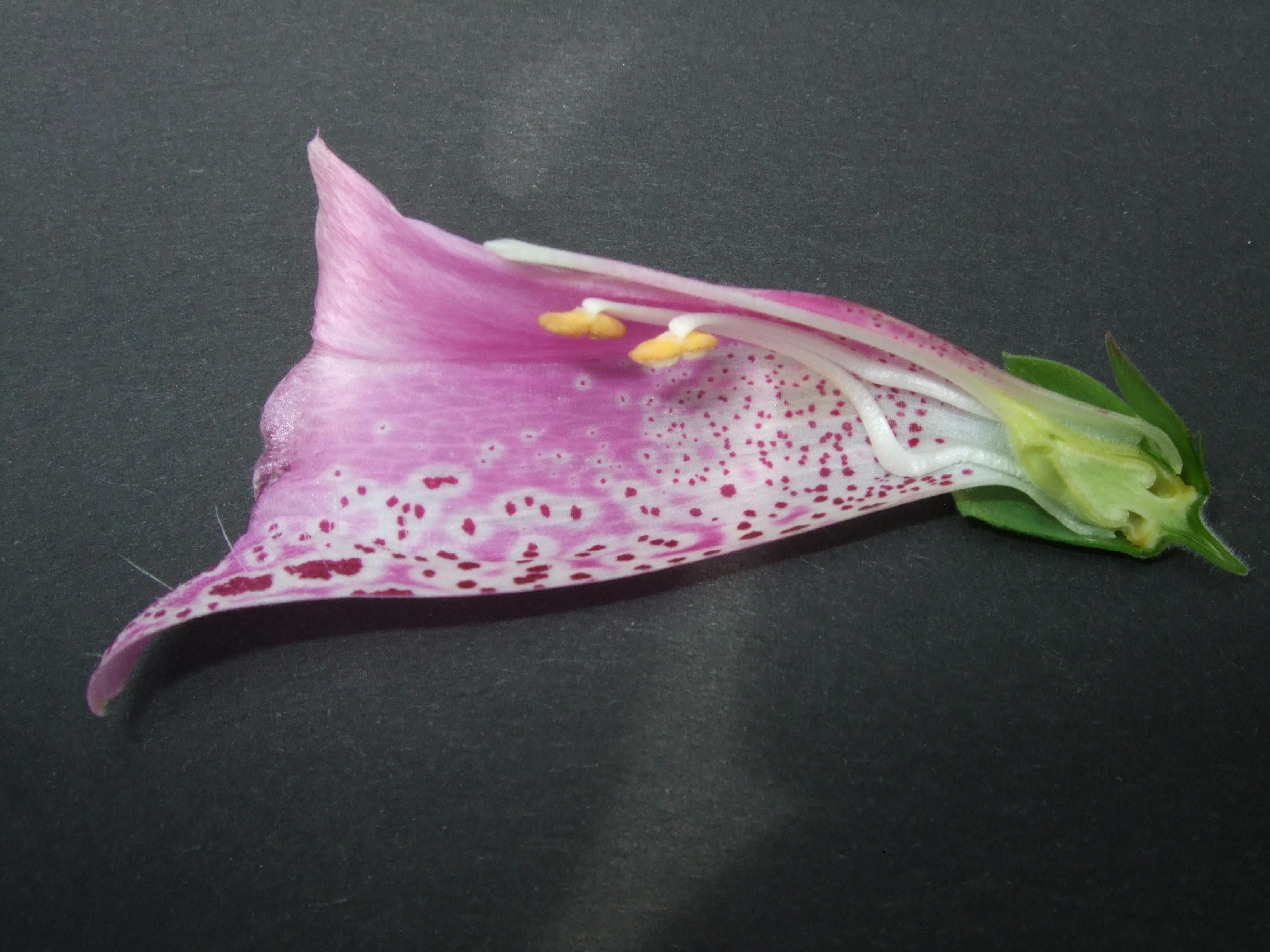
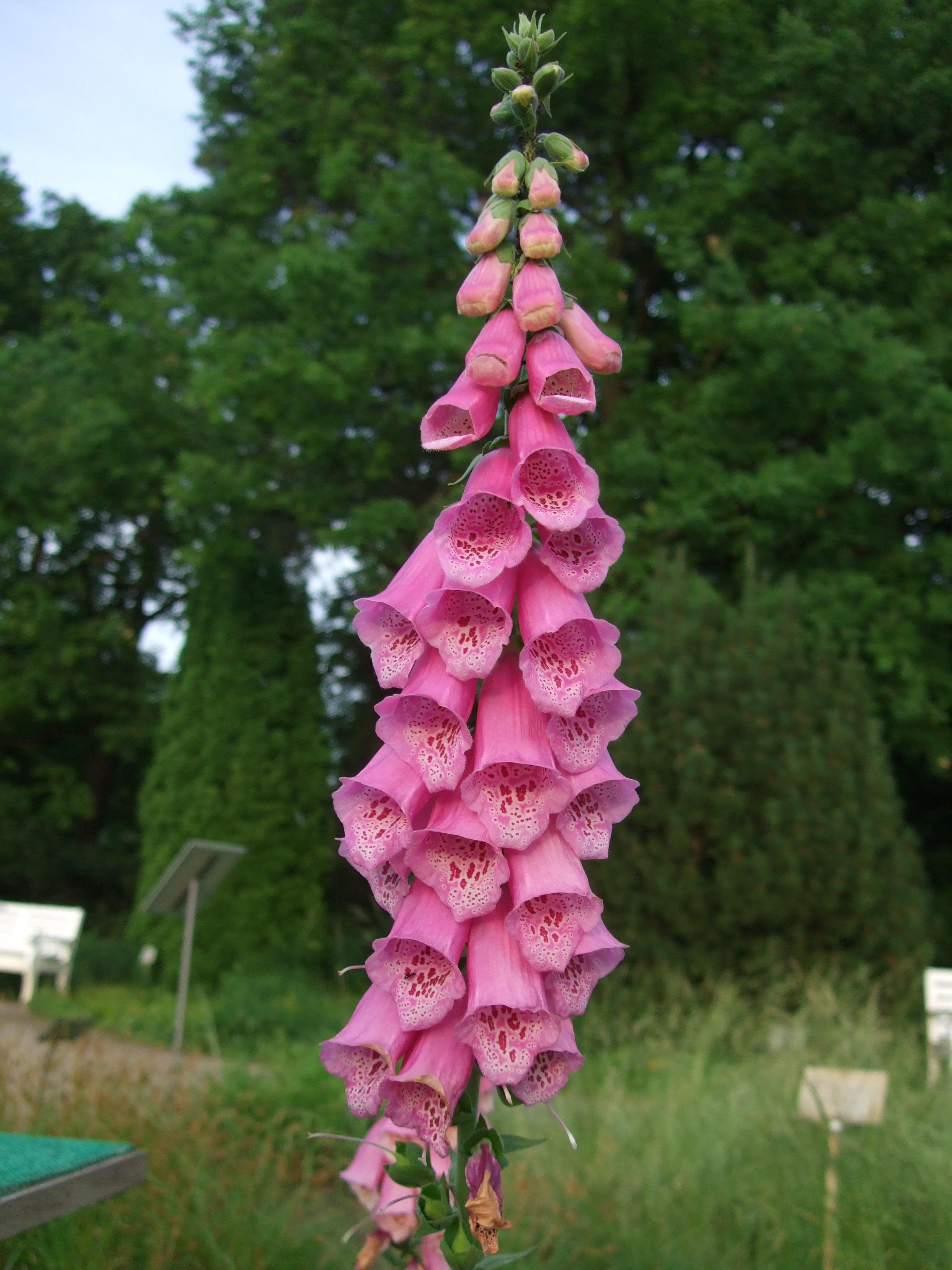
The numerous flowers are arranged in long, one-sided clusters. They are bell-shaped, pink to purple and hairy. The inside of the flowers is dotted with white-bordered dark-red spots.
The fruit is an oval capsule.
Features
Foxglove
Digitalis purpurea
highly poisonous
large pink to purple flowers
flower funnel with dark red spots
In the city
In an urban environment, foxgloves can be found along forest paths and clearings or in gardens. The plant looks striking and is often planted in municipal gardens despite being poisonous. Foxglove prefers sunny to semi-shaded and fresh sites on humus-rich soil.
Fun Facts
In medicine, the ingredient substances of foxglove are used in the treatment of cardiac arrhythmias and myocardial insufficiency.
The spots in the flower simulate anthers, thus attracting pollinators.
It flowers from June to August.
It is a biennial plant. This means that a plant lives for two years, but flowers only once and dies after the seeds have ripened.
- Endangerment level Germany: not endangered
Foxglove is a poisonous plant. All parts of the plant are highly toxic and can result in fatal poisoning or cardiac arrest.
Sources
Habitus, Jörg Hempel, CC BY-SA 3.0, https://commons.wikimedia.org/wiki/File:Digitalis_purpurea_LC0082.jpg

Blüte quer, Alice Kracht, CC BY-SA 4.0, https://offene-naturfuehrer.de/web/Datei:Digitalis_purpurea_(2).JPG
.JPG)
Blütenstand, Alice Kracht, CC BY-SA 4.0, https://offene-naturfuehrer.de/web/Datei:Digitalis_purpurea_(1).JPG
.JPG)
Spohn, M., Golte-Bechtle, M. & Spohn, R. (2015) Was blüht denn da? Stuttgart: Franckh Kosmos Verlag.
Fleischhauer, S. G., Guthmann, J. & Spiegelberger, R. (2007) Essbare Wildpflanzen. 200 Arten bestimmen und verwenden, Baden und München: AT Verlag.
Needon, C. & Petermann, J. (1991) Urania-Naturführer Pflanzen, Leipzig, Jena, Berlin: Urania-Verlag.
Schauer, T., Caspari, C. & Caspari, S. (2015) Der illustrierte BLV-Pflanzenführer für unterwegs. 1150 Blumen, Gräser, Bäume und Sträucher, München: BLV.
Page „Roter Fingerhut“. : Wikipedia, The Free Encyclopedia. Date of last revision: 12.11.2016, 20:11 UTC. URL: https://de.wikipedia.org/w/index.php?title=Roter_Fingerhut&oldid=159630435 (Accessed: 29.11.2016).