
Short Description
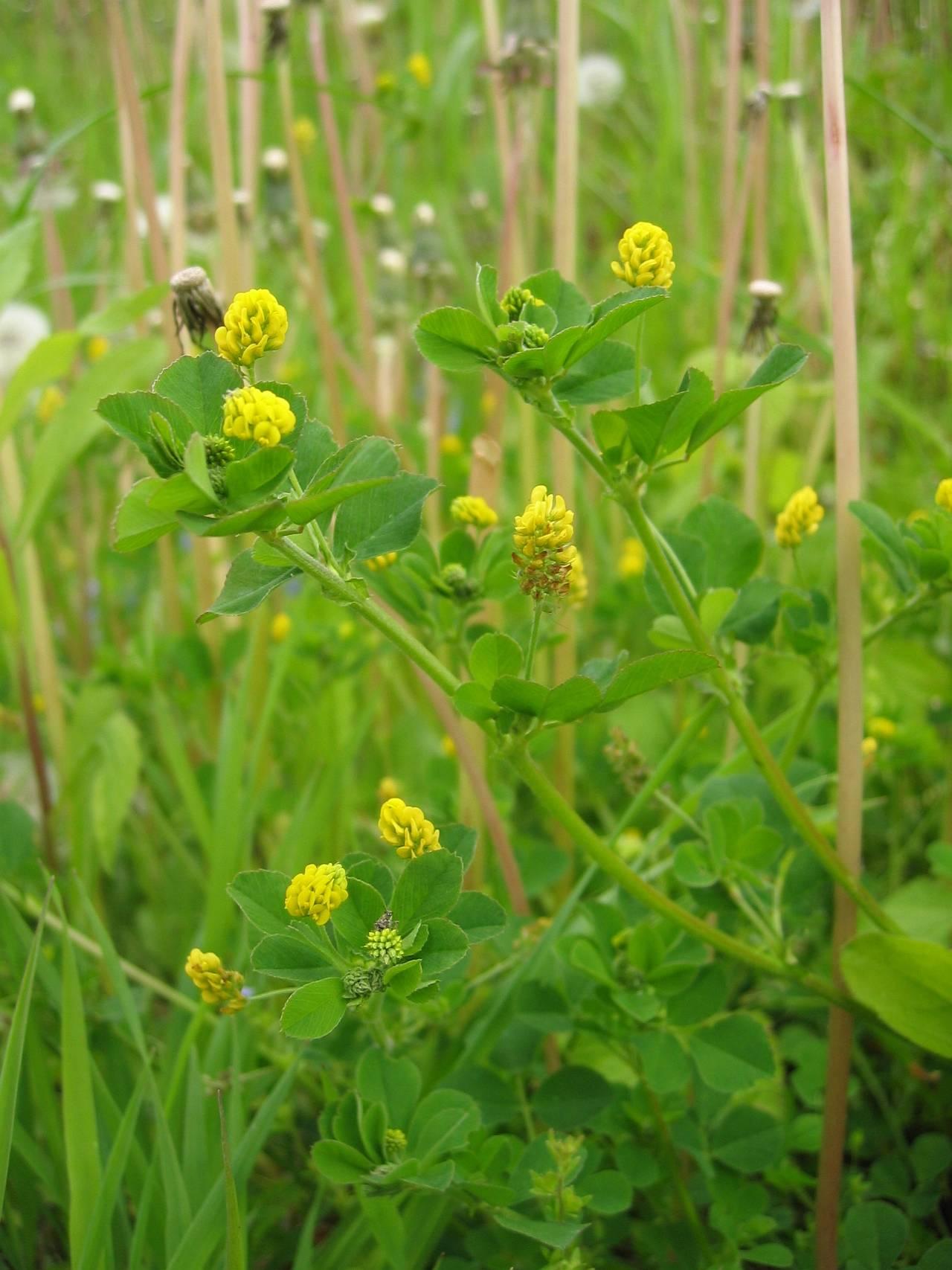
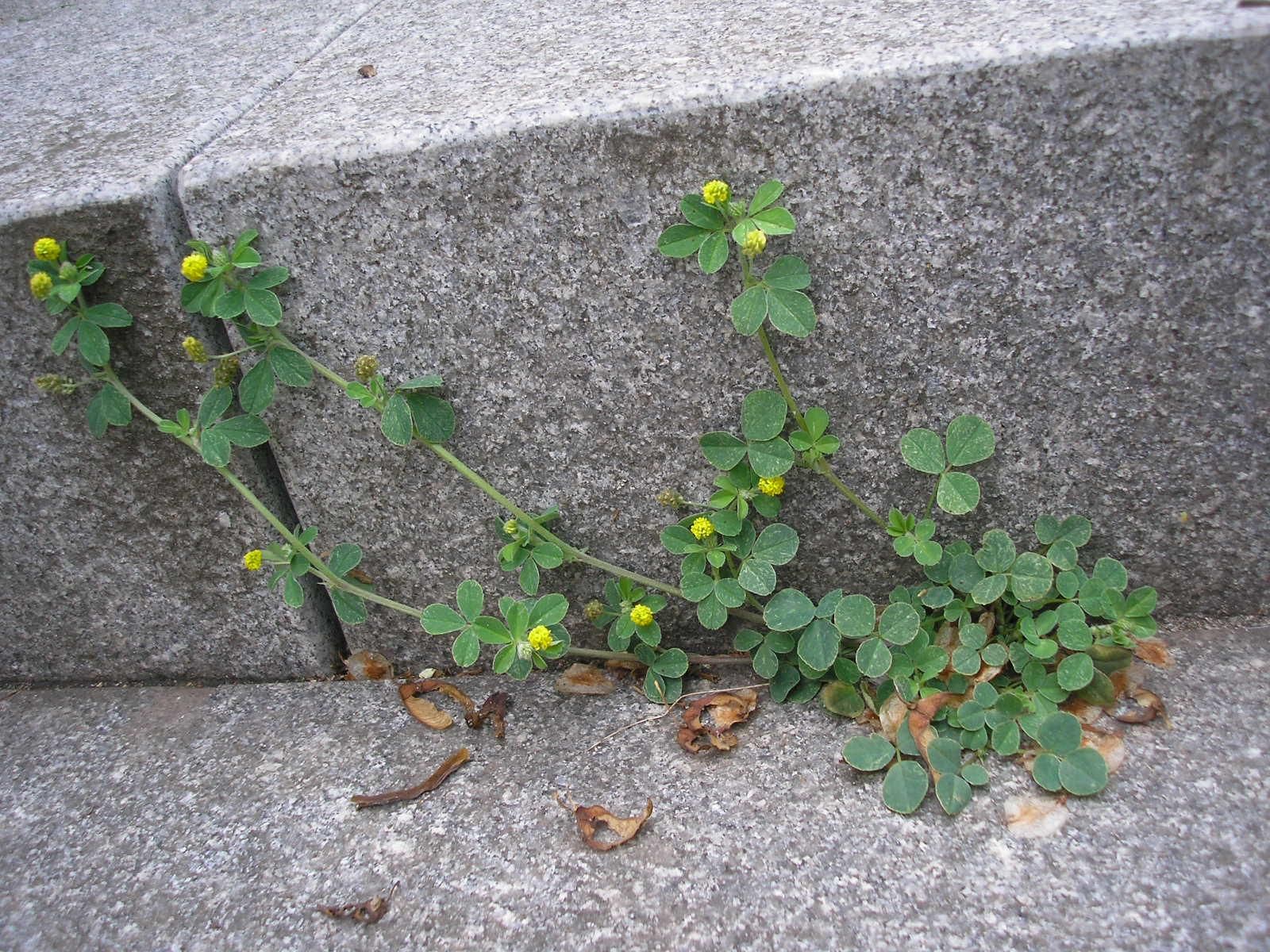
The black medick can grow up to 60 cm high.
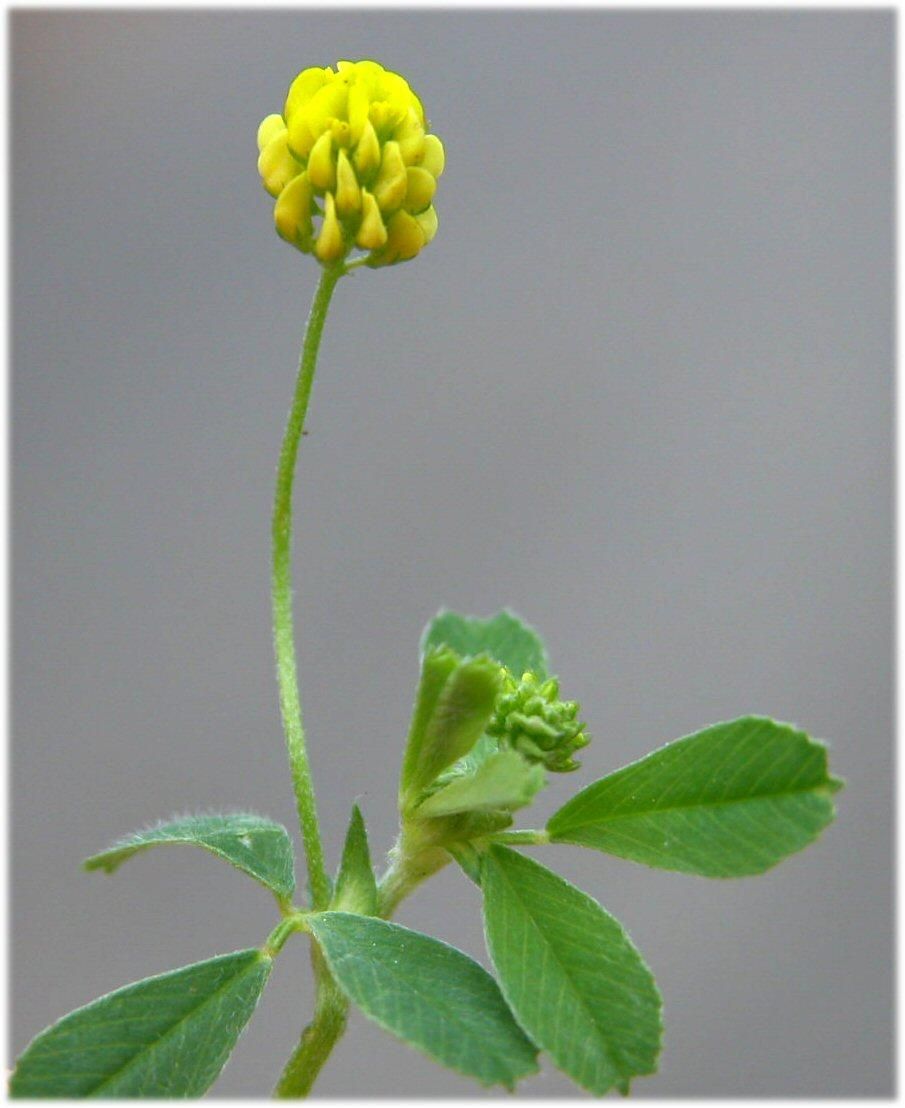
The leaves are composed of three leaflets (trifoliolate). The leaflets are ovate to elliptical. The margin of the leaflets is only toothed at the front and has an attached tip. The top leaflet in the middle is longer stalked than the two lateral leaflets.
The stem is angular and usually grows lying flat.
The flowers are numerous in head-like racemes. The individual flowers are bright yellow. They consist of five petals that form the typical, zygomorphic pea-flower-type (papilionaceous) within this family. The large, upper petal is the standard and projects upwards. The two smaller lateral petals are the wings. The two lower leaves form a hollow keel that surrounds the anthers and the pistil.
The plant forms brown-black legumes. They are almost kidney-shaped and once twisted.
Features
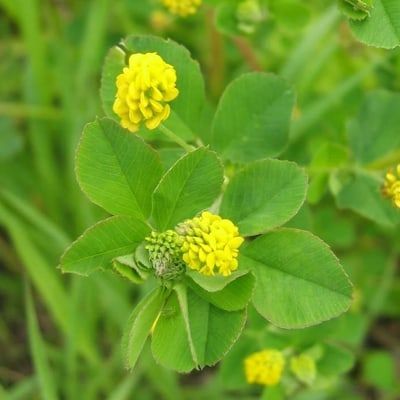
Black medick
Medicago lupulina
yellow, heady inflorescences
leaflets with attached tip
Similar species
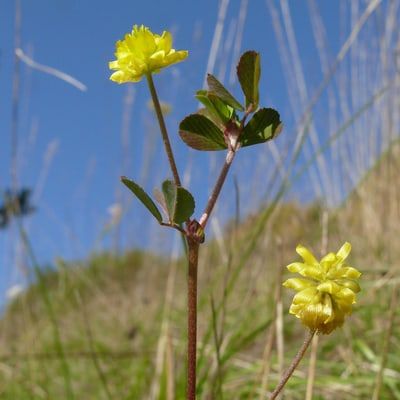
Hop trefoil
Trifolium campestre
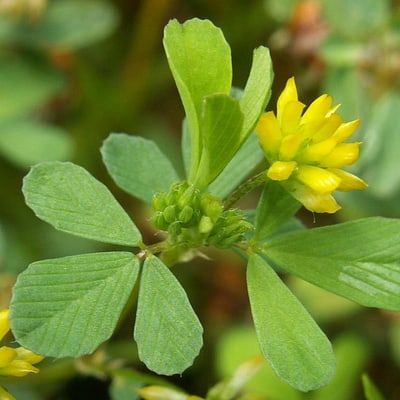
Lesser hop trefoil
Trifolium dubium
In the city
Black medick prefers lime-rich, warm and rather dry sites. It is found in the city on meadows, fields, along paths and on embankments. It is also used in grass mixtures as a fodder plant or for the greening of raw soils.
Fun Facts
At the first insect visit, the stamens shoot out of the keel and press against the insect's abdomen. The insects then spread the pollen.
Pollination is carried out by the honey bee, other small bee species and by various flies.
The flowering period is from May to October.
Living together with root nodule bacteria is typical for the legume family. The bacteria supply the plant with nitrogen. Since the bacteria need a plant for nitrogen fixation, this coexistence has a positive effect on both species (symbiosis).
It is a one to two year old plant. This means that a plant lives for one to two years, but flowers only once and dies after the seeds have matured.
- Endangerment level Germany: not endangered
Black medick is found almost all over Europe and is a native species.
Sources
Habitus, Tigerente, CC BY-SA 3.0, https://commons.wikimedia.org/wiki/File:MedicagoLupulina.jpg

Habitus, Julia Kruse, CC BY-SA 3.0, https://commons.wikimedia.org/wiki/File:Medicago_lupulina_JuliaKruse.jpg

Blütenstand mit jungen Früchten, Andrea Moro 2004, CC BY-SA 3.0, https://commons.wikimedia.org/wiki/File:Dryades_TSB14193.jpg

Kammer, P. M. (2016) Pflanzen einfach bestimmen. Schritt für Schritt einheimische Arten kennenlernen, Bern: Haupt Verlag.
Spohn, M., Golte-Bechtle, M. & Spohn, R. (2015) Was blüht denn da? Stuttgart: Franckh Kosmos Verlag.
Page „Hopfenklee“. : Wikipedia, The Free Encyclopedia. Date of last revision: 24.05.2017, 07:18 UTC. URL: https://de.wikipedia.org/w/index.php?title=Hopfenklee&oldid=165775749 (Accessed: 20.03.2018).