
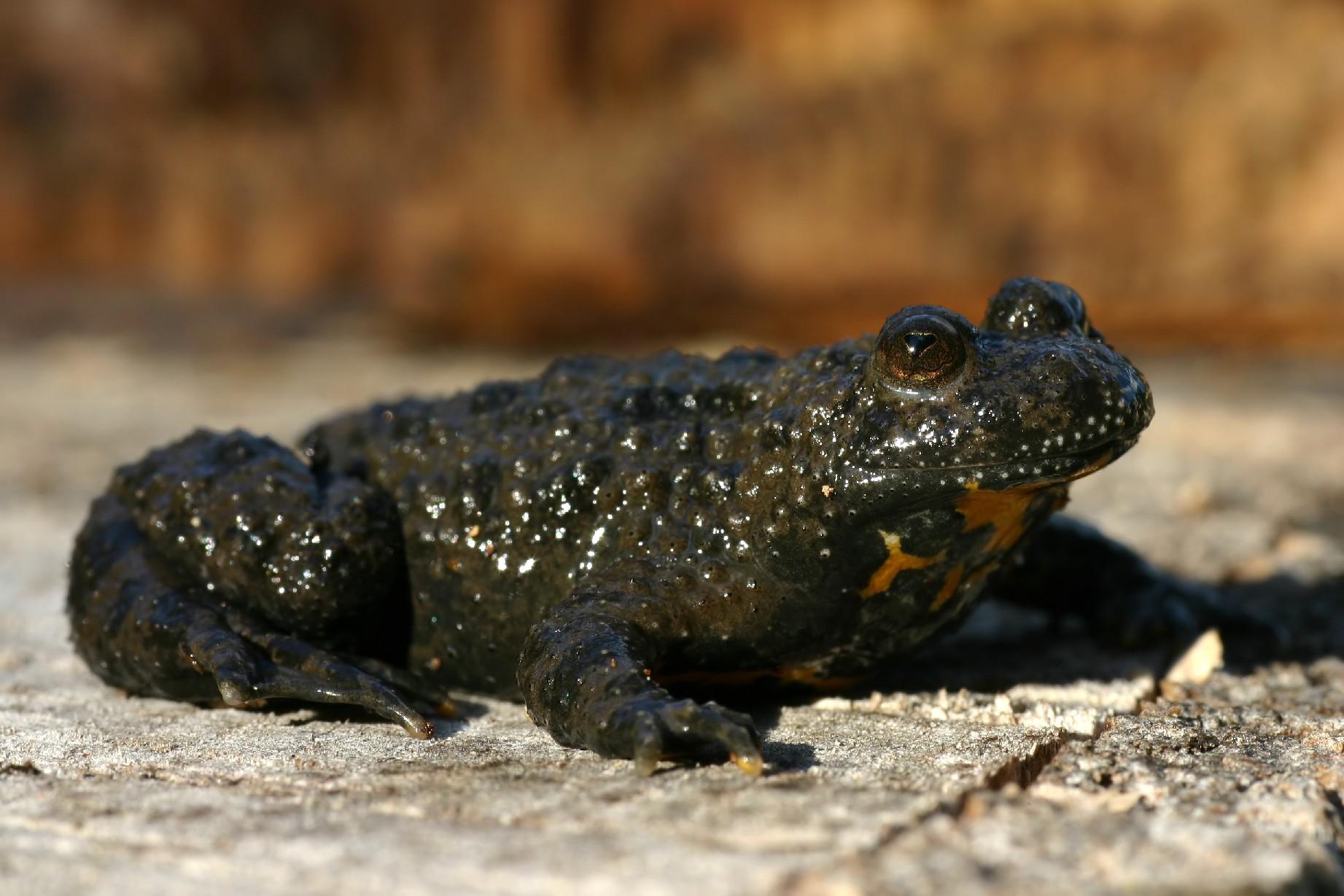
Short Description
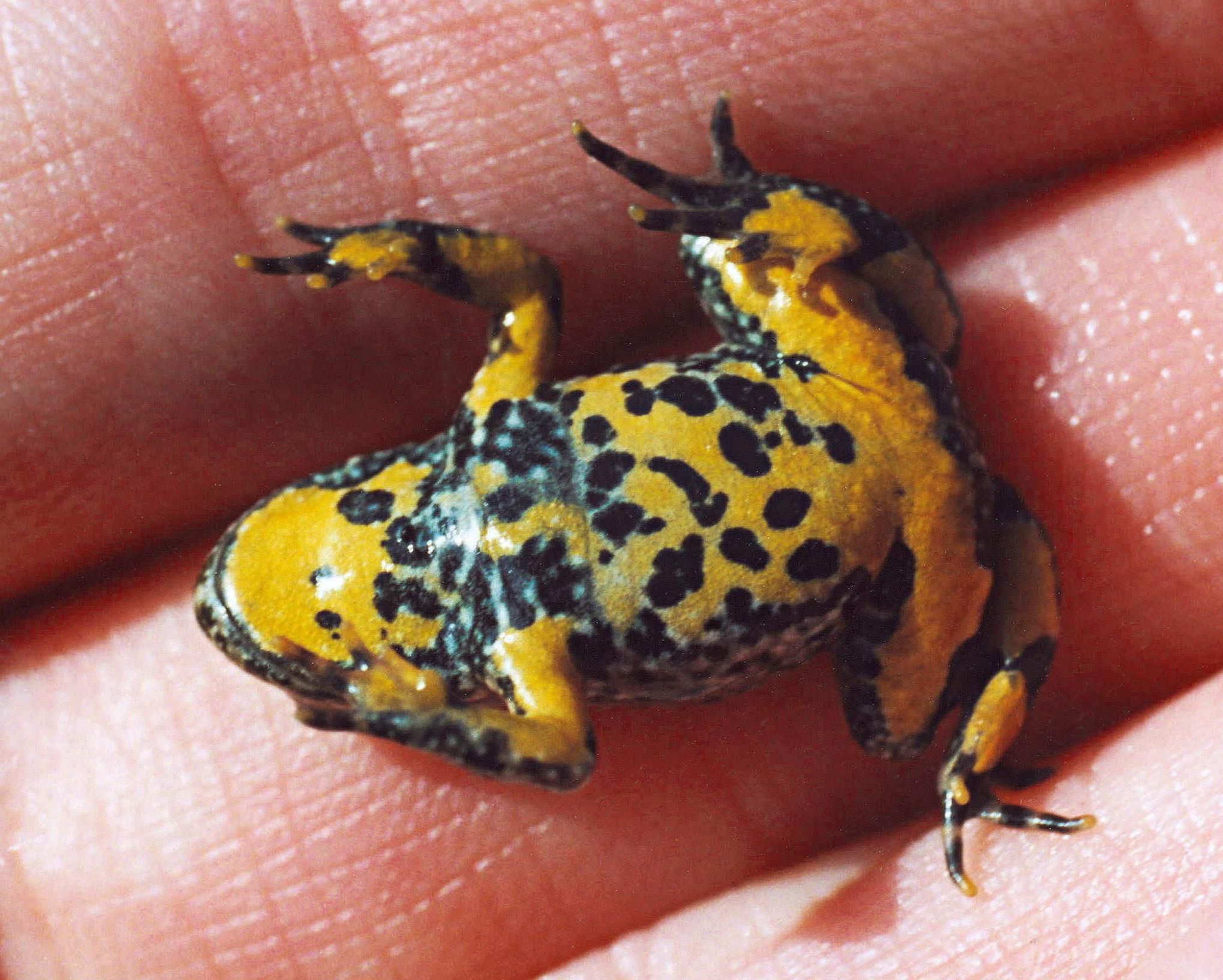
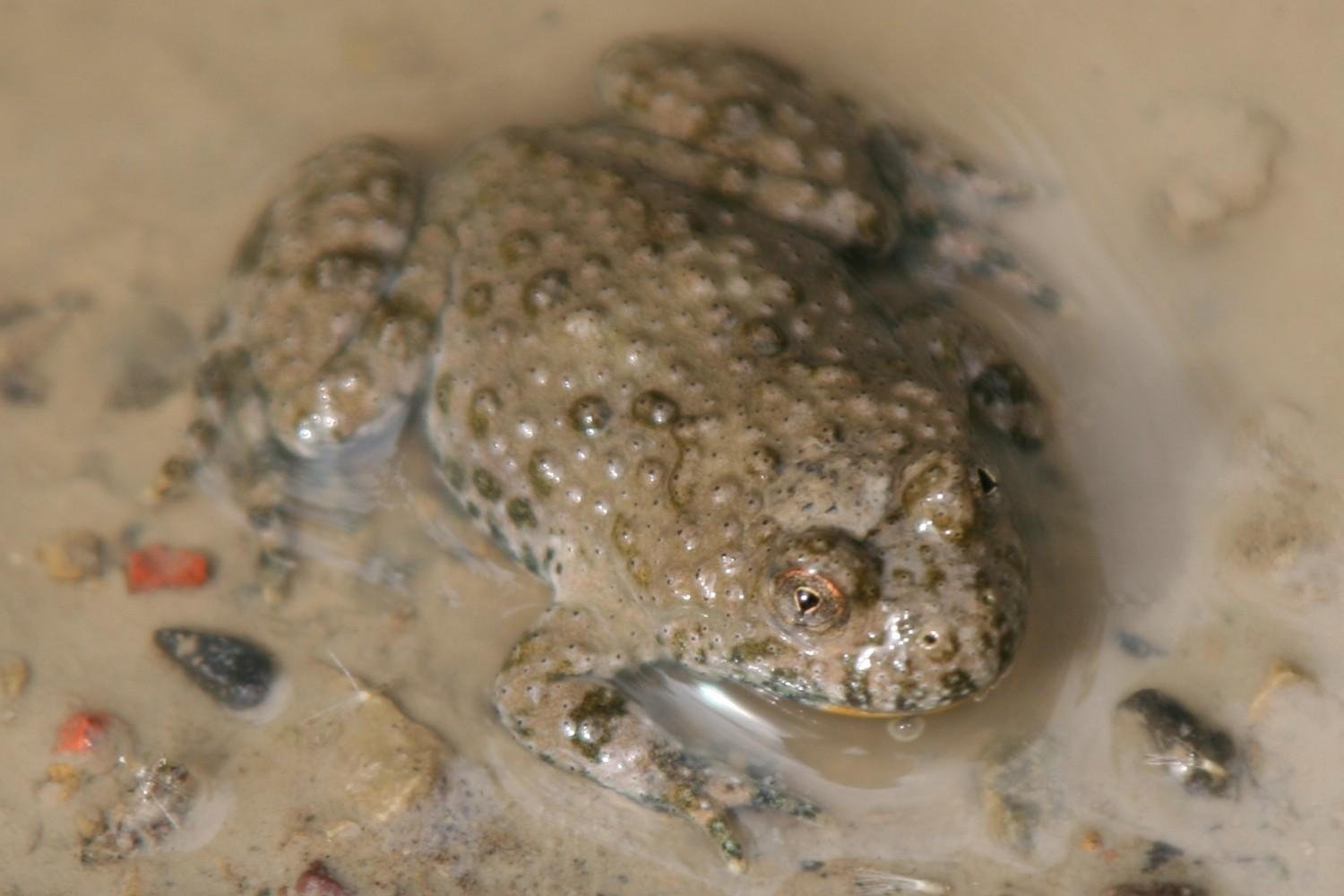
Yellow-bellied toads have a grey-brown coloured upper side with a very warty and rough skin. The underside is yellow-orange with a grey or black spotted pattern. It has the heart-shaped pupils typical of toads.
During the mating season, the males develop dark brown rutting calluses on the inner sides of the forearms and on several fingers.
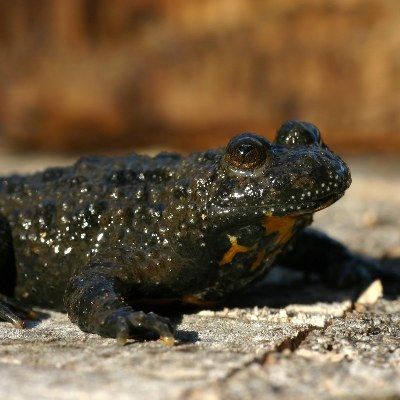
Features
Yellow-bellied toad
Bombina variegata
yellow-orange underside with dark spots
heart-shaped pupil
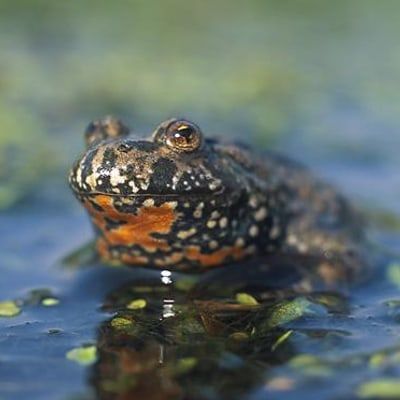
In the city
In areas where natural landscape dynamics are often no longer present, the yellow-bellied toad lives predominantly in man-made habitats. The pioneer species colonises, for example, excavations on industrial sites and military training areas.
Fun Facts
In danger, they present parts of their bright yellow underside. They push through their backs and lift their arms and legs to the sides.
The yellow-black pattern of markings on the underside can be used as an individual distinguishing feature.
Yellow-bellied toads are very long-lived. In the field, animals can live for over 20 years.
When the pioneer species reaches a state population level within a habitat, it tends to migrate and colonise new habitats.
In the common distribution area, crossbreeding with the fire-bellied toad occurs. In these offspring, a mixing of characteristics (hybridisation) is noticeable.
All European amphibians are specially protected and must not be captured, injured or killed.
- Endangerment level Germany: severely endangered
Yellow-bellied toads can release a slightly volatile poison through their skin. The secretion secreted when threatened can cause mucous membrane irritation in humans.
Sources
Habitus , Christoph Leeb, CC BY-SA 3.0, https://commons.wikimedia.org/wiki/File:Gelbbauchunke1.jpg

Jungtier, Christian Fischer, CC-BY-SA-3.0, https://de.wikipedia.org/wiki/Datei:BombinaVariegataJuv.jpg

Habitus , Rosenzweig, CC-BY-SA-3.0, https://de.wikipedia.org/wiki/Datei:Bombina_variegata_Weinsberg_20070707_3_crop.jpg

Page „Gelbbauchunke“. : Wikipedia, The Free Encyclopedia. Date of last revision: 08.10.2017, 08:55 UTC. URL: https://de.wikipedia.org/w/index.php?title=Gelbbauchunke&oldid=169787709 (Accessed: 16.02.2018).
NABU – Naturschutzbund Deutschland e.V. (n.d.) Ein Leben in Pfützen. Die Gelbbauchunke (Bombina variegata), URL: https://www.nabu.de/tiere-und-pflanzen/amphibien-und-reptilien/amphibien/artenportraets/10637.html (Accessed: 16.02.2018).
Gebel, M. (2014) Gelbbauchunke (Bombina variegata), URL: http://www.amphibien-reptilien.com/info-gelbbauchunke-bombina-variegata.html (Accessed: 16.02.2018).
Bundesfachausschuss Feldherpetologie/Ichthyofaunistik im NABU (n.d.) Gelbbauchunke , Bombina variegata, LINNEAEUS, 1758, URL: http://www.amphibienschutz.de/amphib/gun.htm (Accessed: 16.02.2018).
Schulte, U. & Nöllert, A. (2013) Artensteckbrief Gelbbauchunke (Bombina variegata), URL: https://feldherpetologie.de/heimische-amphibien-artensteckbrief/artensteckbrief-gelbbauchunke-bombina-variegata/ (Accessed: 16.02.2018).
Kwet, A. (2015) Reptilien und Amphibien Europas. 250 Arten mit Verbreitungskarten, Stuttgart: Franckh Kosmos Verlag.
Blab, J. & Vogel, H. (2002) Amphibien und Reptilien erkennen und schützen, München: BLV.
Glandt, D. (2008) Heimische Amphibien: Bestimmen – Beobachten – Schützen, Wiebelsheim: AULA-Verlag.
Glandt, D. (2015) Die Amphibien und Reptilien Europas, Wiebelsheim: Quelle & Meyer Verlag.
Matz, G. & Weber, D. (1983) Amphibien und Reptielien – Die 169 Arten Europas farbig abgebildet, München: BLV.