
Short Description
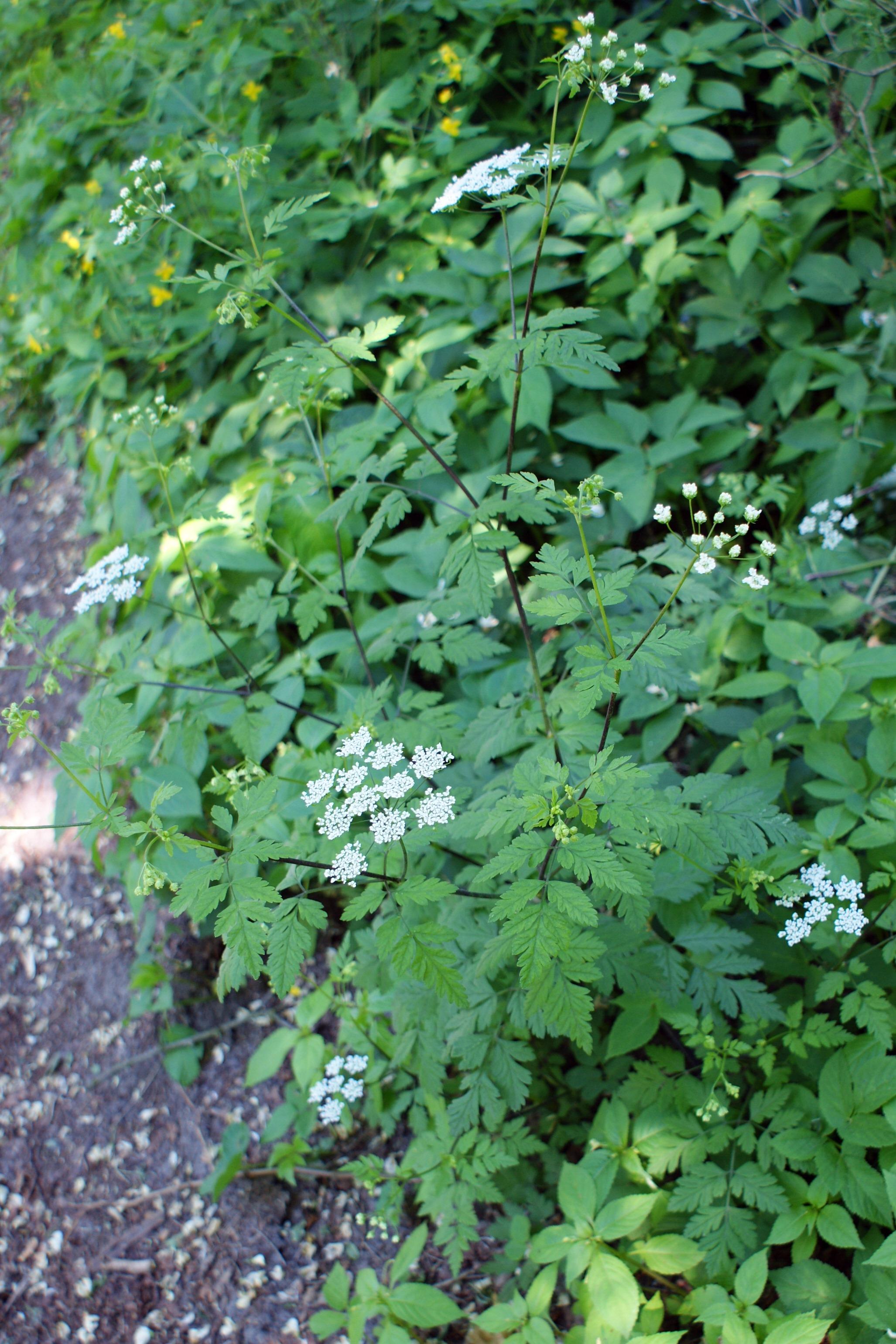
The rough chervil can grow almost 1.5 metres high.
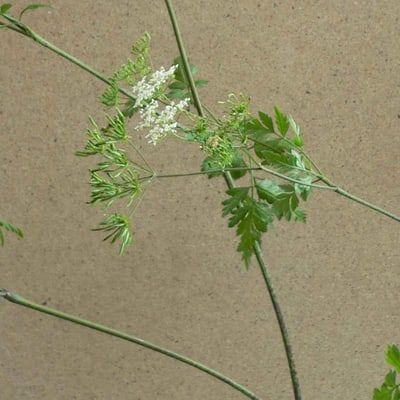
The leaves are rough-haired and bipinnate.
One plant has several stems. The stems are branched, round and have stiff bristly hairs. Towards the base they have dark red spots and club-shaped thickenings at the branches.
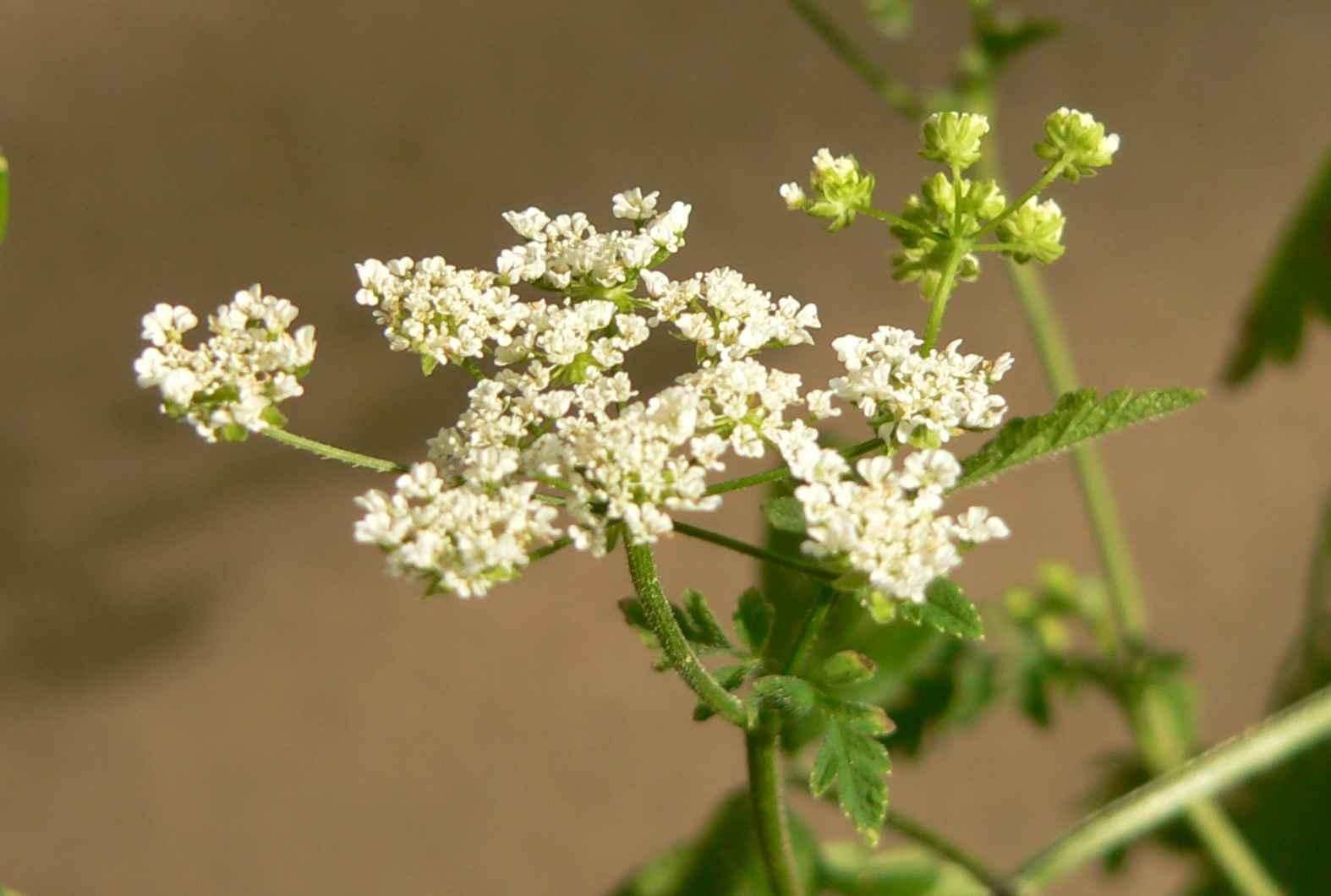
The flowers are small and have five white petals. They are grouped in six- to twelve-rayed inflorescences with several branches (compound umbels).
The fruits are narrow-elliptic to oblong.
Features
Rough chervil
Chaerophyllum temulum
Slightly toxic
spicy smell
rough-haired leaves and stems
In the city
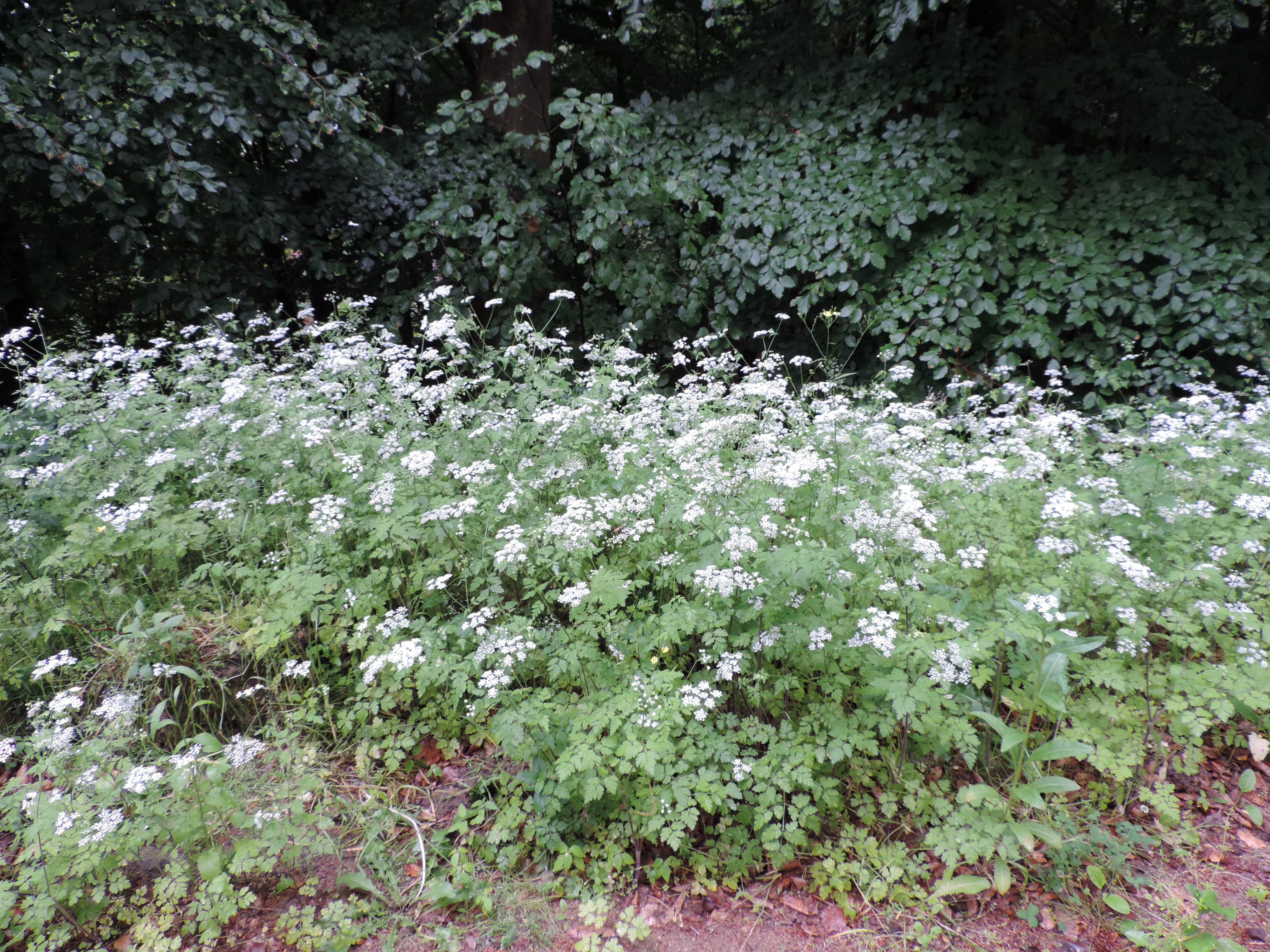
The rough chervil grows along forest edges and in meadows. It prefers nitrogen-rich, moist clay soils. However, it also occurs in drier terrain. It is a nitrogen indicator.
Fun Facts
Its smell is faintly spicy and reminiscent of carrots and caraway.
The fruits often remain on the plant in winter.
The flowering period is from May to July.
It is a biennial plant. This means the plant lives for two years, but flowers only once and dies after the seeds have ripened.
In passing, animals bump the dry, ripe stems. This causes the ripe fruits to be flung far away and spread out.
- Endangerment level Germany: not endangered
It has a low toxin content and is slightly poisonous to humans. Animals that eat the rough chervil suffer paralysis and begin to stagger.
Sources
Habitus, Krzysztof Ziarnek, Kenraiz, CC BY-SA 3.0, https://commons.wikimedia.org/wiki/File:Chaerophyllum_temulum_kz1.JPG

Blütenstand, Philipendula, CC BY-SA 3.0, https://commons.wikimedia.org/wiki/File:Chaerophyllum_temulum_blossom.jpg

Habitus, Krzysztof Ziarnek, Kenraiz, CC BY-SA 4.0, https://commons.wikimedia.org/wiki/File:Chaerophyllum_temulum_kz2.JPG

Page „Hecken-Kälberkropf“. : Wikipedia, The Free Encyclopedia. Date of last revision: 18.05.2018, 15:55 UTC. URL: https://de.wikipedia.org/w/index.php?title=Hecken-K%C3%A4lberkropf&oldid=177540435 (Accessed: 13.07.2018).
Seitz, B., Ristow, M., Meißner, J., Machatzi, B. & Sukopp, H. (2018) Rote Liste und Gesamtartenliste der etablierten Farn- und Blütenpflanzen von Berlin. : Der Landesbeauftragte für Naturschutz und Landschaftspflege / Senatsverwaltung für Umwelt, Klima und Verkehr (eds.) Rote Listen der gefährdeten Pflanzen, Pilze und Tiere von Berlin, URL: https://www.berlin.de/sen/uvk/natur-und-gruen/naturschutz/artenschutz/artenlisten-rote-listen/farn-und-bluetenpflanzen/ (Accessed: 26.03.2021).
Page „Kälberkröpfe“. : Wikipedia, The Free Encyclopedia. Date of last revision: 17.06.2018, 17:14 UTC. URL: https://de.wikipedia.org/w/index.php?title=K%C3%A4lberkr%C3%B6pfe&oldid=178398274 (Accessed: 13.07.2018).
Bundesamt für Naturschutz (n.d.) Artensteckbriefe, URL: http://floraweb.de/pflanzenarten/artenhome.xsql?suchnr=1494& (Accessed: 13.07.2018).