
Short Description
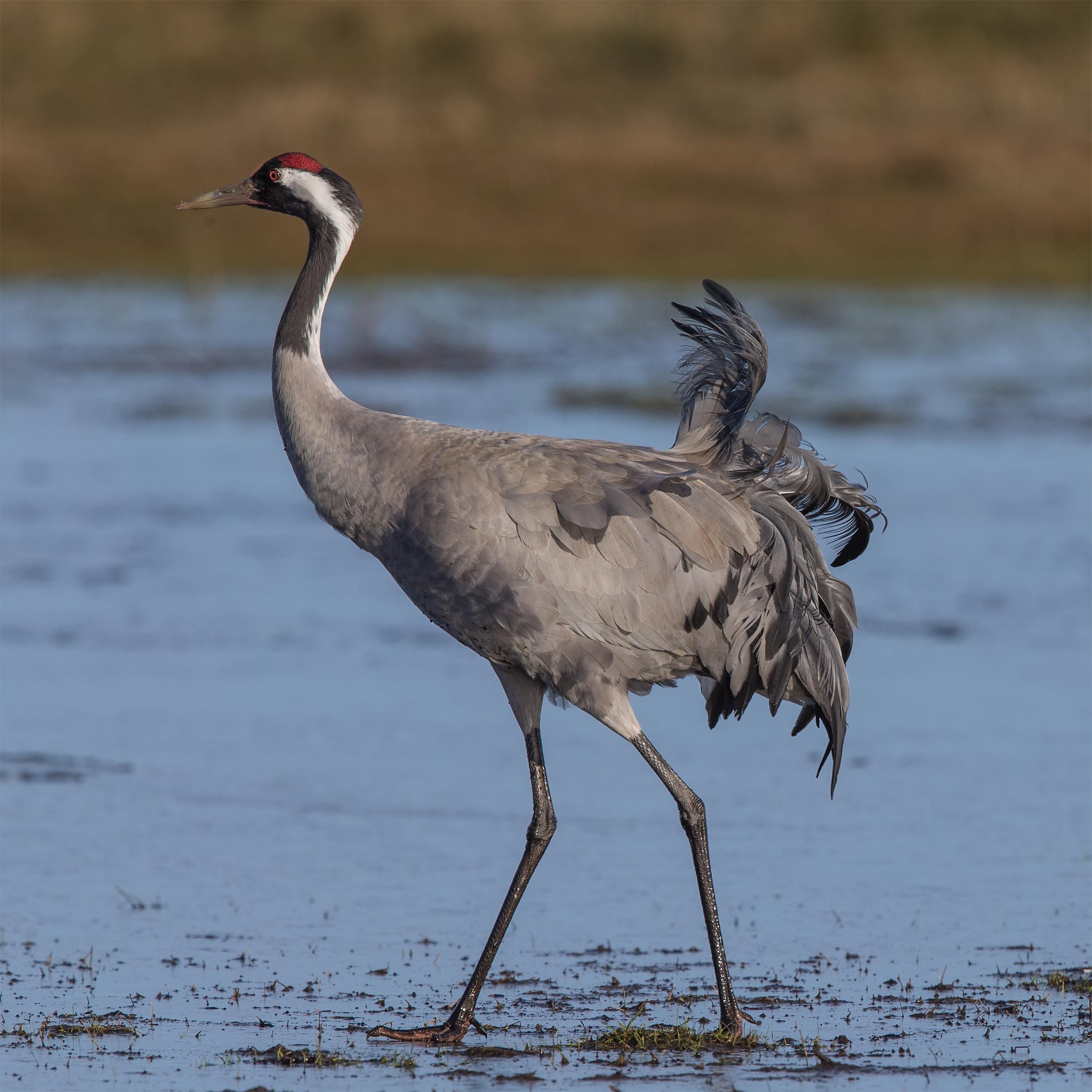
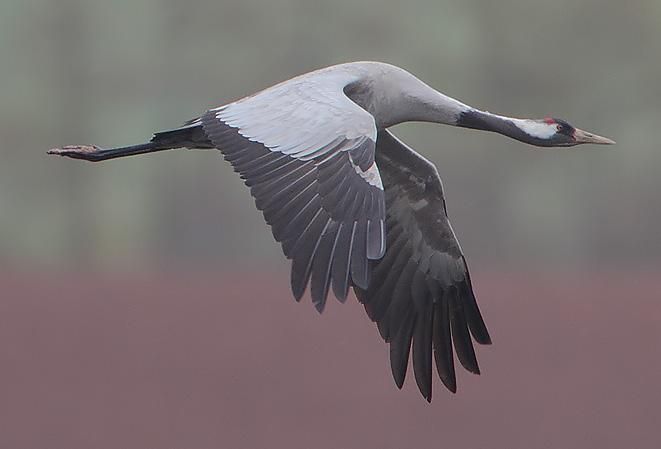
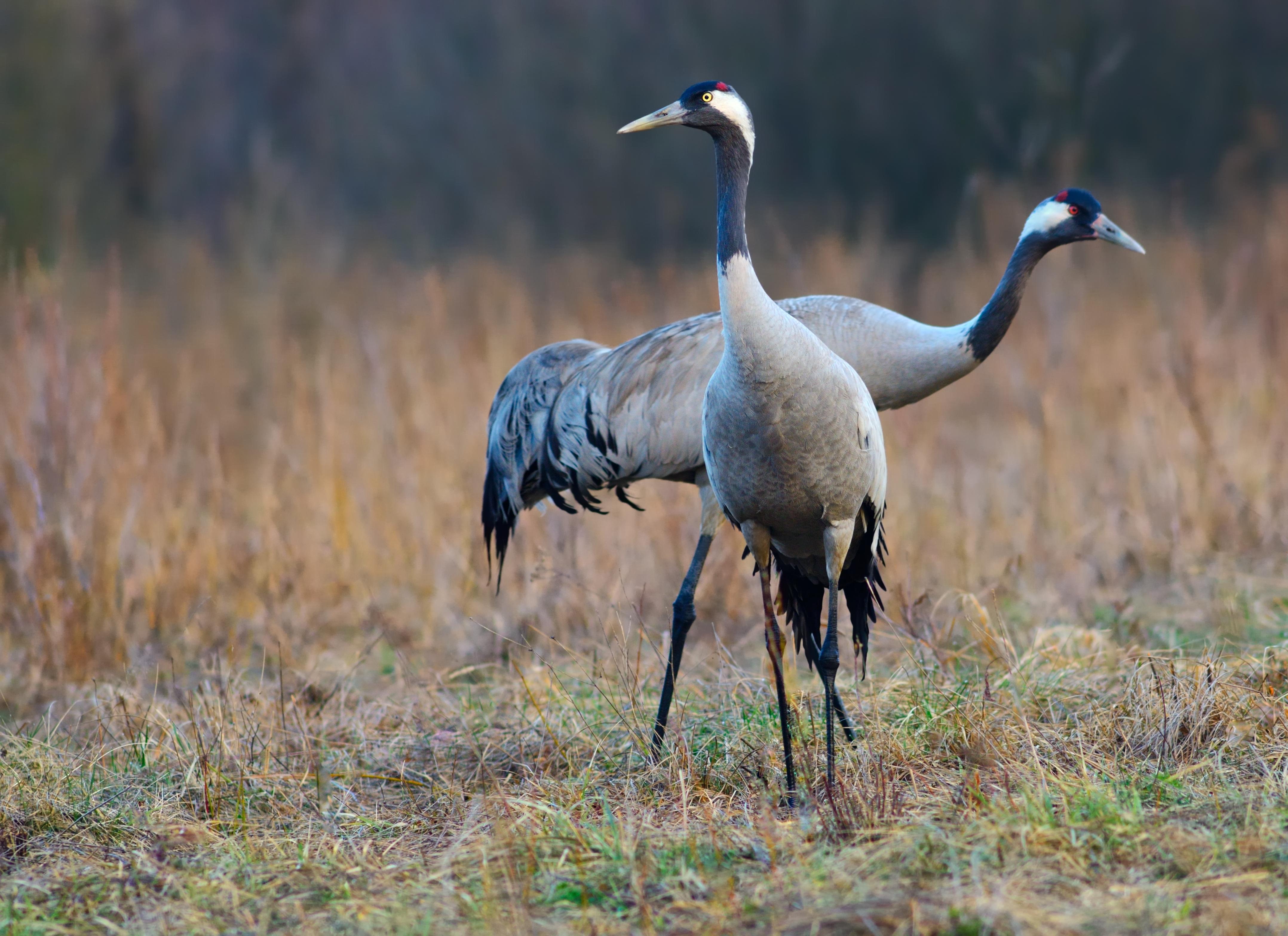
The common crane is very large with long legs and a long neck. Its body is light- to dark-grey, its head and neck are black and white with a bare red crown. Cranes fly in flocks in a “V” formation.

Features
Common crane
Grus grus
long legs and long neck
bare red crown
Duett eines Paares
Frommolt und Tauchert, CC BY-SA 3.0


In the city
The common crane is not a typical urban bird and tends to be found more often at the urban fringes. It can be seen in wet meadows and in marshlands and observed in its search for food in meadows and fields.
Cranes feel easily disturbed and should only be observed from some distance.
Fun Facts
In India, the crane is venerated as a god, in China it is seen as a symbol for wisdom and long life, and in Japan, it is regarded as a harbinger of good luck.
At weddings, it is becoming more popular in Germany, too, to give paper cranes as presents or to use them as decorations. This goes back to a Japanese legend, claiming that a wish will come true if you fold 1000 origami cranes.
Cranes are migratory birds that fly for hibernating to North Africa in mid-October. From the end of February to the beginning of March, they can once again be seen in Germany. In rare instances, common cranes also hibernate in Germany.
According to country lore, high-flying cranes are seen as forerunners of good weather.
- Endangerment level Germany: not endangered
For the ancient Egyptians, the crane was considered the "bird of the sun". It was a frequent offering to the gods, but also a popular food bird. In hieroglyphic writing, it stands for the letter "B".
Sources
Habitus, Andreas Trepte, CC BY-SA 2.5, https://commons.wikimedia.org/wiki/File:Common_crane_grus_grus.jpg

im Flug, Steve Garvie, CC BY-SA 2.0, https://commons.wikimedia.org/wiki/File:Flickr_-_Rainbirder_-_Eurasian_Crane_(Grus_grus)_(cropped).jpg
_(cropped).jpg)
Habitus, Олексій Карпенко, CC BY-SA 4.0, https://commons.wikimedia.org/wiki/File:%D0%96%D1%83%D1%80%D0%B0%D0%B2%D0%B5%D0%BB%D1%8C_%D1%81%D1%96%D1%80%D0%B8%D0%B9_(Grus_grus).jpg
.jpg)
Svensson, L. (2011) Der Kosmos Vogelführer - Alle Arten Europas, Nordafrikas und Vorderasiens, Stuttgart: Franckh Kosmos Verlag.
Bejcek, V. (1988) Zugvögel, Hanau/Main: Verlag Werner Dausien.
Witt, K. & Steiof, K. (2013) Rote Liste und Liste der Brutvögel von Berlin, 3. version, 15.11.2013. : Berliner Ornithologische Arbeitsgemeinschaft e.V. (eds.) Berliner Ornithologischer Bericht, volume 23, Berlin: Berliner Ornithologische Arbeitsgemeinschaft e.V., 1-23.
NABU – Naturschutzbund Deutschland e.V. (2016) Rote Liste der Brutvögel Deutschlands. 5. version, published August 2016, URL: https://www.nabu.de/tiere-und-pflanzen/voegel/artenschutz/rote-listen/10221.html (Accessed: 07.04.2017).
Page „Kranich“. : Wikipedia, The Free Encyclopedia. Date of last revision: 04.04.2016, 12:29 UTC. URL: https://de.wikipedia.org/w/index.php?title=Kranich&oldid=153158768 (Accessed: 19.04.2016).
NABU - Naturschutzbund Deutschland e.V. (n.d.) Hilfe für die Vögel des Glücks. Kranichschutz im NABU, URL: https://www.nabu.de/tiere-und-pflanzen/voegel/artenschutz/kranich/ (Accessed: 22.03.2021).
NABU - Naturschutzbund Deutschland e.V. (n.d.) Balzende und fliegende Kraniche. Infos zum Frühjahrszug der „Vögel des Glücks“, URL: https://www.nabu.de/tiere-und-pflanzen/voegel/artenschutz/kranich/01803.html (Accessed: 23.04.2025)