
Short Description
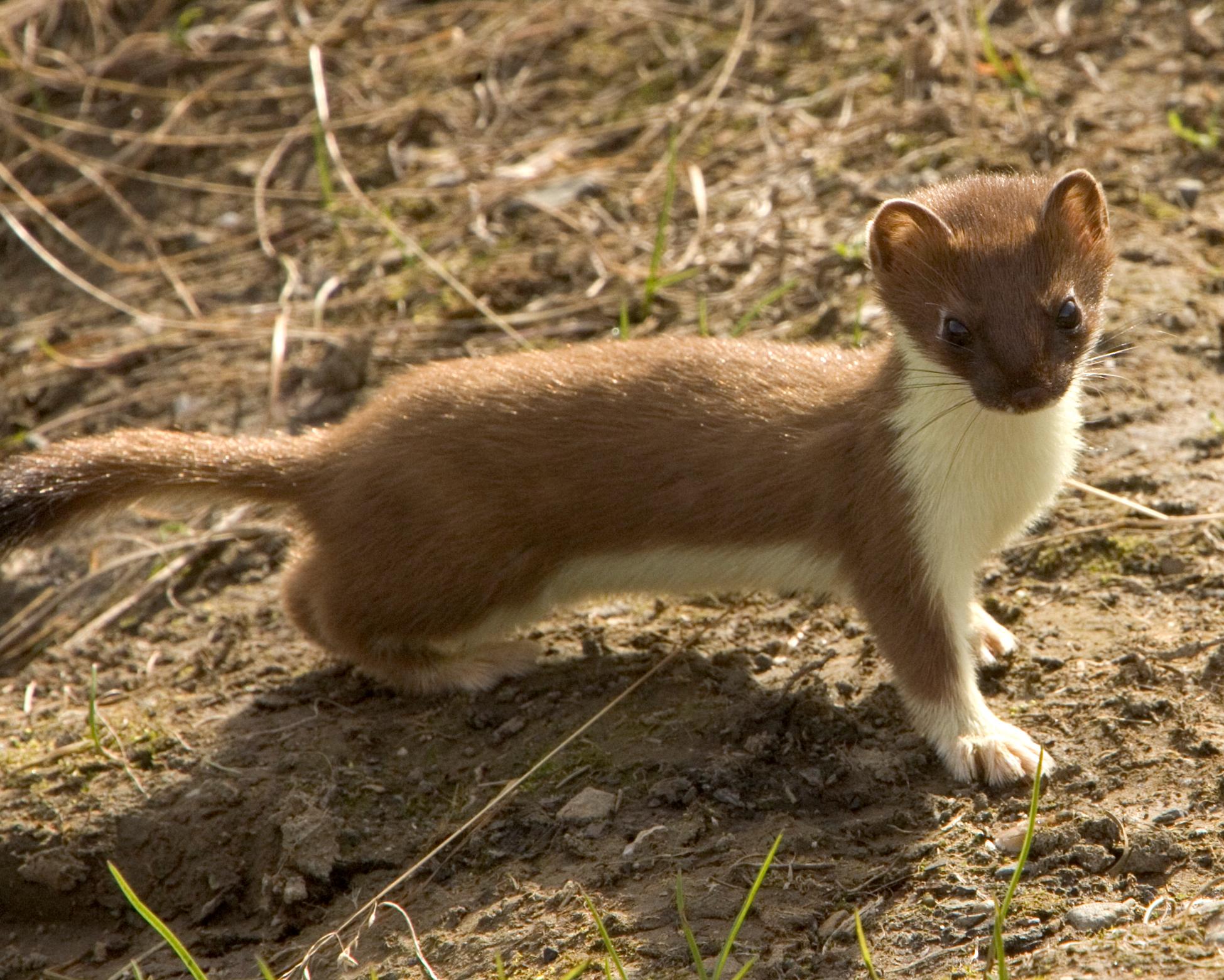
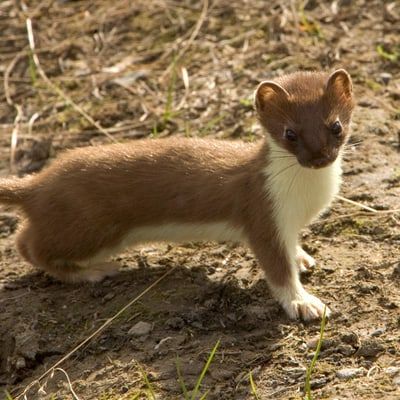
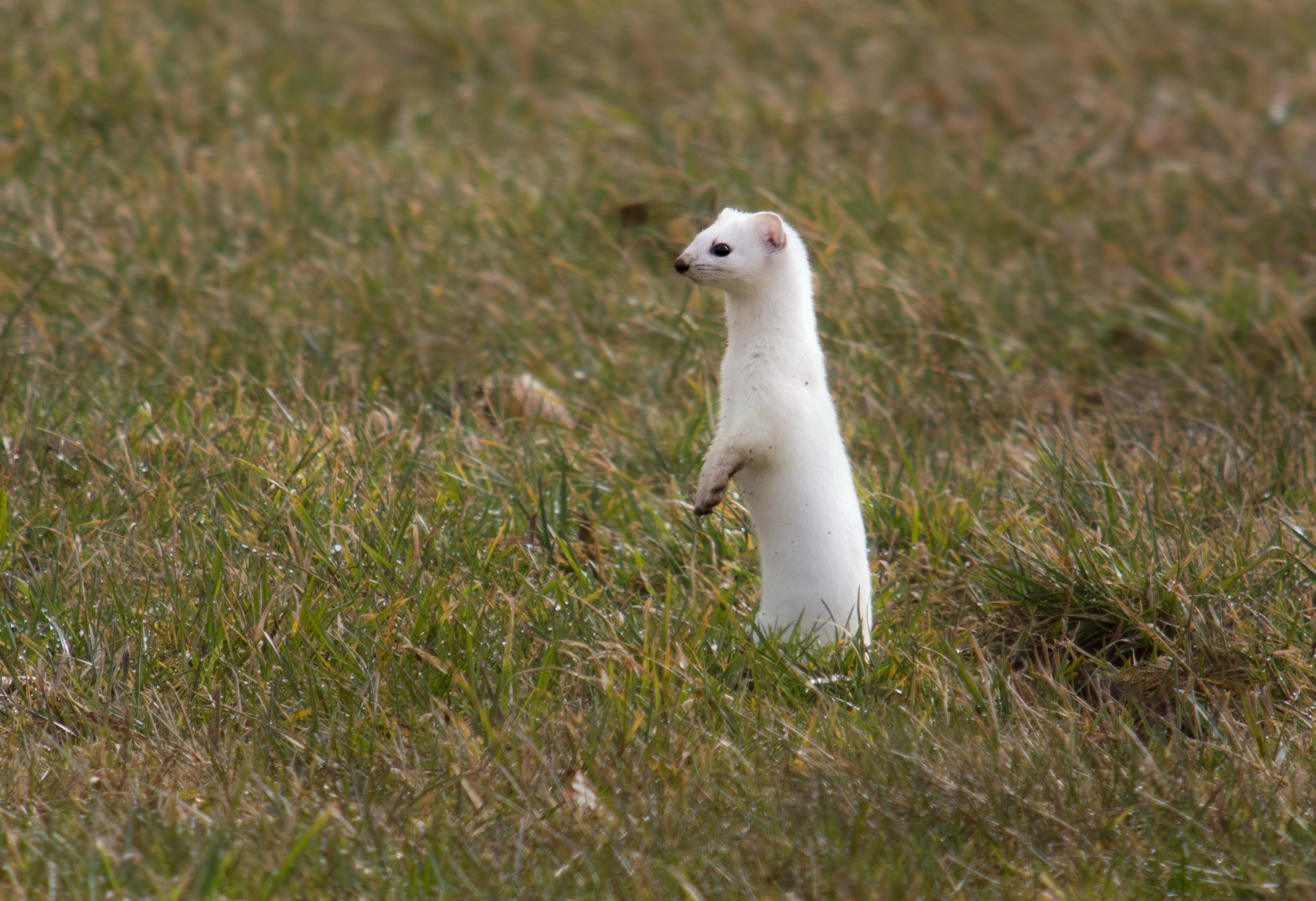
Stoats can be easily identified by their long slim bodies. Their winter fur is pure white. In summer, their upper parts are coloured brown. The black tip of their tails is obvious both in winter and in summer. Its trackways are longish with five toe pads and easy to see, depending on ground quality.
Features
Stoat
Mustela erminea
black-tipped tail
Similar species
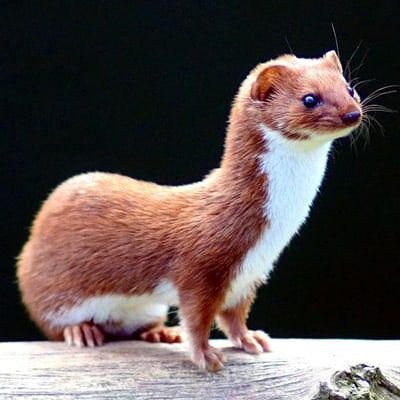
Weasel
Mustela nivalis

Beech marten
Martes foina
In the city
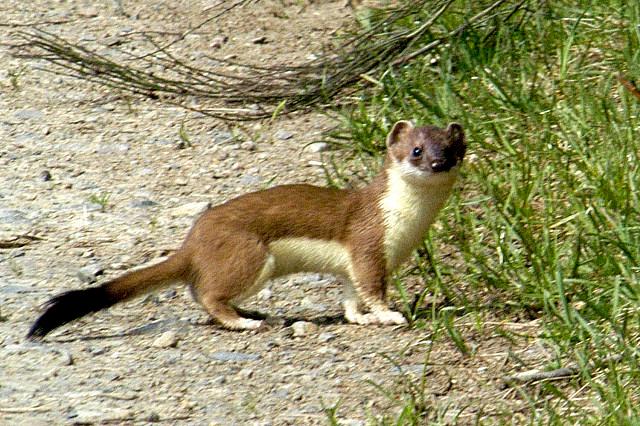
Stoats are often found close to human habitation. The availability of prey (mice, rats, rabbits) plays a crucial role in its distribution. In urban settings, stoats make use of the additional food supply resulting from human activity.
From the Middle Ages onwards, stoats were frequently kept on farms and as pets to hunt mice. Their pure white winter coat is very popular in the fur industry.
Fun Facts
Next to the weasel, stoats are the second smallest indigenous predatory animal.
toats can live to seven years. However, it has many predators and thus generally only survives for one or two years.
Its pure white winter coat known as ermine has been regarded a desirable royal adornment since Antiquity. It was supposed to symbolise the wearer’s chastity and purity.
It is a myth that stoats suck their prey’s blood.
Stoats are predominantly active at twilight (crepuscular). Their hiding places include gaps in trees or rocks, piles of stones or the abandoned nests of other animals.
- Endangerment level Germany: insufficient data available
Sources
Habitus , Steve Hillebrand, USFWS, public domain, https://commons.wikimedia.org/wiki/Mustela_erminea?uselang=de#/media/File:Mustela_erminea.jpg

Habitus , James Lindsey, CC BY-SA 3.0, http://popgen.unimaas.nl/~jlindsey/commanster.html
Habitus (saisonal), Frank Vassen, CC BY 2.0, https://commons.wikimedia.org/wiki/File:Hermelin_(Mustela_erminea),_Holzwarchetal_bei_M%C3%BCrringen,_Ostbelgien_(12937326844).jpg
,_Holzwarchetal_bei_M%C3%BCrringen,_Ostbelgien_(12937326844).jpg)
Reid, F., Helgen, K. & Kranz, A. (2016) Mustela erminea. The IUCN Red List of Threatened Species, URL: http://www.iucnredlist.org/details/29674/0 (Accessed: 29.12.2016).
NABU Landesverband Nordrhein-Westfalen (n.d.) Das Hermelin. Mustela erminea, URL: https://nrw.nabu.de/natur-und-landschaft/landnutzung/jagd/jagdbare-arten/beutegreifer/04939.html (Accessed: 29.12.2016).
Naturlexikon (n.d.) Hermelin, URL: http://www.natur-lexikon.com/Texte/MZ/001/00100-Hermelin/MZ00100-Hermelin.html (Accessed: 29.12.2016).
Böttcher, S. (2014) Hermelin – kleiner Räuber mit weißem Winterfell, URL: http://www.wildes-berlin.de/hermelin/ (Accessed: 29.12.2016).
Baake, K.-H. (n.d.) Marder, Frettchen, Iltis, Wiesel, URL: http://www.bio-gaertner.de/Nuetzling/Marder-Frettchen-Iltis-Wiesel (Accessed: 29.12.2016).
NABU Landesverband Berlin (n.d.) Wildtiere in der Stadt. Von tierischen Mitbewohnern in Berlin, URL: https://berlin.nabu.de/tiere-und-pflanzen/wildtiere-in-der-stadt/ (Accessed: 29.12.2016).
Grand-Duché de Luxembourg Région wallonne (2007) Spuren/Trittsiegel erkennen. Spurensucherschulung: Europa LIFE, URL: http://www.loutres.be/IMG/pdf/Spurensucherschulung.pdf (Accessed: 01.12.2016).
Haupt, H., Ludwig, G., Gruttke, H., Binot-Hafke, M., Otto C. & Pauly, A. (2009) Rote Liste gefährdeter Tiere, Pflanzen und Pilze Deutschlands. volume 1: Wirbeltiere, Bonn-Bad Godesberg: Bundesamt für Naturschutz.
Klawitter, J., Altenkamp, R., Kallasch, C., Köhler, D., Krauß, M., Rosenau, S. & Teige, T. (2005) Rote Liste und Gesamtartenliste der Säugetiere (Mammalia) von Berlin. : Der Landesbeauftragte für Naturschutz und Landschaftspflege / Senatsverwaltung für Stadtentwicklung (eds.) Rote Listen der gefährdeten Pflanzen und Tiere von Berlin, URL: https://www.berlin.de/sen/uvk/natur-und-gruen/naturschutz/artenschutz/artenlisten-rote-listen/saeugetiere/ (Accessed: 30.03.2021).