
Short Description
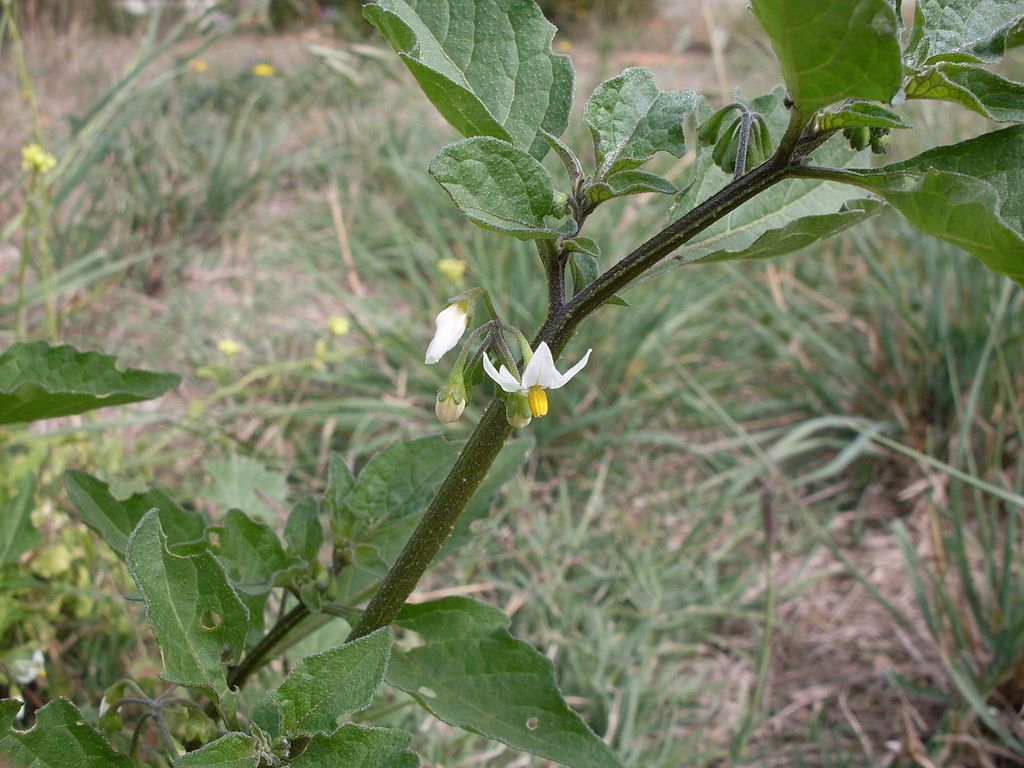
The black nightshade can grow over half a metre high.
The leaves are oval or triangular. They have leaf stalks. The leaf margin is usually crenate.
The stem can grow lying down or upright.
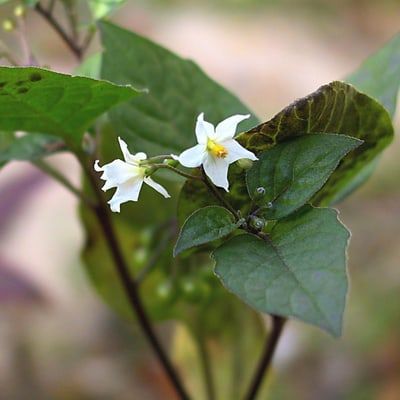
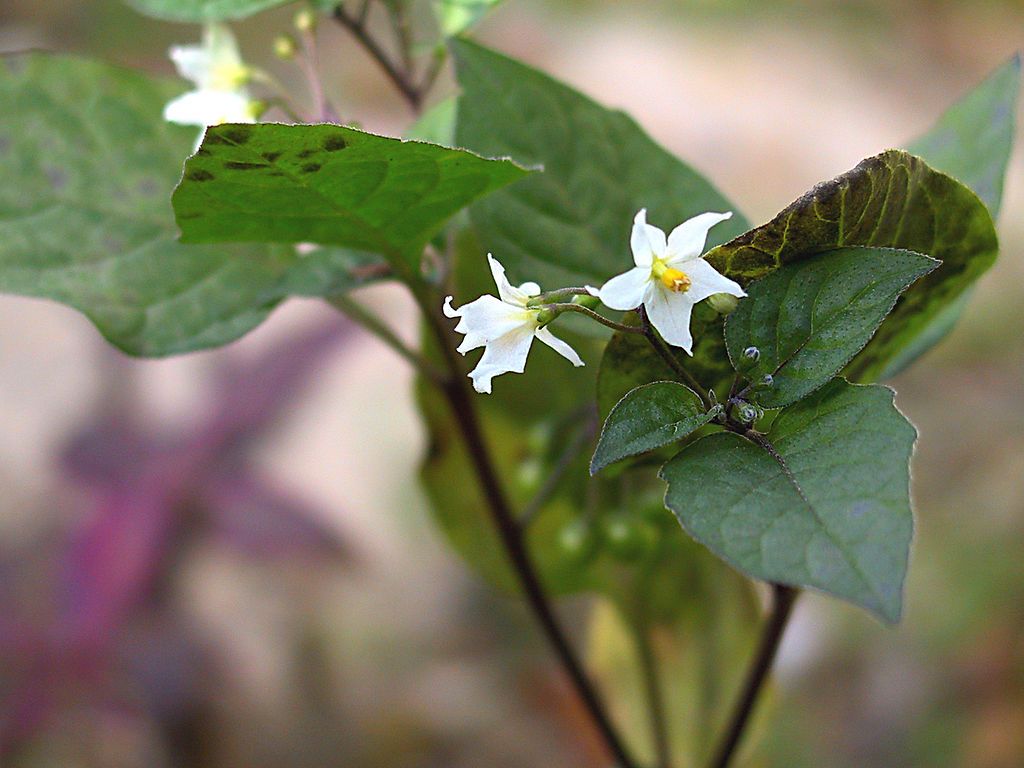
The flowers have five white petals that are fused together up to halfway. The yellow stamens are clearly visible.
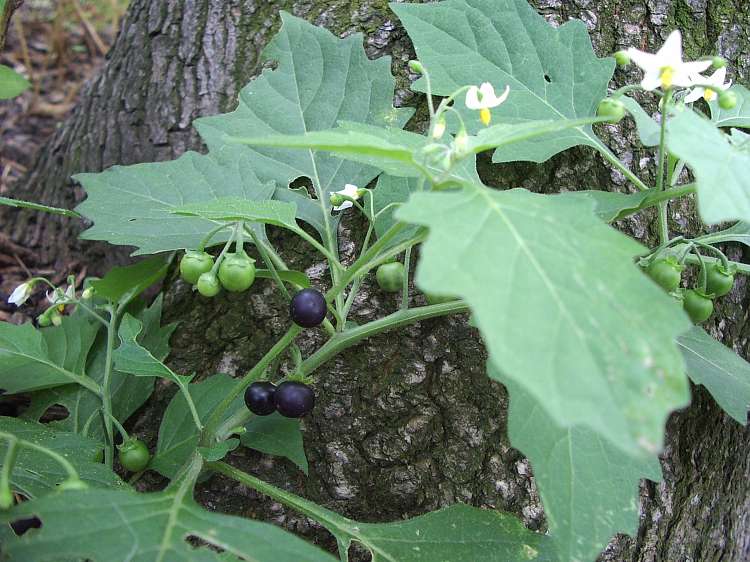
The plant develops black berries. In rare cases they can also be greenish-yellow.
Features
Black nightshade
Solanum nigrum
poisonous
clearly visible, yellow stamens
In the city
It grows on rubble, fields and in gardens. It is widespread and well adapted to different environmental conditions. However, it cannot survive long periods of drought.
Fun Facts
The flowering period is from June to October.
Chickens can die after eating its poisonous, unripe berries.
It is an annual plant. This means the plant dies in the first year after the seeds have ripened.
- Endangerment level Germany: not endangered
It is often categorised as a poisonous plant. However, the concentration of its toxins probably depends on the age of the plant and the climate and soil type in which it grows. This explains why it is sometimes considered a poisonous plant, but also a food.
Sources
Habitus, John Tann, CC BY 2.0, https://de.wikipedia.org/wiki/Schwarzer_Nachtschatten#/media/Datei:Black_nightshade_flower_(3438091564).jpg
.jpg)
Früchte, Harald Hubich , CC BY-SA 3.0, https://de.wikipedia.org/wiki/Schwarzer_Nachtschatten#/media/Datei:Solanum_nigrum_leafs_flowers_fruits.jpg

Blüten, Juni aus Kyoto, CC BY 2.0, https://de.wikipedia.org/wiki/Schwarzer_Nachtschatten#/media/Datei:Solanum_nigrum.jpg

Schauer, T., Caspari, C. & Caspari, S. (2015) Der illustrierte BLV-Pflanzenführer für unterwegs. 1150 Blumen, Gräser, Bäume und Sträucher, München: BLV.
Seitz, B., Ristow, M., Meißner, J., Machatzi, B. & Sukopp, H. (2018) Rote Liste und Gesamtartenliste der etablierten Farn- und Blütenpflanzen von Berlin. : Der Landesbeauftragte für Naturschutz und Landschaftspflege / Senatsverwaltung für Umwelt, Klima und Verkehr (eds.) Rote Listen der gefährdeten Pflanzen, Pilze und Tiere von Berlin, URL: https://www.berlin.de/sen/uvk/natur-und-gruen/naturschutz/artenschutz/artenlisten-rote-listen/farn-und-bluetenpflanzen/ (Accessed: 26.03.2021).
Schauer, T., Caspari, C. & Caspari, S. (2015) Der illustrierte BLV-Pflanzenführer für unterwegs. 1150 Blumen, Gräser, Bäume und Sträucher, München: BLV.
Bundesamt für Naturschutz (n.d.) Artensteckbriefe, URL: http://floraweb.de/pflanzenarten/artenhome.xsql?suchnr=5665& (Accessed: 04.09.2018).
Page „Schwarzer Nachtschatten“. : Wikipedia, The Free Encyclopedia. Date of last revision: 13.08.2018, 14:35 UTC. URL: https://de.wikipedia.org/w/index.php?title=Schwarzer_Nachtschatten&oldid=179979582 (Accessed: 04.09.2018).
Netzwerk Phytodiversität Deutschlands (NetPhyD) e.V. (n.d.) Deutschland Flora. Floristische Kartierung Deutschlands, URL: https://karten.deutschlandflora.de/map.phtml?config=taxnr5665&PHPSESSID=14sdtgmreditr35p36lhluip67&resetsession=allGroups (Accessed: 04.09.2018).