
Short Description
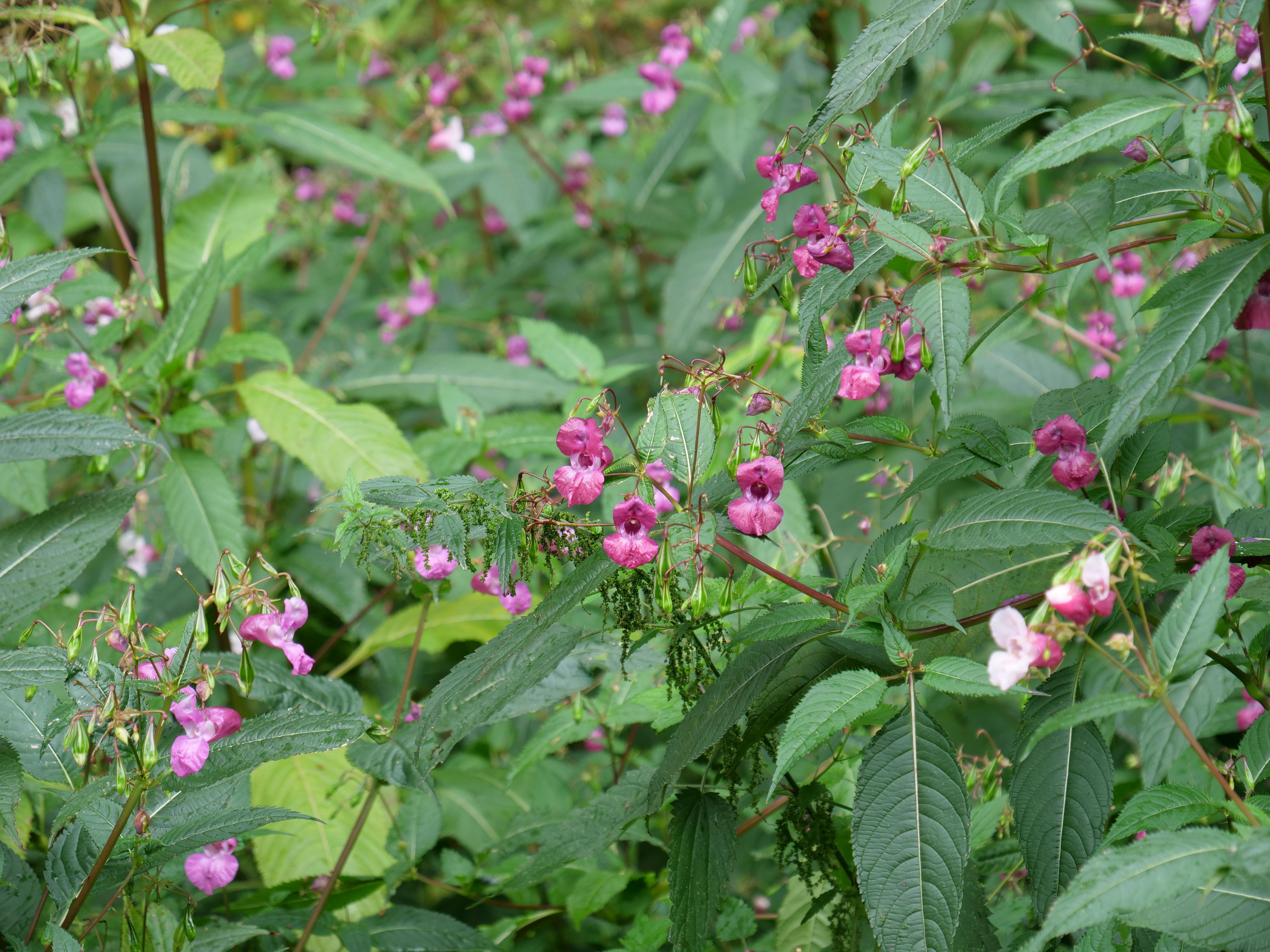
Himalayan balsam can grow up to a height of two metres in a very short time.
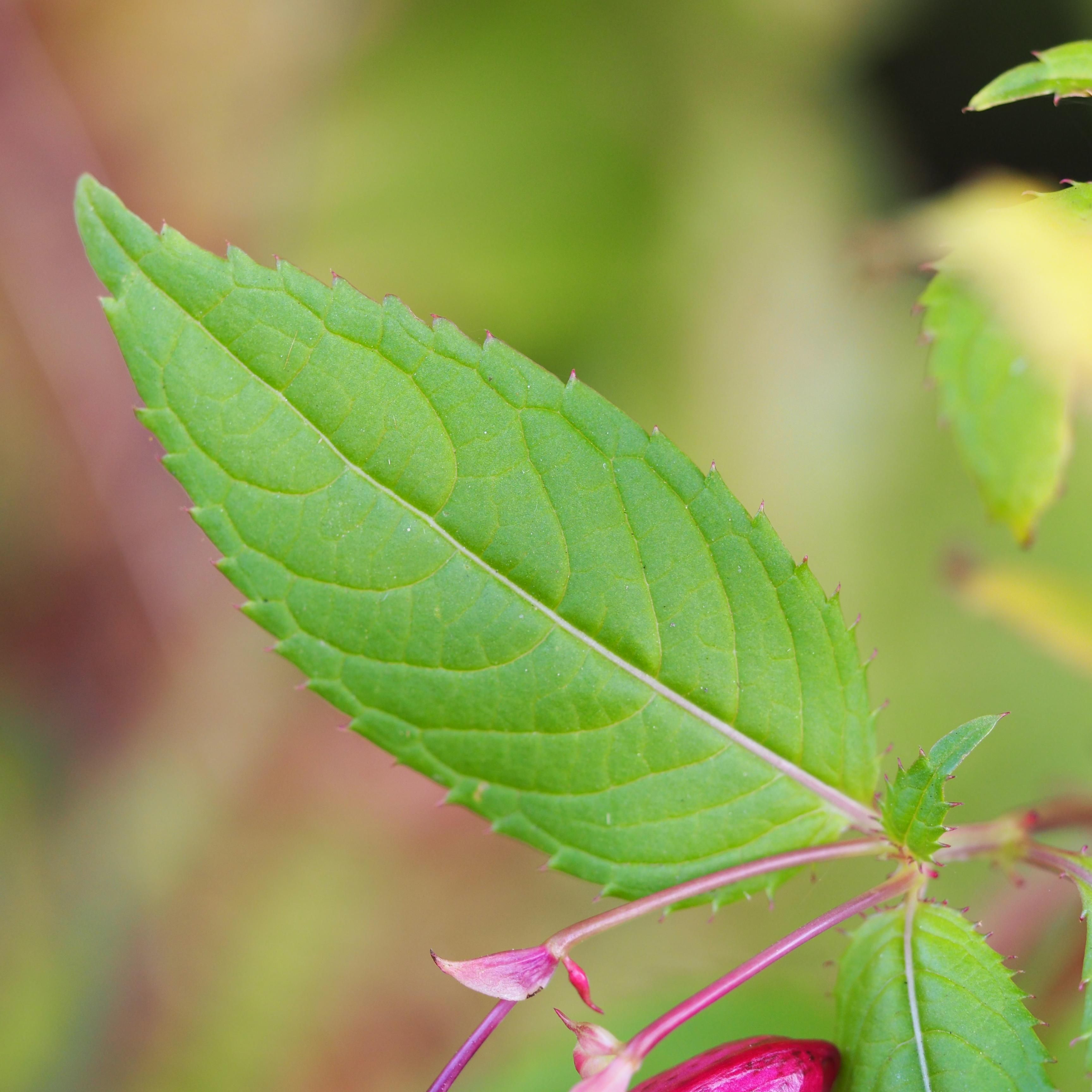
The leaves are arranged in opposite pairs on the stem or three leaves radially at the node (ternate). They are oval, elongated (ovo-lanceolate) and sharply serrated with reddish glands at the base.
The stem is reddish and glassy translucent. It is thickened at the nodes.
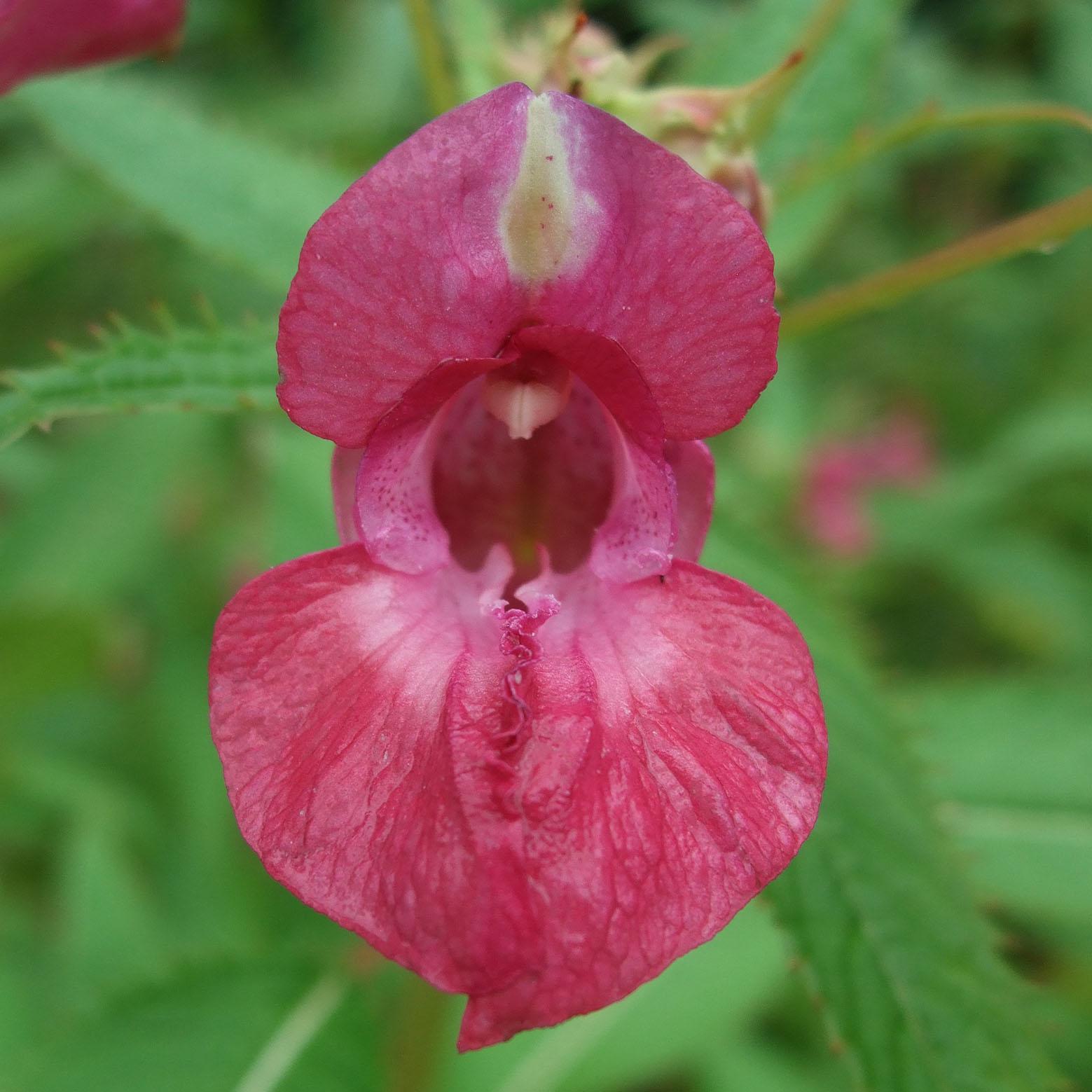
The colour of the flowers can range from crimson to white. They are helmet-shaped and mirror-symmetric (zygomorphic). They have a flower funnel (figworts) and a small green spur.
The fruits are oblong capsules that burst open when the fruit is ripe and eject the seeds (dehiscent).
Features
Himalayan balsam
Impatiens glandulifera
large crimson to white flowers
very glandular leaves
In the city
In an urban environment, Himalayan balsam is often found near water or in damp forests. It is used in gardens as an ornamental plant. It prefers damp to wet nutrient-rich sites with sandy or loamy soils.
Fun Facts
Himalayan balsam became established in Europe in a very short while and is now combatted in many places as an invasive neophyte (non-indigenous species). However, scientists disagree as to whether it actually constitutes a hazard to native plants.
Himalayan balsam has an unpleasantly smelling gland at the base of its leaves.
Its flowers have a pleasant scent and are rich in nectar. They are a good source of food for insects, particularly bees.
It flowers from June to October.
The scientific genus name “impatiens" (i.e. impatient, sensitive) refers to the fruit of the plant that burst open at the slightest touch.
It is an annual plant, i.e. it flowers for only one summer and dies after the seeds have ripened.
- Endangerment level Germany: not evaluated
- Usage:
In Asia, the plant is used to dye skin and nails.
Himalayan balsam originates from Eastern Asia. It was brought to Europe as an ornamental plant in the 19th century and has since gone wild.
The seeds can be used as seasoning and are said to have a pleasantly nutty taste.
Sources
Habitus, Leonhard Lenz, CC0 1.0, https://commons.wikimedia.org/wiki/File:Impatiens_glandulifera_near_Rurberg_01.jpg

Blatt, Alice Kracht, CC BY-SA 4.0, https://offene-naturfuehrer.de/web/Datei:Impatiens_glandulifera_(1).JPG
.JPG)
Blüte, Alice Kracht, CC BY-SA 4.0, https://offene-naturfuehrer.de/web/Datei:Impatiens_glandulifera_(39).jpg
.jpg)
Spohn, M., Golte-Bechtle, M. & Spohn, R. (2015) Was blüht denn da? Stuttgart: Franckh Kosmos Verlag.
Fleischhauer, S. G., Guthmann, J. & Spiegelberger, R. (2007) Essbare Wildpflanzen. 200 Arten bestimmen und verwenden, Baden und München: AT Verlag.
Schauer, T., Caspari, C. & Caspari, S. (2015) Der illustrierte BLV-Pflanzenführer für unterwegs. 1150 Blumen, Gräser, Bäume und Sträucher, München: BLV.
Scherf, G. (2006) Wildpflanzen neu entdecken, München: BLV.
Page „Drüsiges Springkraut“. : Wikipedia, The Free Encyclopedia. Date of last revision: 26.09.2016, 22:08 UTC. URL: https://de.wikipedia.org/w/index.php?title=Dr%C3%BCsiges_Springkraut&oldid=158251636 (Accessed: 28.09.2016).