
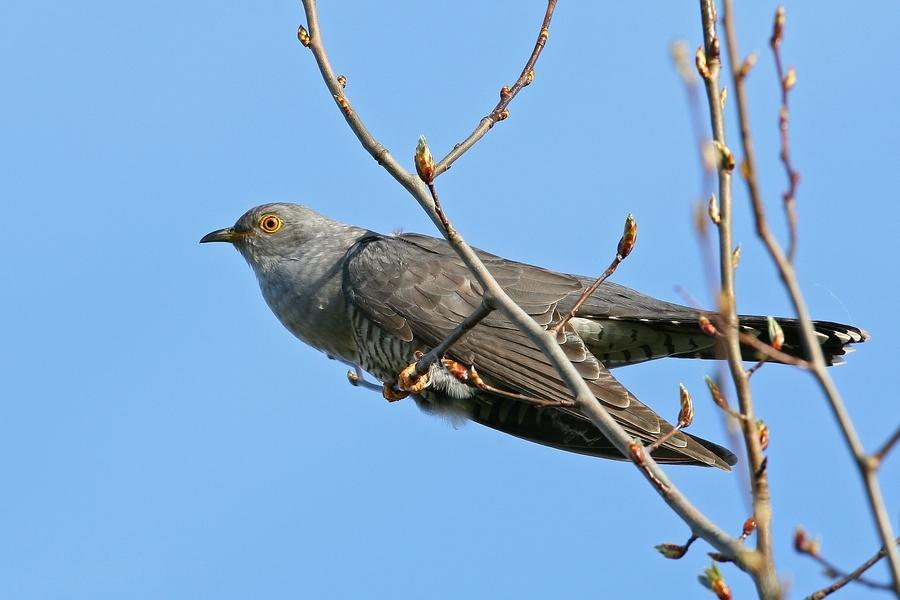
Short Description
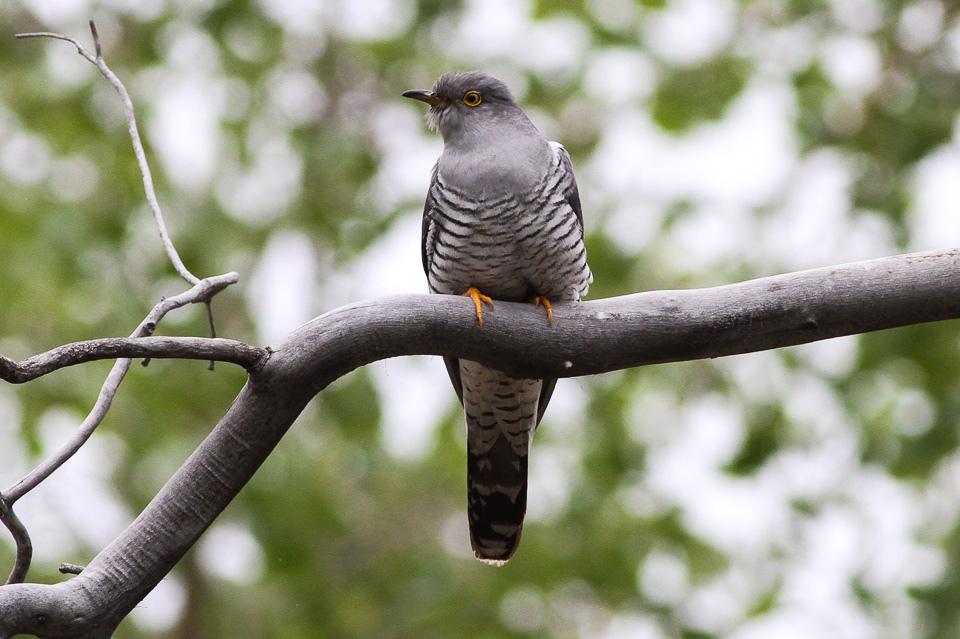
The cuckoo’s plumage is mainly grey in a variety of shades. Head and chest are light-grey, the underparts are pale with dark transverse stripes. The legs are a strong orange.
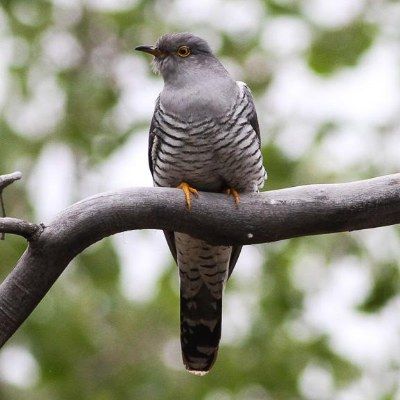
Features
Common cuckoo
Cuculus canorus
light-yellow eyes
Rufreihen
Tembrock, CC BY-SA 3.0

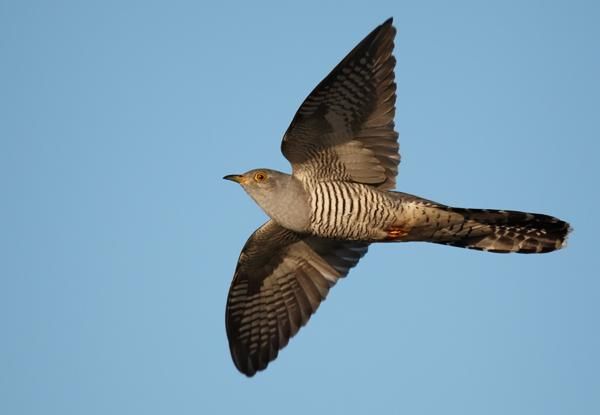
In the city
Cuckoos live in a variety of habitats including towns. Their only prerequisite is the availability of suitable host birds into whose nests they lay their eggs.
Fun Facts
Cuckoos do not look after their own young. Instead, it lays its eggs singly into the nest of smaller song birds such as for example the great reed warbler.
Its characteristic call that gave the bird its name (“cook - koo”) has found its way into numerous songs and poems and is used in German cuckoo clocks.
From April to June, cuckoos start to sing approx. 50 minutes before sunrise.
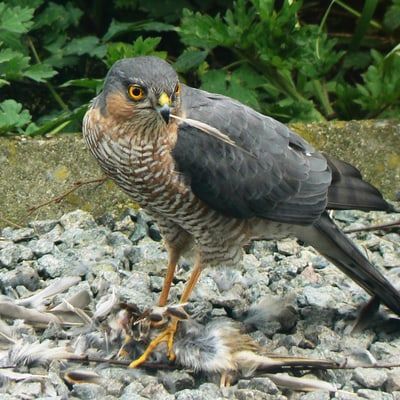
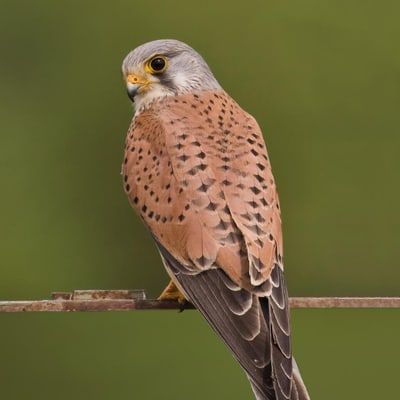
In appearance, cuckoos are similar to sparrowhawks and kestrels. In that way, it fools its host birds into thinking that a bird of prey is approaching, thus driving them from their nest.
Cuckoos are migratory birds. They can be observed in Germany from April to early August. They spend their winters south of the equator.
In many languages its name is imitating the call: French (Coucou), Italian (cucú), Russian (Kukuschka), Greek (koukoula), English (Cuckoo), Polish (Kukułka) and Latin (cuculus).
- Endangerment level Germany: Warning list
In Greek mythology, the cuckoo is associated with the goddess Hera
Sources
Habitus , Tim Peukert, CC BY-SA 3.0, https://commons.wikimedia.org/wiki/File:Kuckuck_%28Cuculus_canorus%29_by_Tim_Peukert.jpg
_by_Tim_Peukert.jpg)
im Flug, Chris Romeiks/vogelart.info, GNU, https://commons.wikimedia.org/wiki/File:Cuculus_canorus_vogelartinfo.jpg

Habitus , Ron Knight, CC-BY SA 2.0, https://commons.wikimedia.org/wiki/File:Common_Cuckoo_(Cuculus_canorus)_(8079424957).jpg
_(8079424957).jpg)
Bejcek, V. (1988) Zugvögel, Hanau/Main: Verlag Werner Dausien.
Witt, K. & Steiof, K. (2013) Rote Liste und Liste der Brutvögel von Berlin, 3. version, 15.11.2013. : Berliner Ornithologische Arbeitsgemeinschaft e.V. (eds.) Berliner Ornithologischer Bericht, volume 23, Berlin: Berliner Ornithologische Arbeitsgemeinschaft e.V., 1-23.
Page „Kuckuck“. : Wikipedia, The Free Encyclopedia. Date of last revision: 28.01.2016, 16:59 UTC. URL: https://de.wikipedia.org/w/index.php?title=Kuckuck&oldid=150788669 (Accessed: 12.02.2016).
NABU – Naturschutzbund Deutschland e.V. (2016) Vogeluhr, URL: https://www.nabu.de/nabu_vogeluhr2/index.php?iframed=1 (Accessed: 10.02.2021).
NABU – Naturschutzbund Deutschland e.V. (n.d.) Meist nur im Flug zu sehen. Der Kuckuck im Steckbrief, URL: https://www.nabu.de/tiere-und-pflanzen/aktionen-und-projekte/vogel-des-jahres/2008-kuckuck/07193.html (Accessed: 22.03.2021).