
Short Description
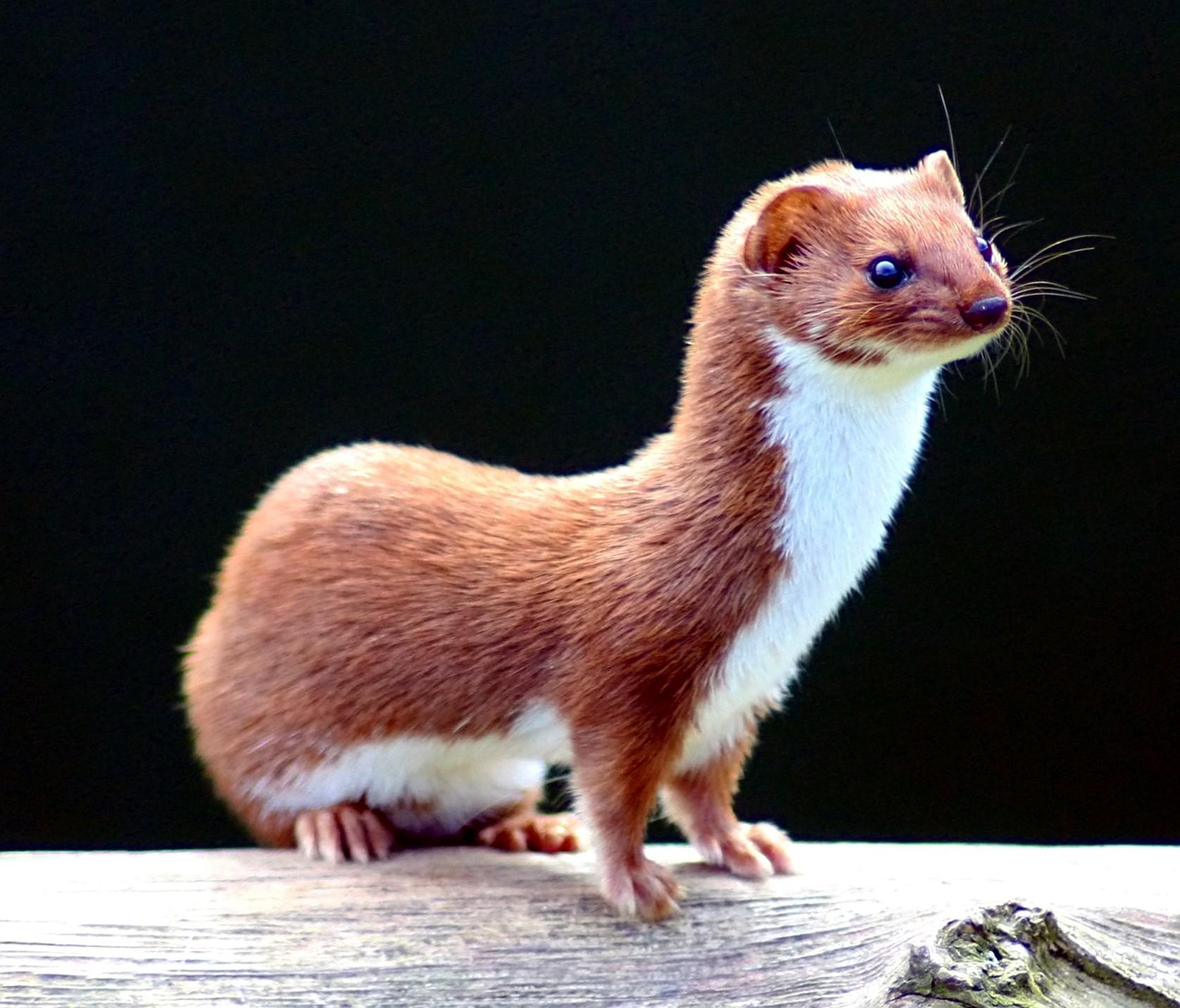
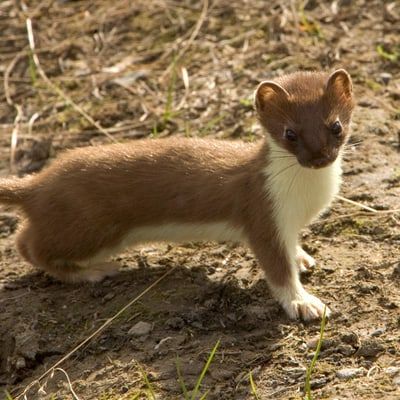
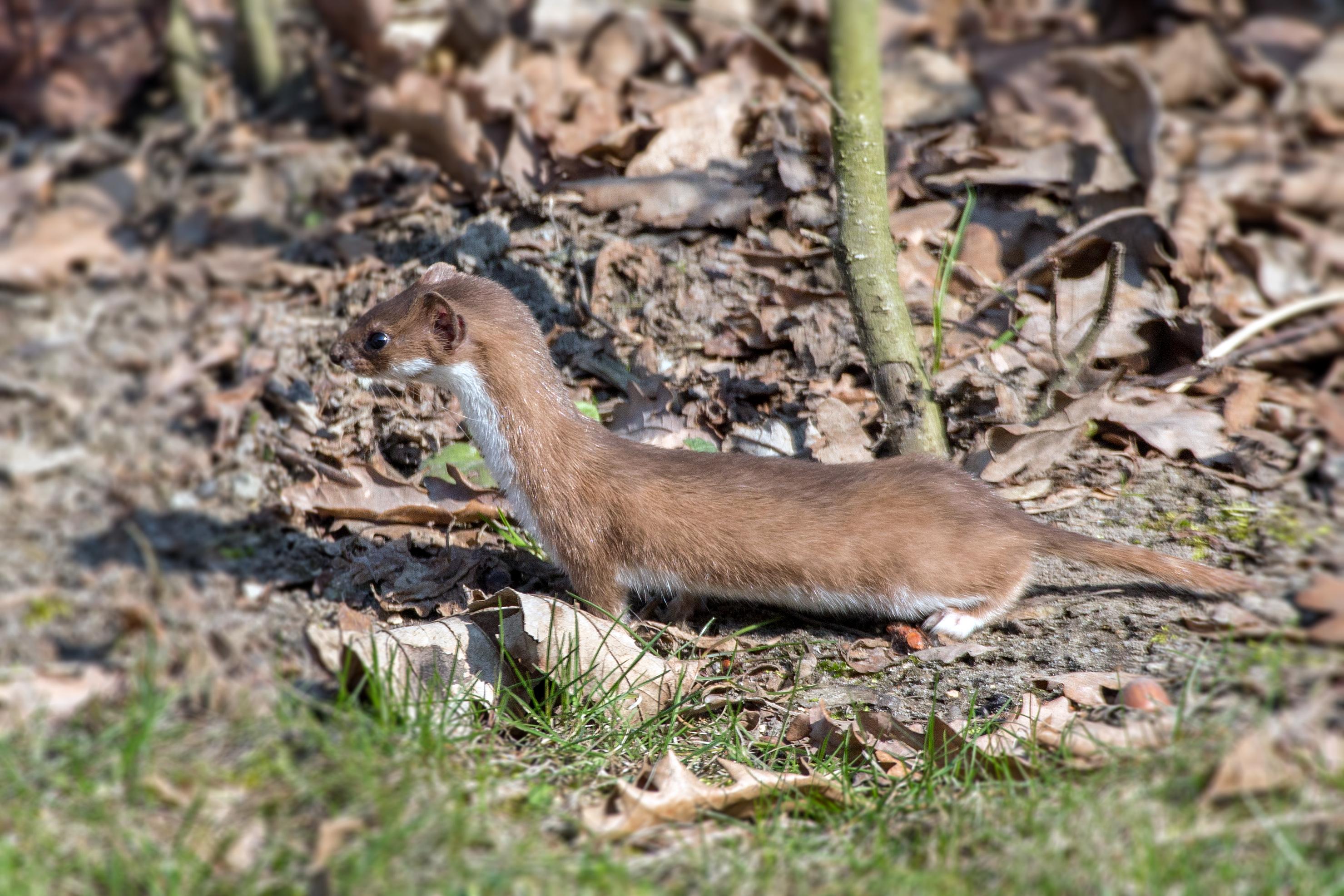
The weasel is small and thin with short legs. Its upper parts are red-brown, the underparts white. Its short legs and tail are brown. Its tracks show an oblong main pad. The five toe pads can generally be clearly seen.
Females are markedly thinner and lighter than males.

Features
Weasel
Mustela nivalis
marten-like, brown tail without black tip

In the city
Weasels mainly live in orchards, meadows and forest margins that offer sufficient cover. They find protective cover in holes in the ground or in trees as well as in piles of stones.
Weasels were formerly used early on to combat vermin in the house and farmyard. Compared to other weasel species, weasels are less commonly hunted or bred for their fur.
Fun Facts
Its main food are various small mammals, particularly mice. Because of their small bodies, they can enter into mouse burrows without problems.
In Germany, the subspecies Mustela nivalis vulgaris is the most common. Its distinctive feature is an uneven dividing line between the fur on the back and on the belly. Furthermore, it does not change between summer and winter coats.
Weasels often kill more prey than they can eat. Left-overs are turned into a food store.
- Endangerment level Germany: insufficient data available
In former times, the weasel was considered to bring bad luck. It was also associated with witchcraft.
Sources
Habitus , Keven Law, CC BY-SA 2.0, https://commons.wikimedia.org/wiki/File:Mustela_nivalis_-British_Wildlife_Centre-4.jpg

Habitus , Jerzy Strzelecki, CC BY 3.0, https://commons.wikimedia.org/wiki/File:Least_Weasel(js)02.jpg
02.jpg)
Habitus , Juan lacruz, CC-BY-SA 4.0, https://commons.wikimedia.org/wiki/File:Mustela_1.jpg

McDonald, R.A., Abramov, A.V., Stubbe, M., Herrero, J., Maran, T., Tikhonov, A., Cavallini, P., Kranz, A., Giannatos, G., Kryštufek, B. & Reid, F. (2016) Mustela nivalis. The IUCN Red List of Threatened Species, URL: http://www.iucnredlist.org/details/70207409/0 (Accessed: 29.12.2016).
Ludwig, B. (n.d.) Mauswiesel (Mustela nivalis Linné, 1758), URL: http://marder-info.eu/heimische-arten/mauswiesel/ (Accessed: 29.12.2016).
Baake, K.-H. (n.d.) Marder, Frettchen, Iltis, Wiesel, URL: http://www.bio-gaertner.de/Nuetzling/Marder-Frettchen-Iltis-Wiesel (Accessed: 29.12.2016).
Deutscher Jagdverband e. V. (n.d.) Mauswiesel (Mustela nivalis), URL: https://www.jagdverband.de/content/mauswiesel-mustela-nivalis (Accessed: 29.12.2016).
Prader, W. (n.d.) Hermelin, URL: http://www.jagd.it/niederwild/hermelin/index.htm (Accessed: 29.12.2016).
Bayerisches Staatsministerium für Ernährung, Landwirtschaft und Forsten (n.d.) Mauswiesel, URL: http://www.wildtierportal.bayern.de/wildtiere_bayern/101647/index.php (Accessed: 29.12.2016).
Grand-Duché de Luxembourg Région wallonne (2007) Spuren/Trittsiegel erkennen. Spurensucherschulung: Europa LIFE, URL: http://www.loutres.be/IMG/pdf/Spurensucherschulung.pdf (Accessed: 01.12.2016).
Haupt, H., Ludwig, G., Gruttke, H., Binot-Hafke, M., Otto C. & Pauly, A. (2009) Rote Liste gefährdeter Tiere, Pflanzen und Pilze Deutschlands. volume 1: Wirbeltiere, Bonn-Bad Godesberg: Bundesamt für Naturschutz.
Klawitter, J., Altenkamp, R., Kallasch, C., Köhler, D., Krauß, M., Rosenau, S. & Teige, T. (2005) Rote Liste und Gesamtartenliste der Säugetiere (Mammalia) von Berlin. : Der Landesbeauftragte für Naturschutz und Landschaftspflege / Senatsverwaltung für Stadtentwicklung (eds.) Rote Listen der gefährdeten Pflanzen und Tiere von Berlin, URL: https://www.berlin.de/sen/uvk/natur-und-gruen/naturschutz/artenschutz/artenlisten-rote-listen/saeugetiere/ (Accessed: 30.03.2021).