
Short Description
The sweet chestnut is an up to 35 m tall deciduous tree with a broad and expansive crown.
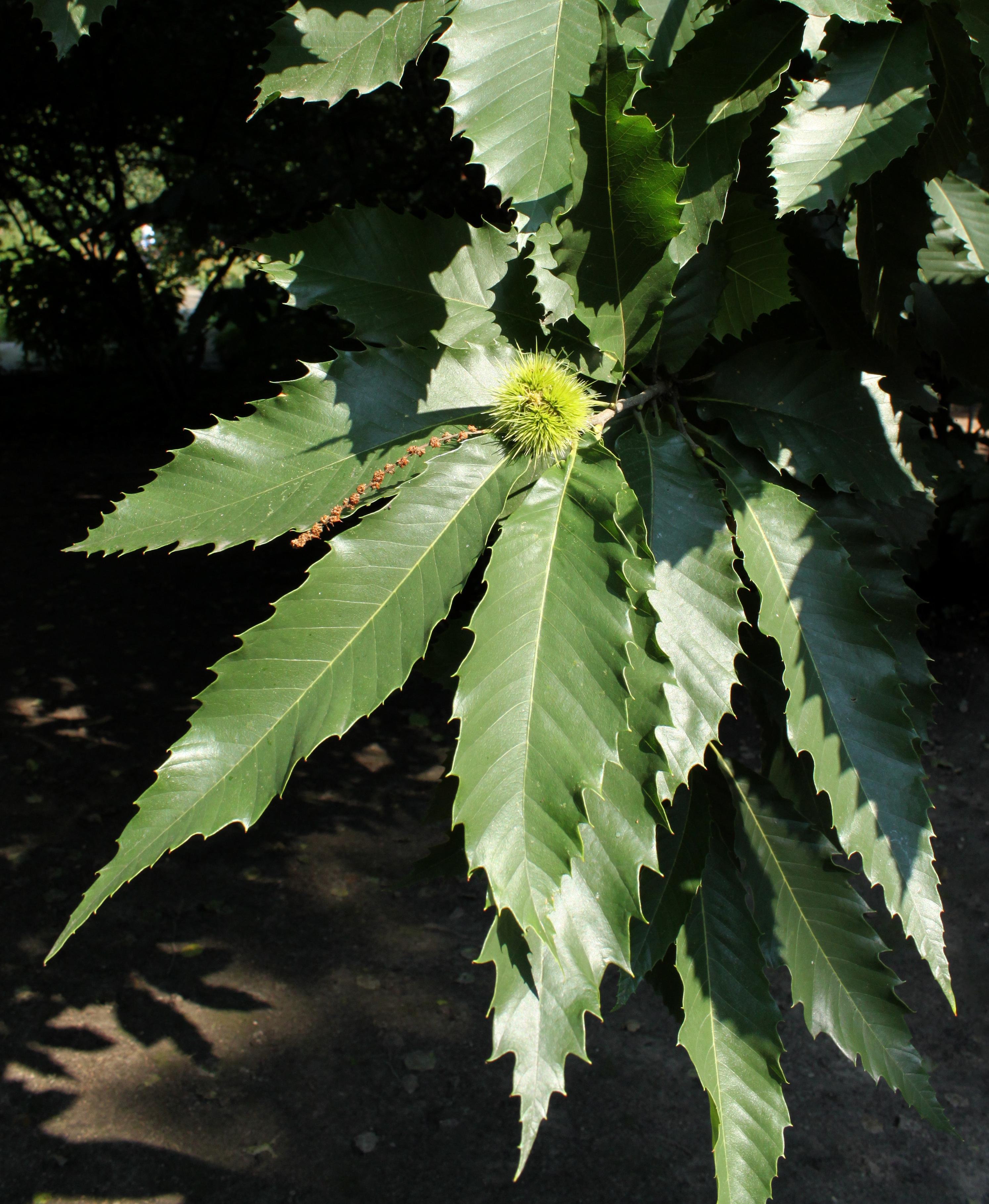
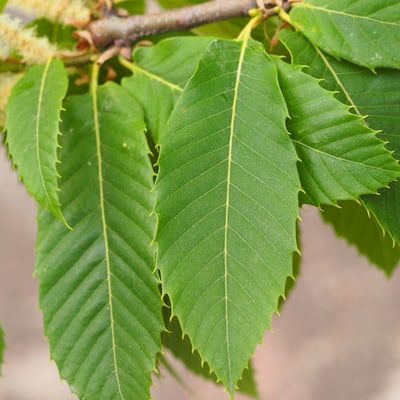
The lance-shaped leaves are up to 30 cm in size and generally grow alternately on the branch. They are rough with boldly serrated leaf margins and raised leaf veins.
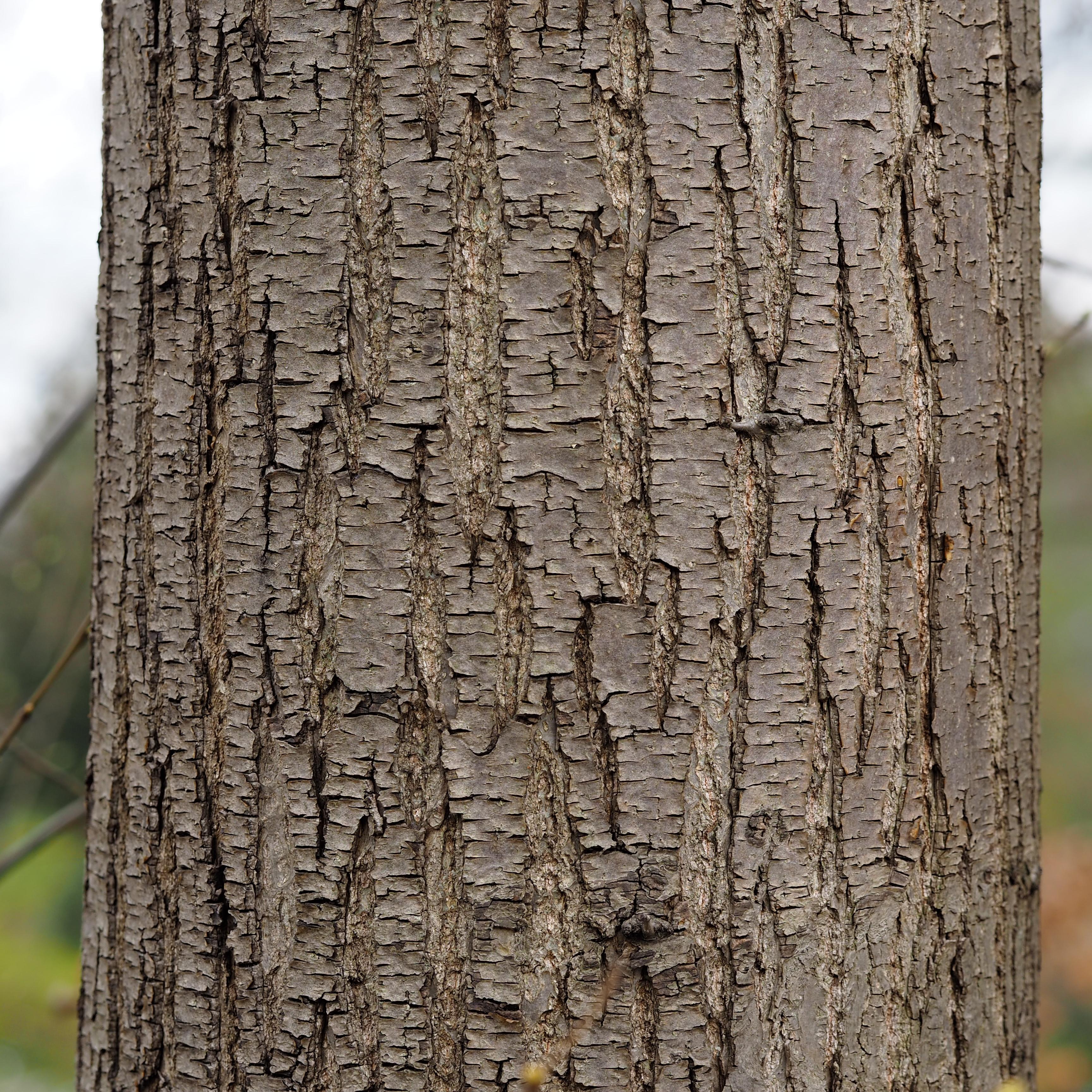
The bark is smooth and olive-brown. With age, it develops deep fissures and turns grey-brown.
The whitish flowers are clustered in upright catkins (the flower heads). These are the male flowers. The female flowers are inconspicuous, enclosed by a green cupule (husk) and are below the male flowers.
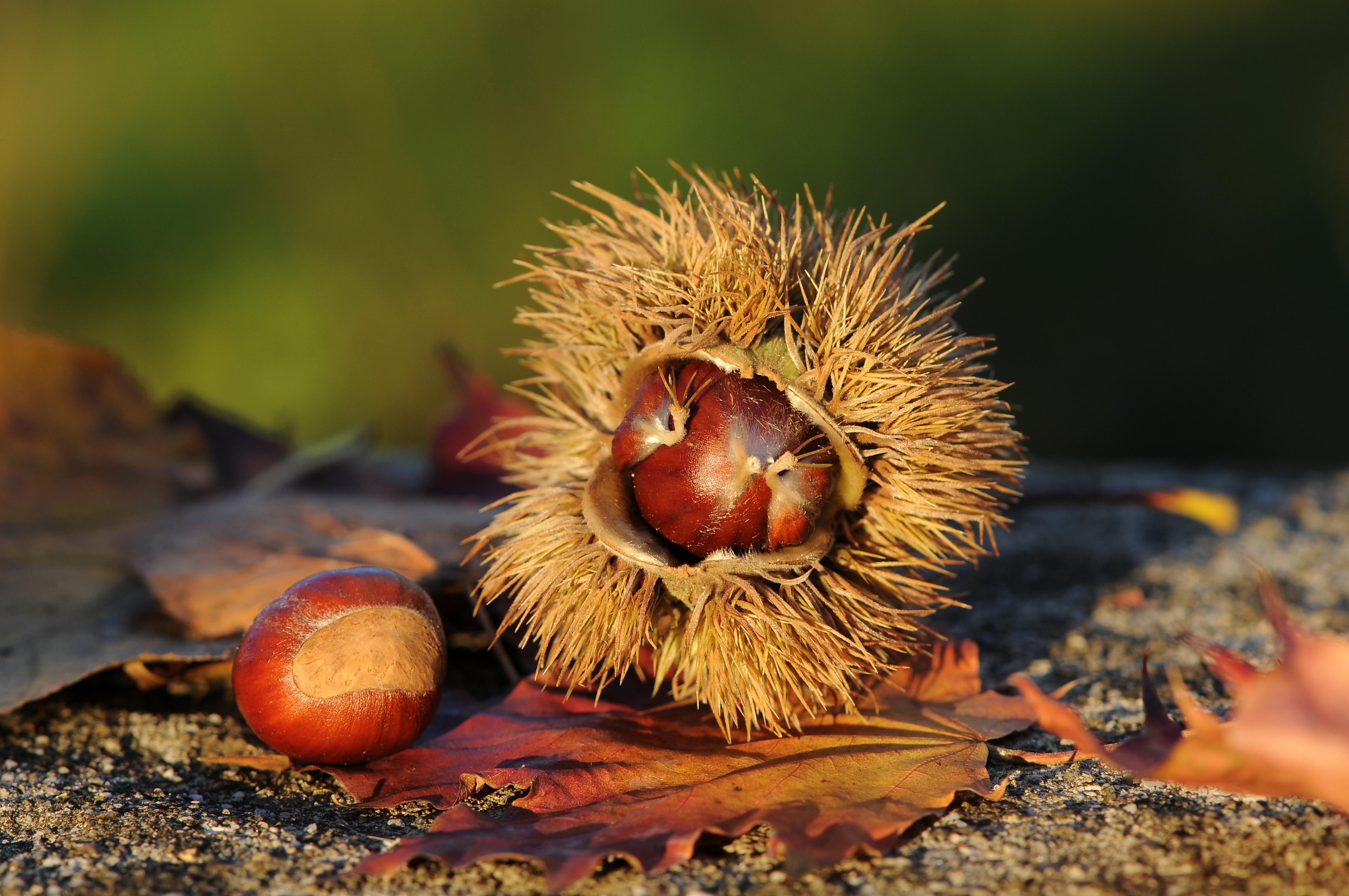
The fruits are large brown glossy nuts up to 3 cm in size. They are enclosed by a green spiky cupule (husk).
Features
Sweet chestnut
Castanea sativa
large lance-shaped leaves with raised leaf veins
large brown glossy nuts
In the city
Sweet chestnuts are shade and emission tolerant, can handle droughts and is a woody host plant for bees. All of these properties make them a very useful tree for parks and gardens. This species is not suitable as roadside trees predominantly because of their sensitivity to late frosts.
Fun Facts
In flower the sweet chestnut emits an unpleasant smell.
Despite their name and the similarity in their fruits, the sweet chestnut is no close relation of the horse chestnut. Together with the common beech, the sweet chestnut is part of the Fagaceae (beech) family.
The fruit ripening season is in October.
It flowers from May to July.
- Endangerment level Germany: not endangered
- Usage:
Its leaves are used to make a cough linctus.
At the end of the Middle Ages, chestnuts were associated with poor digestion, headaches and increased sex drive. Therefore, they were considered food for workers and for fattening pigs.
Their original origin is unknown. It is presumed that they originate from the Mediterranean region. The species has been growing in Central Europe for approx. 2000 years.
The fruits of the tree are edible and can be prepared in many different ways. As they are gluten-free, they can be used as a cereal substitute.
Sources
Blatt, Crusier, CC BY-SA 3.0, https://commons.wikimedia.org/wiki/File:Castanea_sativa_UW.jpg

Rinde, Alice Kracht, CC BY-SA 4.0, https://offene-naturfuehrer.de/web/Datei:Castanea_sativa_(2).JPG
.JPG)
Frucht, böhringer friedrich, CC BY-SA 2.5, https://commons.wikimedia.org/wiki/File:Cupula_Edelkastanie,_Castanea_sativa_8.JPG

Aas, G. & Riedmiller, A. (2002) Laubbäume. Bestimmen – Kennenlernen – Schützen, Bindlach: Gondrom Verlag.
Böhlmann, D. (2015) Laubbäume temperierter Klimate mit ihrer Artenvielfalt, Berlin: Patzer Verlag.
Mitchell, A. (1975) Die Wald- und Parkbäume Europas. Ein Bestimmungsbuch, Hamburg und Berlin: Verlag Paul Parey.
Quartier, A. (1989) Bäume und Sträucher, München: BLV.
Roloff, A. (2013) Bäume in der Stadt. Besonderheiten - Funktion - Nutzen - Arten - Risiken, Stuttgart: Verlag Eugen Ulmer.
Page „Edelkastanie“. : Wikipedia, The Free Encyclopedia. Date of last revision: 12.04.2016, 23:55 UTC. URL: https://de.wikipedia.org/w/index.php?title=Edelkastanie&oldid=153425605 (Accessed: 03.05.2016).