
Short Description
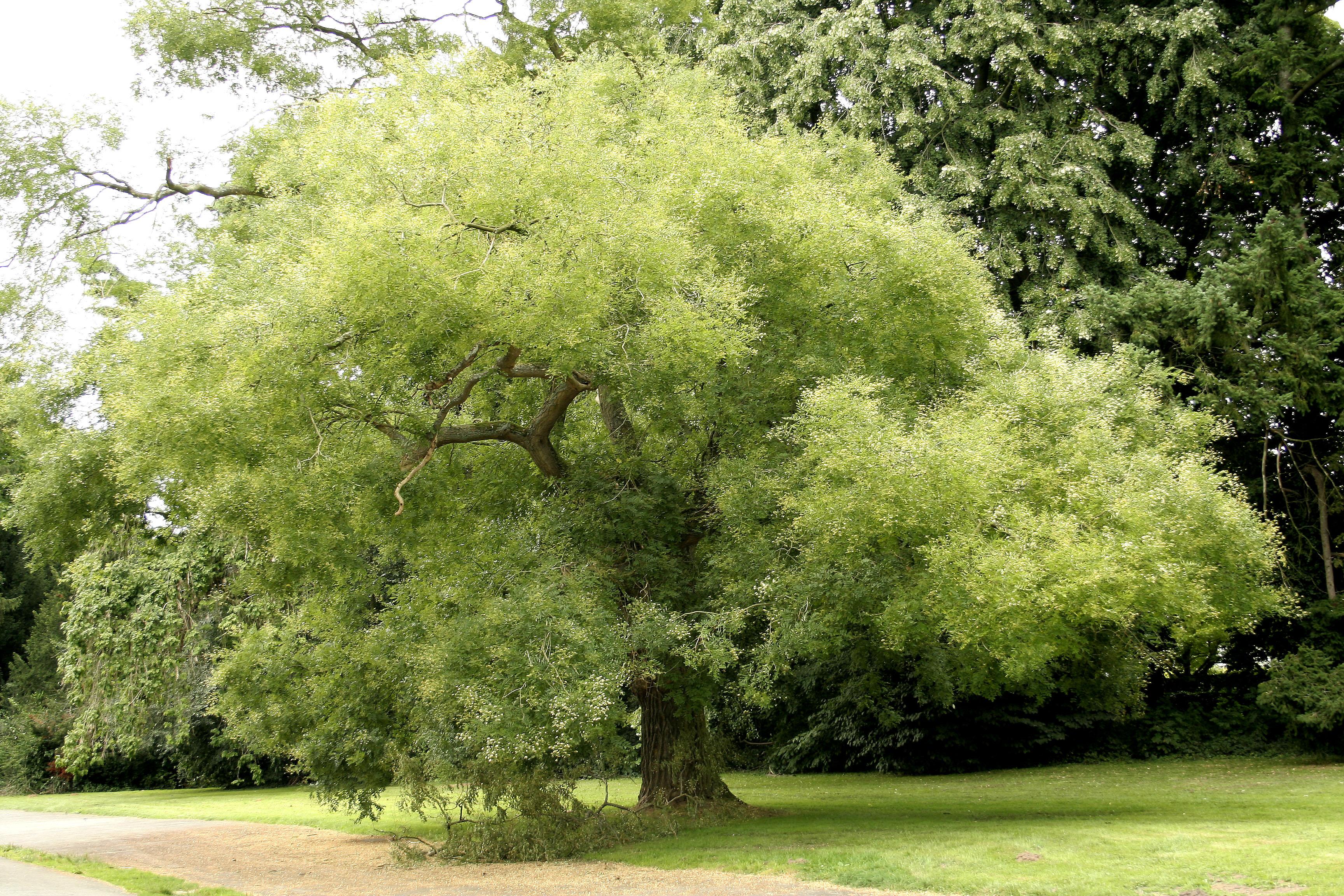
The Japanese pagoda tree is an up to 25 m tall deciduous tree. Its crown is irregular, sparse and often expansive.
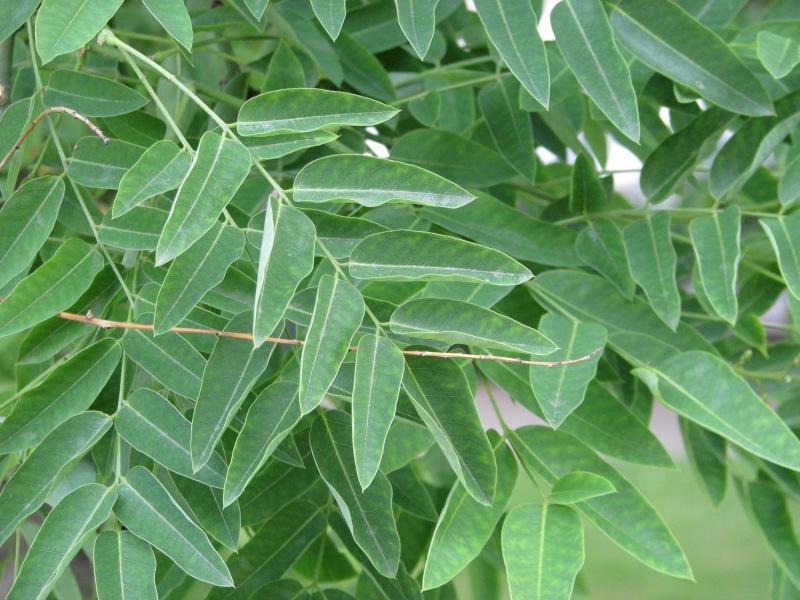
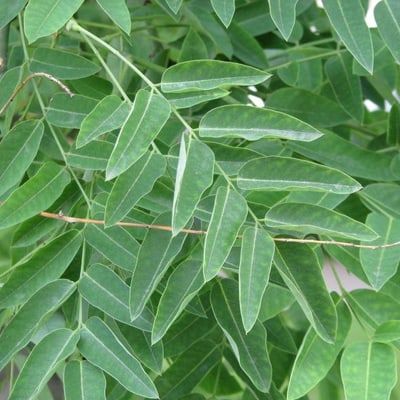
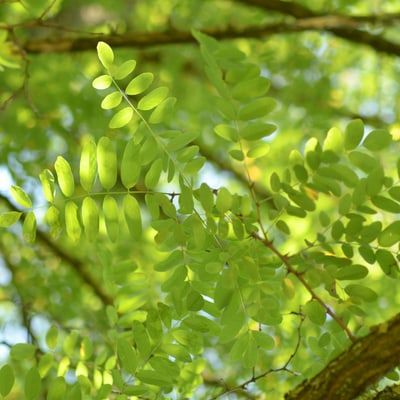
Each leaf consists of several leaflets (pinnate). These leaflets are oval and pointed. The leaf margin is smooth and the underside finely haired. They finish with a terminal leaflet (unequally pinnate).
The bark is dark-grey to brown and grooved in a broad web-like pattern.
The flowers are yellow-green to whitish and are clustered in great numbers in large, highly branched panicles.
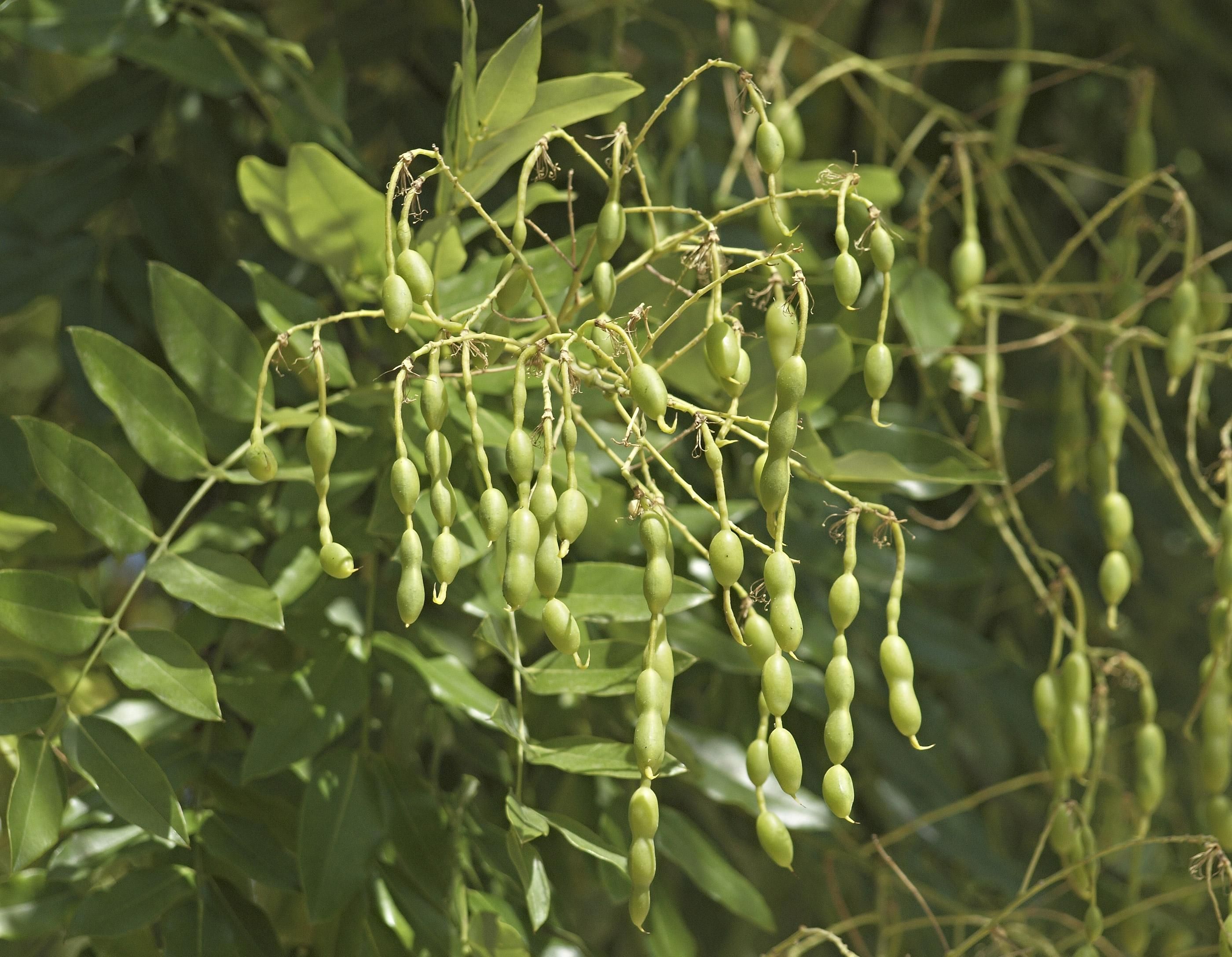
The fruits are long green pods, constricted between the several seeds (thus reminiscent of a string of beads).
Features
Japanese pagoda tree
Styphnolobium japonicum
branches without thorns
pointed pinnate leaves
In the city
The Japanese pagoda tree prefers dry and sunny sites, as can frequently be found in cities. In central Europe, it is a park tree. In France, it is also planted as a roadside tree.
Fun Facts
In China, the flowers are used as an ingredient in pancakes.
Despite its name, the pagoda tree does not come from Japan.
It flowers from August to September.
The fruit ripening season is in September to October.
- Endangerment level Germany: not evaluated
The Japanese pagoda tree originates from Korea and China. It is a non-native plant (neophyte).
The entire plant with the exception of the flowers is highly poisonous.
Sources
Blatt, Frank, CC BY-SA 3.0, https://commons.wikimedia.org/wiki/File:Styphnolobium_japonicum_1348.jpg

Habitus, Jean-Pol GRANDMONT, CC BY-SA 3.0, https://commons.wikimedia.org/wiki/File:Sophora_japonica_JPG2Aa.jpg

Fruchtstand, Luis Fernández García, CC BY-SA 3.0, https://commons.wikimedia.org/wiki/File:Styphnolobium-japonicum-20130915.jpg

Aas, G. & Riedmiller, A. (2002) Laubbäume. Bestimmen – Kennenlernen – Schützen, Bindlach: Gondrom Verlag.
Roloff, A. (2013) Bäume in der Stadt. Besonderheiten - Funktion - Nutzen - Arten - Risiken, Stuttgart: Verlag Eugen Ulmer.
Böhlmann, D. (2015) Laubbäume temperierter Klimate mit ihrer Artenvielfalt, Berlin: Patzer Verlag.
Mitchell, A. (1975) Die Wald- und Parkbäume Europas. Ein Bestimmungsbuch, Hamburg und Berlin: Verlag Paul Parey.
Page „Japanischer Schnurbaum“. : Wikipedia, The Free Encyclopedia. Date of last revision: 20.01.2016, 01:03 UTC. URL: https://de.wikipedia.org/w/index.php?title=Japanischer_Schnurbaum&oldid=150448295 (Accessed: 27.05.2016).