
Short Description
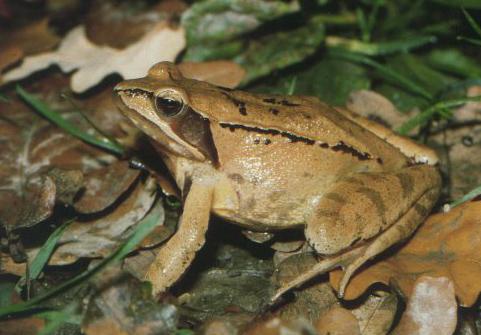
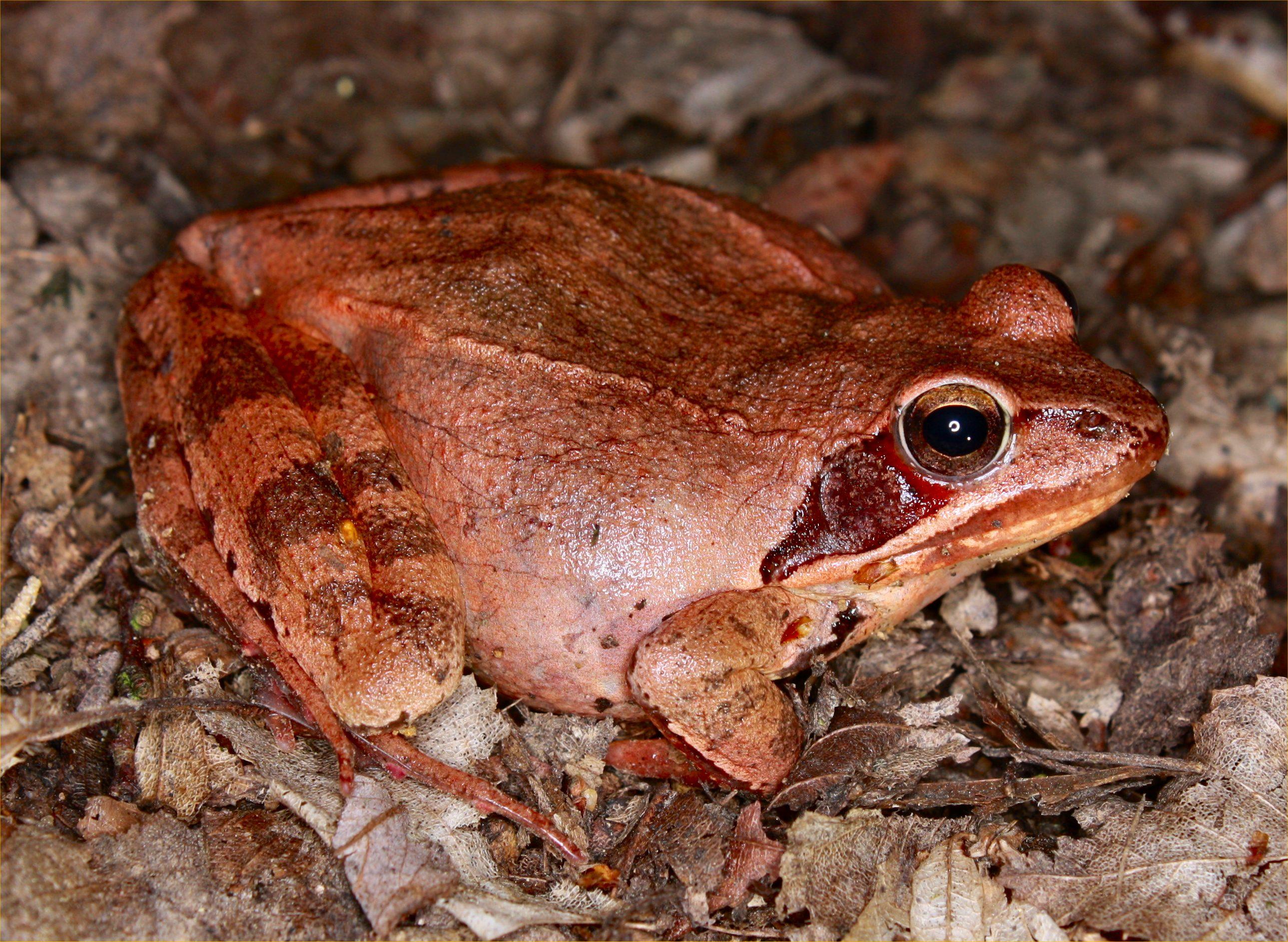
The agile frog is a relatively slender brown frog with long hind legs and a moderately pointed snout. It usually has foliage-like colours, such as yellow-brown, reddish-brown, sandy or grey-brown with no or washed-out spots. Its throat is unspotted, unlike many other brown frogs. A characteristic feature of the species is the large eardrum, which is close to the eye.
Males can reach a length of 6.5 cm.
The females are much larger and grow up to 9 cm long.
Features
Agile frog
Rana dalmatina
large eardrum close to the eye
long hind legs
In the city
The destruction and degradation of its habitats through the input of rubbish, fertilisers and environmental toxins are endangering the agile frog. Above all, the islandisation of habitats together with the fragmentation of migration routes and habitats is having an impact on its population density. It is therefore all the more important to promote measures that counteract this fragmentation. These include, for example, the construction of green bridges, amphibian tunnels and the creation of new ecological stepping stones to reconnect isolated habitats.
Fun Facts
Jumping frogs are easy to identify with the heel test. To do this, carefully stretch the hind leg forward. In an adult, it clearly protrudes beyond the tip of the snout.
After hibernation, agile frogs herald the start of the amphibian season, so to speak. Sexually mature animals are the first frogs at the spawning waters in early spring, often as early as February.
The calls of the males are very quiet as they do not have vocal sacs and the sounds are mostly emitted under water.
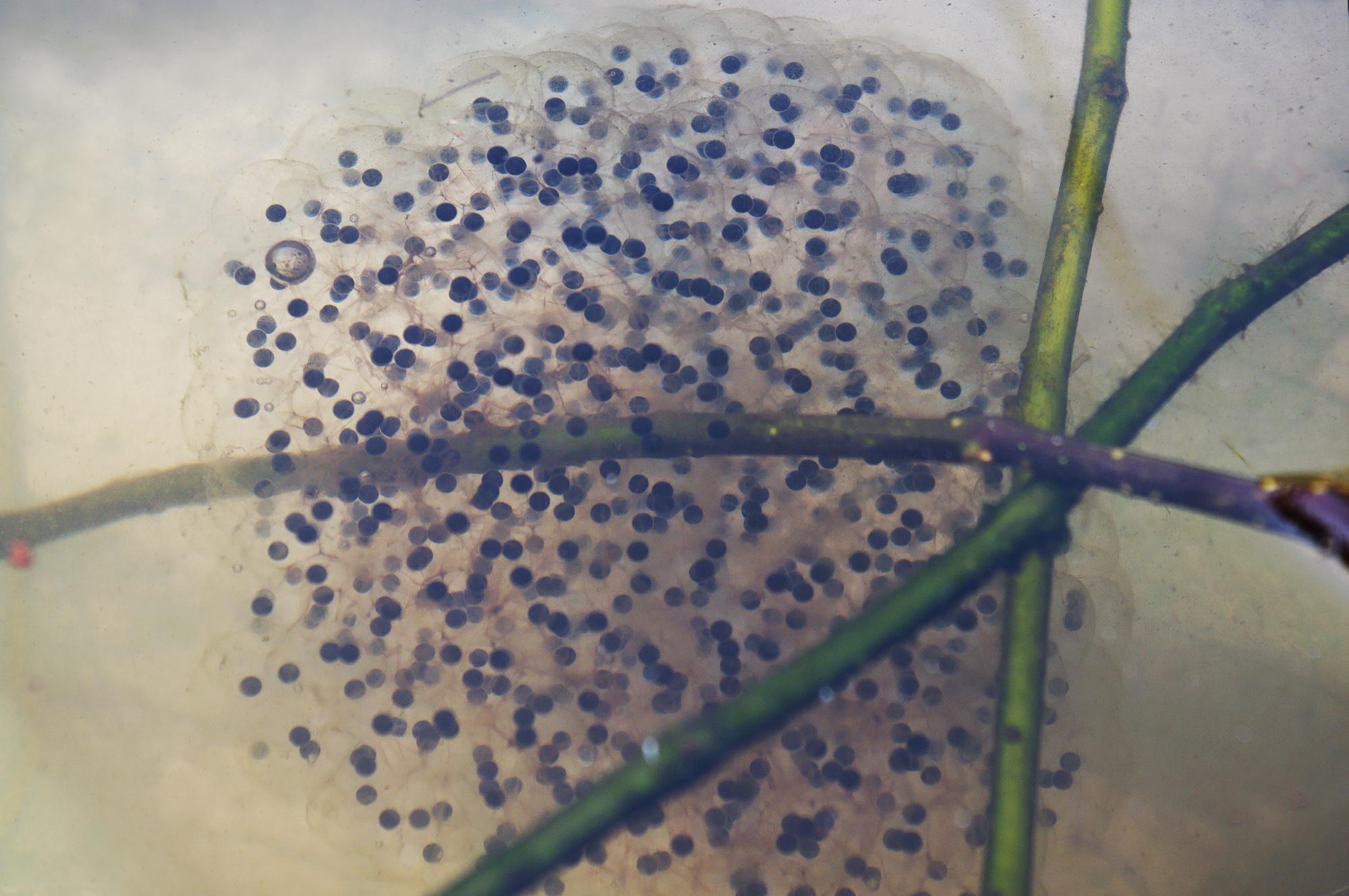
The females attach individual spawn balls with 400-1800 eggs to branches, roots or various plant stems under water so that they look like "impaled".
Escape jumps can be up to 2 m wide and 75 cm high.
- Endangerment level Germany: endangered
Its name refers to its great jumping ability.
Sources
Habitus , Franco Andreone, CC BY-SA 2.5, https://commons.wikimedia.org/wiki/File:Rana_dalmatina.jpg

Weibchen, Weddi, CC BY-SA 3.0, https://de.wikipedia.org/wiki/Datei:Kottenforst_Bonn_Annaberger_Feld_M%C3%A4rz_2014_Weddeling2_7616.jpg

Spawn, Christian Fischer, CC BY-SA 3.0, https://de.wikipedia.org/wiki/Datei:RanaDalmatinaSpawn.jpg

Kwet, A. (2015) Reptilien und Amphibien Europas. 250 Arten mit Verbreitungskarten, Stuttgart: Franckh Kosmos Verlag.
Blab, J. & Vogel, H. (2002) Amphibien und Reptilien erkennen und schützen, München: BLV.
Glandt, D. (2008) Heimische Amphibien: Bestimmen – Beobachten – Schützen, Wiebelsheim: AULA-Verlag.
Glandt, D. (2015) Die Amphibien und Reptilien Europas, Wiebelsheim: Quelle & Meyer Verlag.
Matz, G. & Weber, D. (1983) Amphibien und Reptielien – Die 169 Arten Europas farbig abgebildet, München: BLV.
Page „Springfrosch“. : Wikipedia, The Free Encyclopedia. Date of last revision: 03.03.2018, 21:34 UTC. URL: https://de.wikipedia.org/w/index.php?title=Springfrosch&oldid=174590206 (Accessed: 08.03.2018).
NABU – Naturschutzbund Deutschland e.V. (n.d.) Weitspringer aus dem Süden. Der Springfrosch (Rana dalmatina), URL: https://www.nabu.de/tiere-und-pflanzen/amphibien-und-reptilien/amphibien/artenportraets/10691.html (Accessed: 08.03.2018).
Gebel, M. (2014) Springfrosch (Rana dalmatina), URL: http://www.amphibien-reptilien.com/info-springfrosch-rana-dalmatina.php (Accessed: 08.03.2018).
Schulte, U. (2013) Artensteckbrief Springfrosch (Rana dalmatina), URL: https://feldherpetologie.de/heimische-amphibien-artensteckbrief/artensteckbrief-springfrosch-rana-dalamtina/ (Accessed: 08.03.2018).
Riegler, C. (n.d.) Springfrosch - Rana dalmatina (BONAPARTE, 1840), URL: https://www.herpetofauna.at/index.php/slider-amphibien/22-springfrosch-rana-dalmatina-bonaparte-1840 (Accessed: 08.03.2018).