
Short Description
The common walnut is a deciduous tree with an expansive crown. It can grow up to 30 m tall.
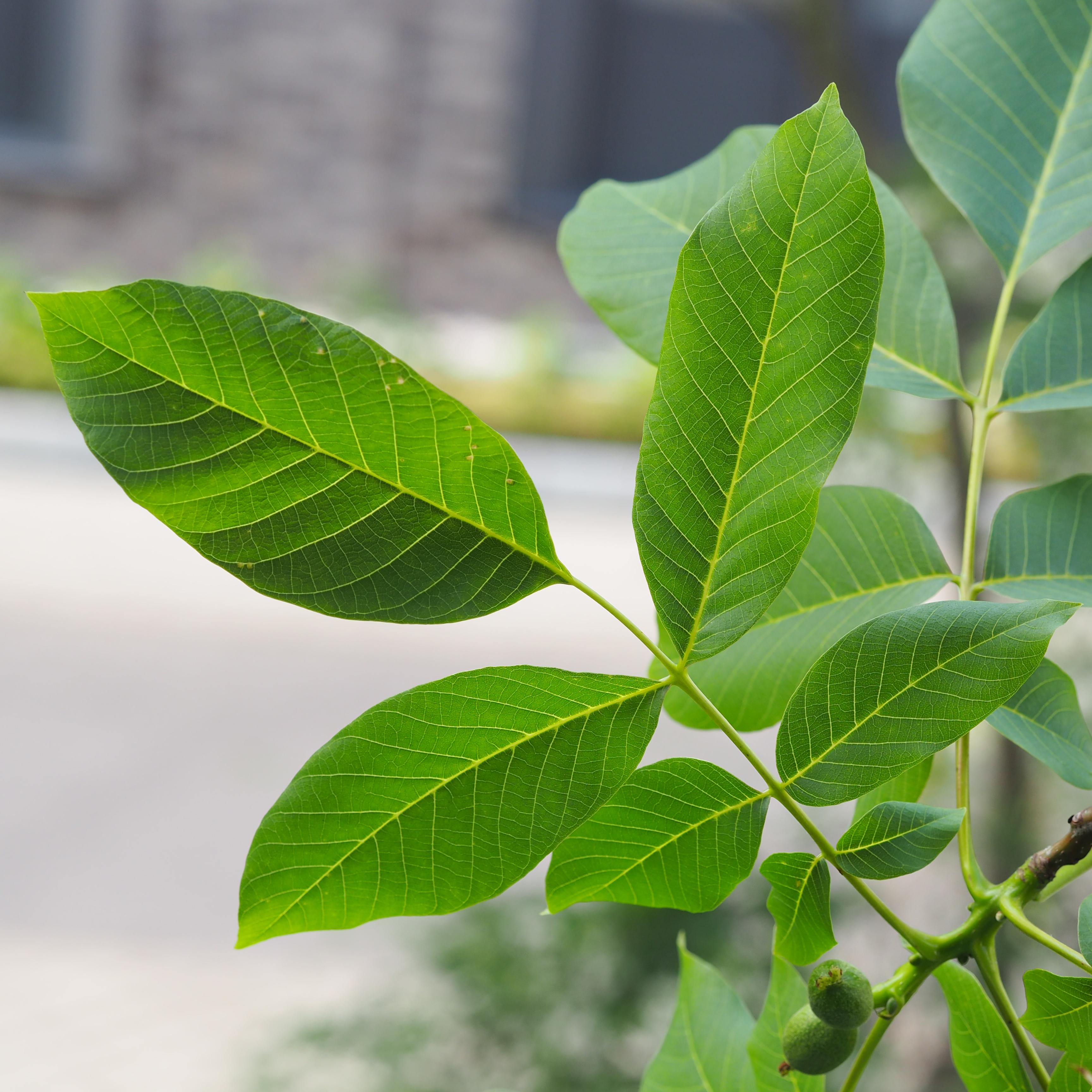
The leaves grow alternately on the branch. The pinnate leaf consists of five to nine smaller, elongated oval leaflets. The terminal leaflet has a stalk and is a bit larger.
The gnarled tree often has a leaning trunk. The bark is initially smooth and dark-grey and later turns into a blackish-grey deeply fissured web-like bark.
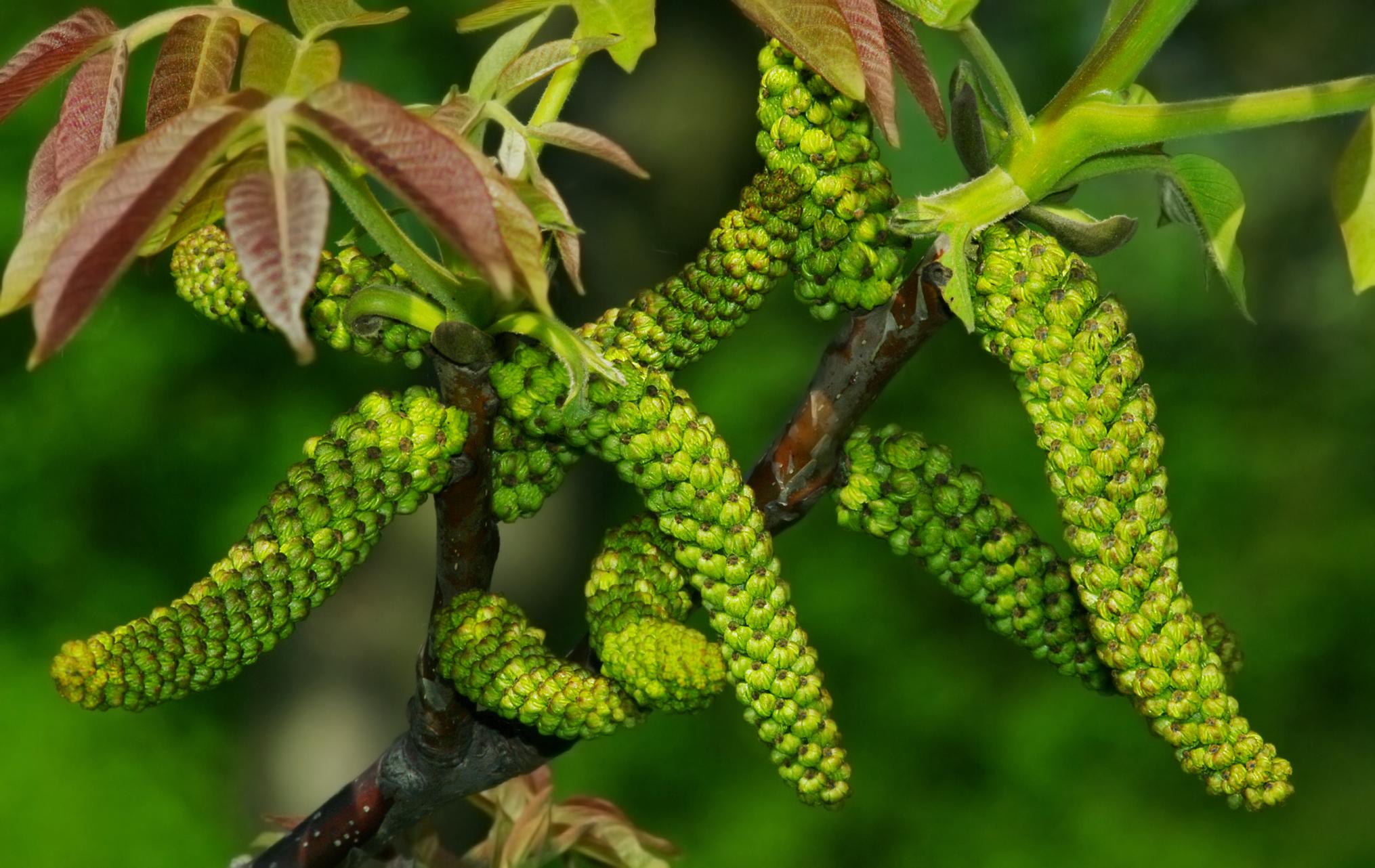
The tree has male and female flowers. The male flowers are brown-greenish and droop in elongated flower heads (catkins). The female flowers are green and rather unremarkable.
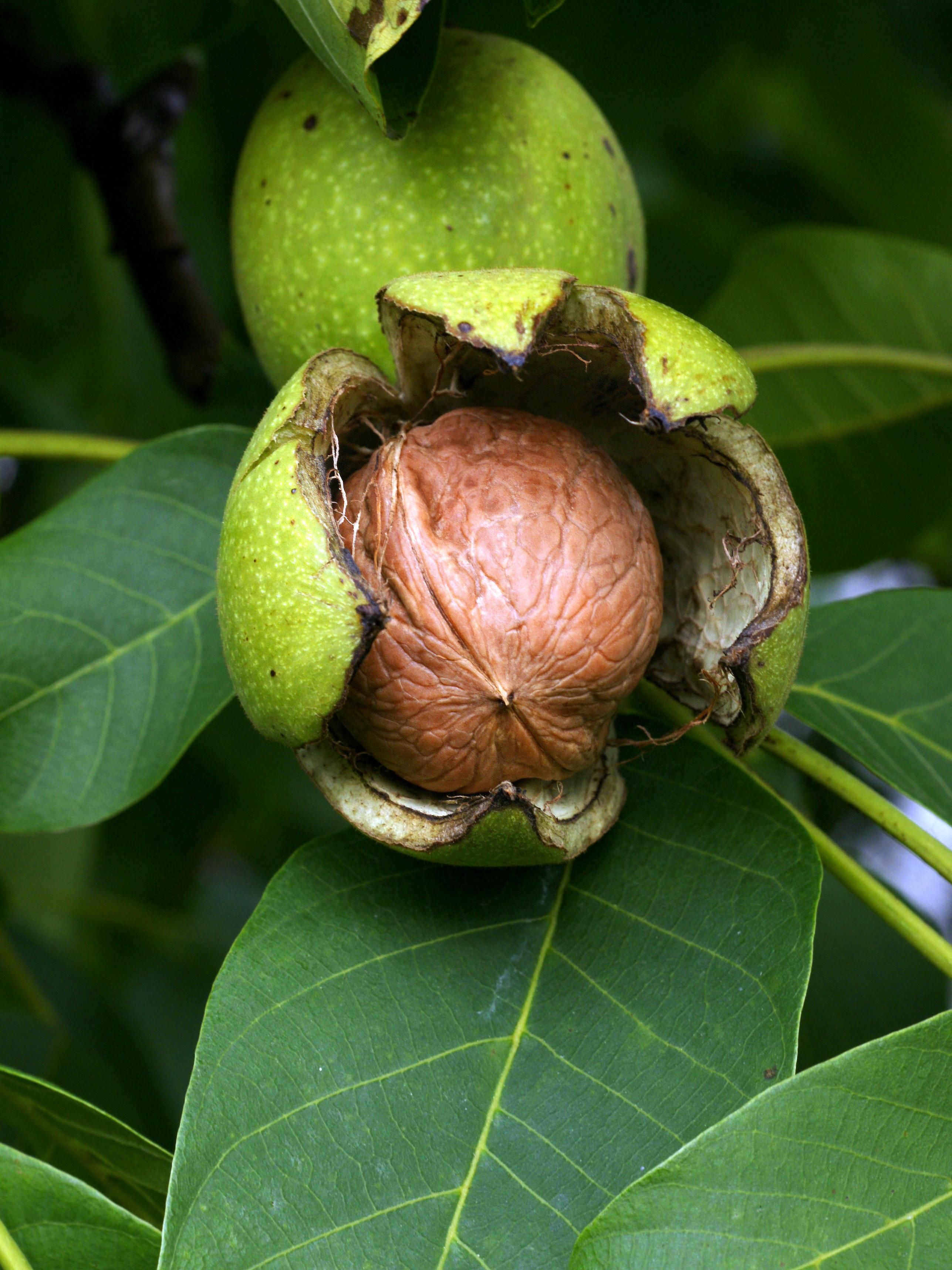
The fruit is the very familiar walnut. It is initially enclosed by a green, later turning brown, smooth husk. In autumn, the husk springs open and the woody stone fruit with a seed inside (“walnut kernel”) drops out.
Features
Common walnut
Juglans regia
aromatic leaf scent when rubbed
large, round fruits (walnuts)
In the city
Because of the edible fruits, the common walnut is a popular garden tree. It prefers moist, nutrient- and lime-rich loam and clay soils. As it is very sensitive to winter cold and late frosts, it grows well in the mild urban climate.
Fun Facts
It grows up to 200 years old.
It flowers from April to May.
The fruit ripening season is in September to October.
- Endangerment level Germany: not endangered
- Usage:
The consumption of walnuts is said to protect against diabetes and high blood pressure in stressful situations.
In Christianity it is considered a symbol of fertility and woman.
It originates from the Mediterranean and the Middle Eastern region. Cultivated walnut trees were introduced into western and northern Europe very early, in Roman times or earlier, and to the US in the 17th century, by English colonists.
The walnut is cultivated primarily for its fruit yield, but the wood is also in demand for furniture making. The consumption of walnuts is said to protect against diabetes and high blood pressure in stressful situations.
Sources
Blatt, Alice Kracht, CC BY-SA 4.0, https://offene-naturfuehrer.de/web/Datei:Juglans_regia_(10).JPG
.JPG)
männliche Blüte, Kruczy89, CC BY-SA 3.0, https://commons.wikimedia.org/wiki/File:Juglans_regia_-_male_inflorescences.jpg

Frucht, Böhringer Friedrich, CC BY-SA 2.5, https://commons.wikimedia.org/wiki/File:Juglans_regia_Echte_Walnussfrucht_1.jpg

Aas, G. & Riedmiller, A. (2002) Laubbäume. Bestimmen – Kennenlernen – Schützen, Bindlach: Gondrom Verlag.
Amann, G. & Richter, P. (1962) Bäume und Sträucher des Waldes, Melsungen: Verlag J. Neumann – Neudamm.
Quartier, A. (1989) Bäume und Sträucher, München: BLV.
Roloff, A. (2013) Bäume in der Stadt. Besonderheiten - Funktion - Nutzen - Arten - Risiken, Stuttgart: Verlag Eugen Ulmer.
Page „Echte Walnuss“. : Wikipedia, The Free Encyclopedia. Date of last revision: 18.04.2016, 13:36 UTC. URL: https://de.wikipedia.org/w/index.php?title=Echte_Walnuss&oldid=153586937 (Accessed: 21.04.2016).
Umweltforschungszentrum Leipzig - Halle GmbH, Sektion Biozönoseforschung (n.d.) Datenbank biologisch-ökologischer Merkmale der Flora von Deutschland, URL: www.biolflor.de (Accessed: 20.04.2016).
Page "Juglans regia". : Wikipedia, The Free Encyclopedia. Date of last revision: 29.03.2021, 06:26 UTC. URL: https://en.wikipedia.org/w/index.php?title=Juglans_regia&oldid=992228678 (Accessed: 16.04.2021).