
Short Description
Alders often grow multi-stemmed. They can grow up to 30 m tall and have a rounded crown.
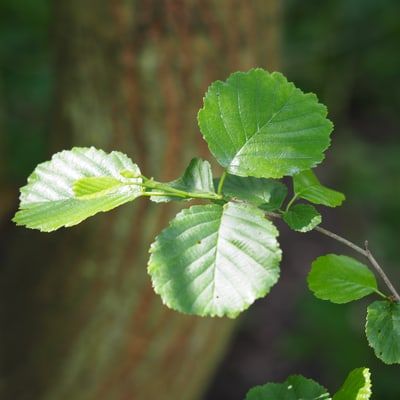
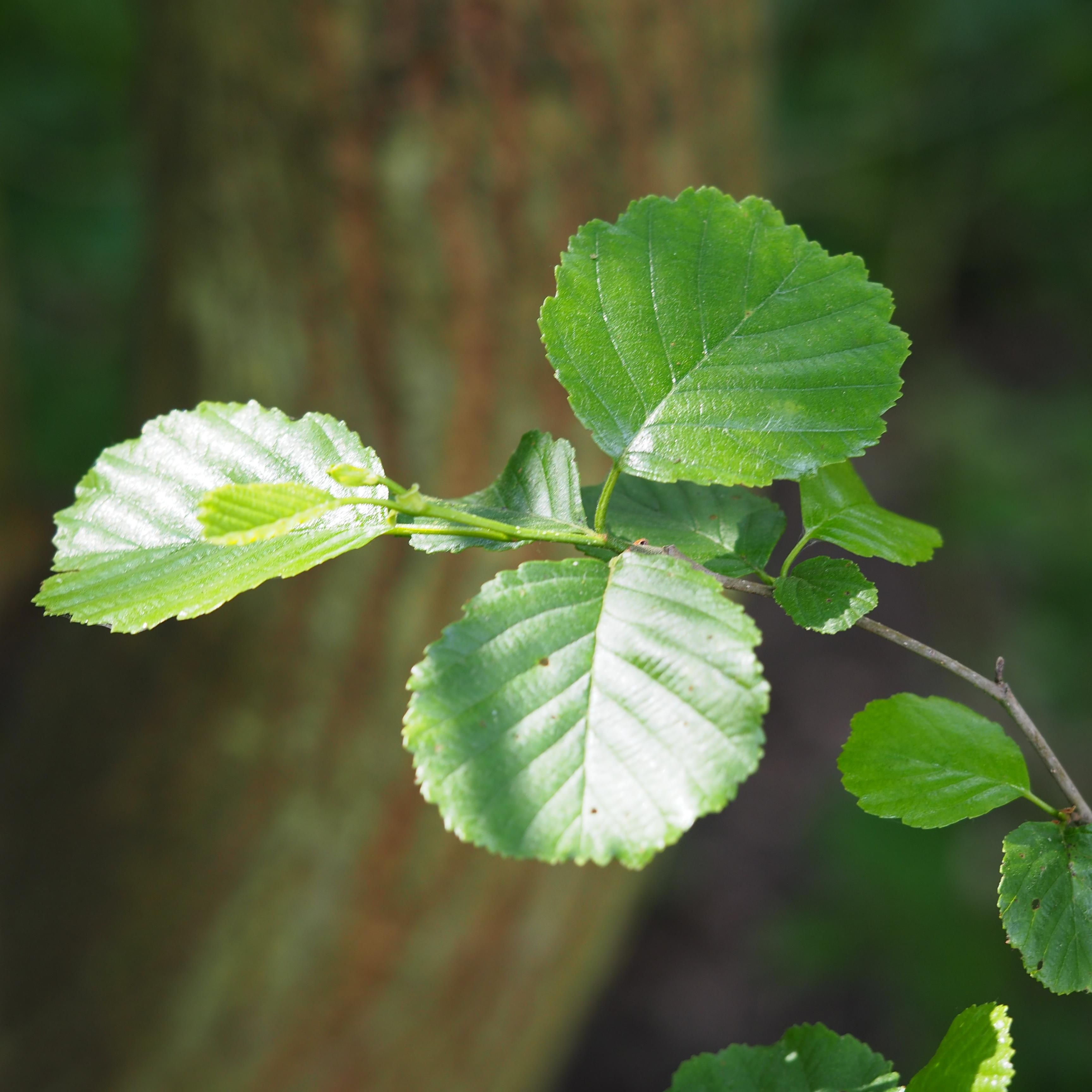
The leaves are roundish to inverse oval. The leaf margins are coarsely serrated and the tip of the leaf generally indented. The leaves grow alternately on the branch.
The bark is initially smooth and a shiny red-brown. A dark fissured outer bark is formed later.
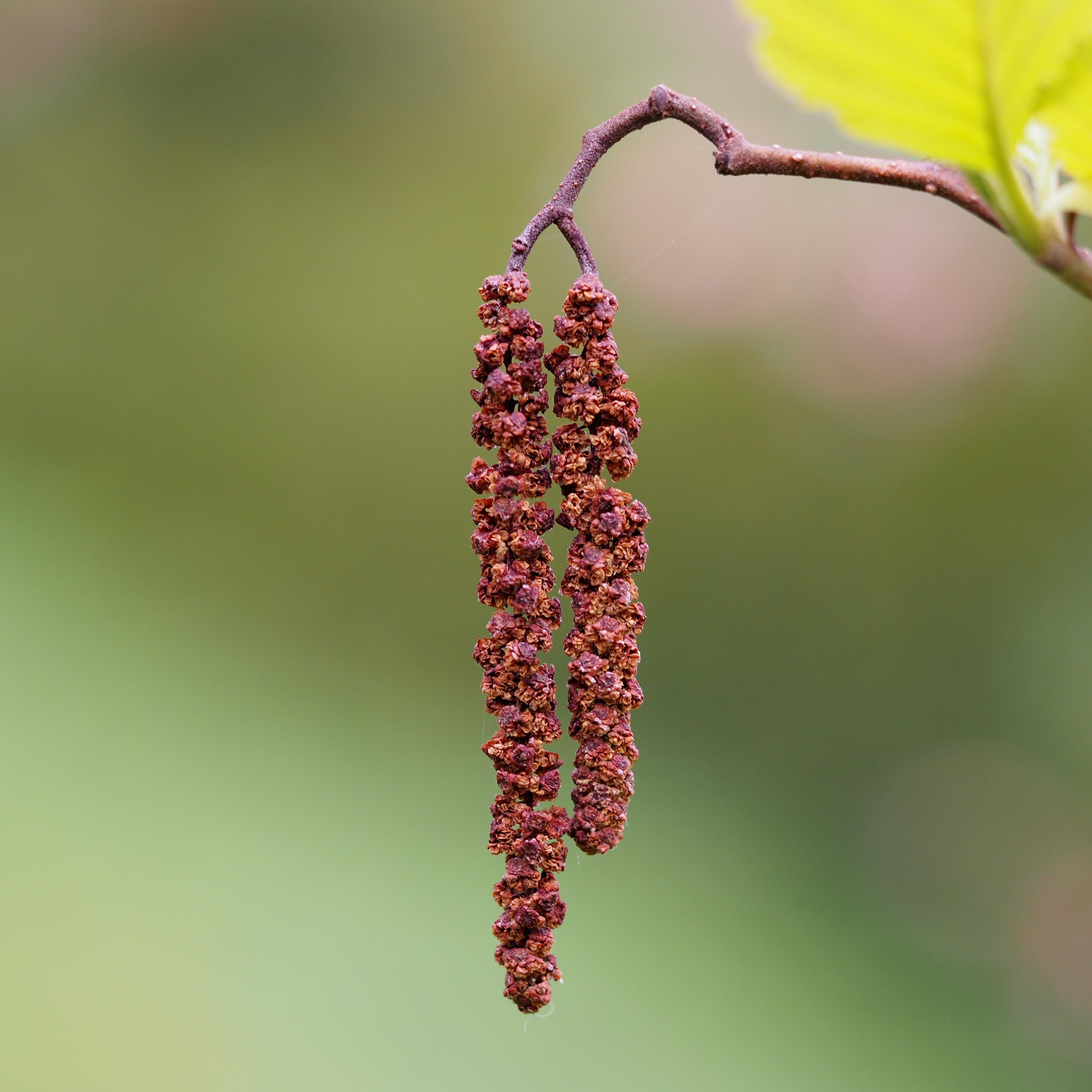
The flowers are green or yellowish and clustered in catkins. The tree has male and female flowers. Male catkins are long and pendulous. Female flower heads are globular and cone-shaped.
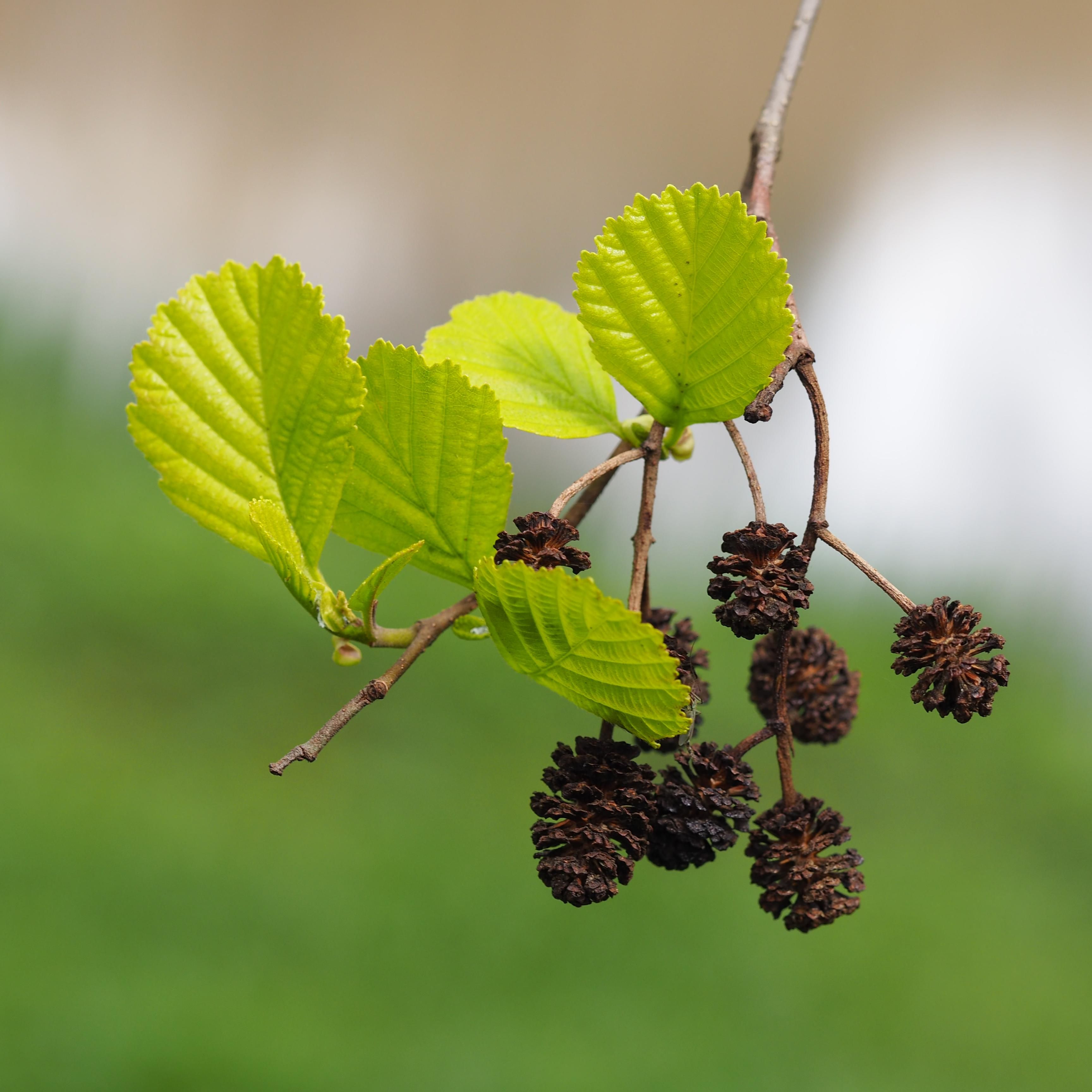
The fruit is a small winged nut. They are clustered in woody, cone-shaped seed heads that can easily be mistaken for the fruit itself. They remain on the tree during the winter.
Features
Alder
Alnus glutinosa
rounded leaves, generally indented at the tip
woody cones
In the city
The alder can be found on riverbanks, lakeshores or at the edge of water bodies in parks. Due to the increasing periods of drought, the tree will only be found to a limited extent in the city in the future. Only locations with sufficient water supply, such as in parks and gardens, remain suitable. As an important ecological service of the alder, its potential for improving urban air quality by binding particulate matter is discussed.
Alders are often used to stabilise banks.
Fun Facts
Alders meet their nitrogen requirements through symbiosis with bacteria that absorb nitrogen from the air. This results in swellings in the roots and the formation of root nodules.
Its bark can be used in tanning.
The cones can be used to make ink.
It flowers from March to April.
The fruit ripening season is in September to October.
- Endangerment level Germany: not endangered
- Usage:
Alder wood is often used to make furniture and various household items.
Alder pollen is considered allergenic.
Sources
Fruchtstand, Alice Kracht, CC BY-SA 4.0, http://species-id.net/openmedia/File:Alnus_glutinosa_%289%29.JPG
.JPG)
Blatt, Alice Kracht, CC BY-SA 4.0, https://offene-naturfuehrer.de/web/Datei:Alnus_glutinosa_(8).JPG
.JPG)
männliche Blüte, Alice Kracht, CC BY-SA 4.0, https://offene-naturfuehrer.de/web/Datei:Alnus_glutinosa_(4).JPG
.JPG)
Aas, G. & Riedmiller, A. (2002) Laubbäume. Bestimmen – Kennenlernen – Schützen, Bindlach: Gondrom Verlag.
Amann, G. & Richter, P. (1962) Bäume und Sträucher des Waldes, Melsungen: Verlag J. Neumann – Neudamm.
Forum DIE GRÜNE STADT (2013) Bäume und Pflanzen lassen Städte atmen. Schwerpunkt - Feinstaub, URL: https://www.die-gruene-stadt.de/baeume-und-pflanzen-lassen-staedte-atmen.pdfx (Accessed: 02.08.2018).
Böhlmann, D. (2015) Laubbäume temperierter Klimate mit ihrer Artenvielfalt, Berlin: Patzer Verlag.
Roloff, A. (2013) Bäume in der Stadt. Besonderheiten - Funktion - Nutzen - Arten - Risiken, Stuttgart: Verlag Eugen Ulmer.
Page „Schwarz-Erle“. : Wikipedia, The Free Encyclopedia. Date of last revision: 09.04.2016, 07:21 UTC. URL: https://de.wikipedia.org/w/index.php?title=Schwarz-Erle&oldid=153310586 (Accessed: 03.05.2016).