
Short Description
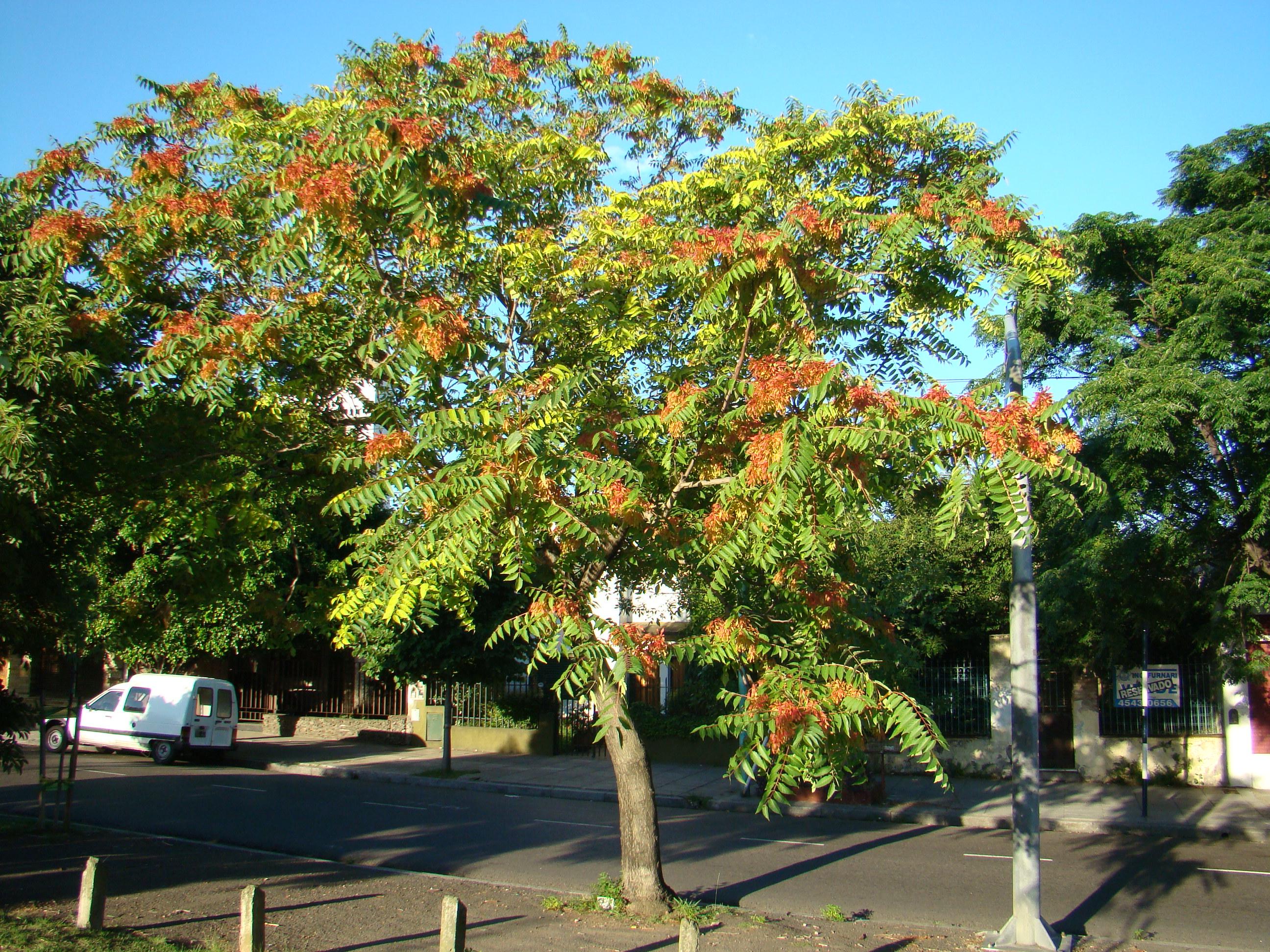
The tree of heaven is a fast-growing tree with a large broad crown.
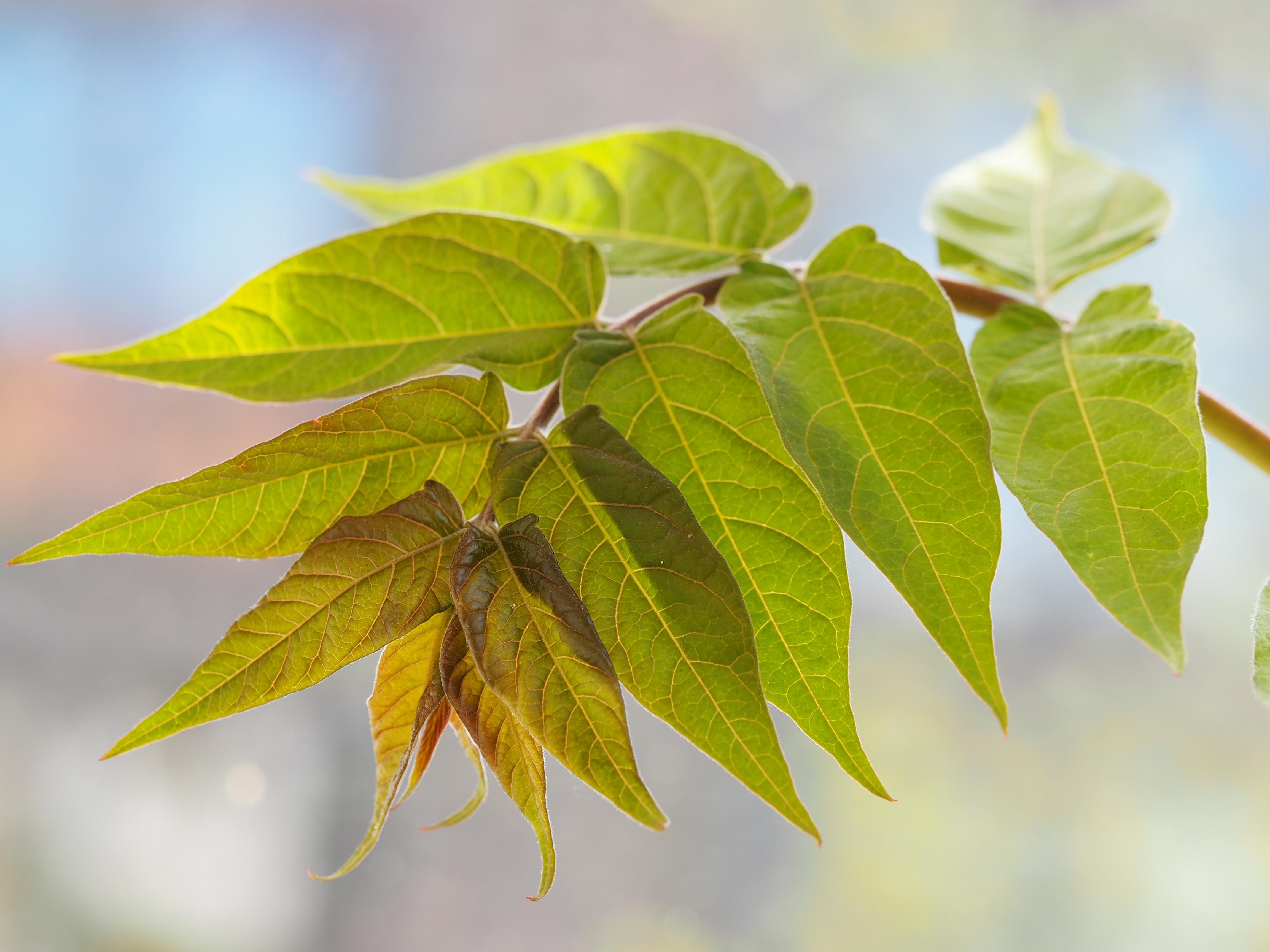
The very large leaves can grow as large as one metre and grow alternately on the branch. They consist of several leaflets that finish with a single terminal leaflet (unequally pinnate). They are lance-shaped with smooth margins and very few large glandular teeth at the base.
The tree has a straight, roughly branched stem with upright branches and high crown. The bark is grey-brown and smooth with pale vertical stripes.
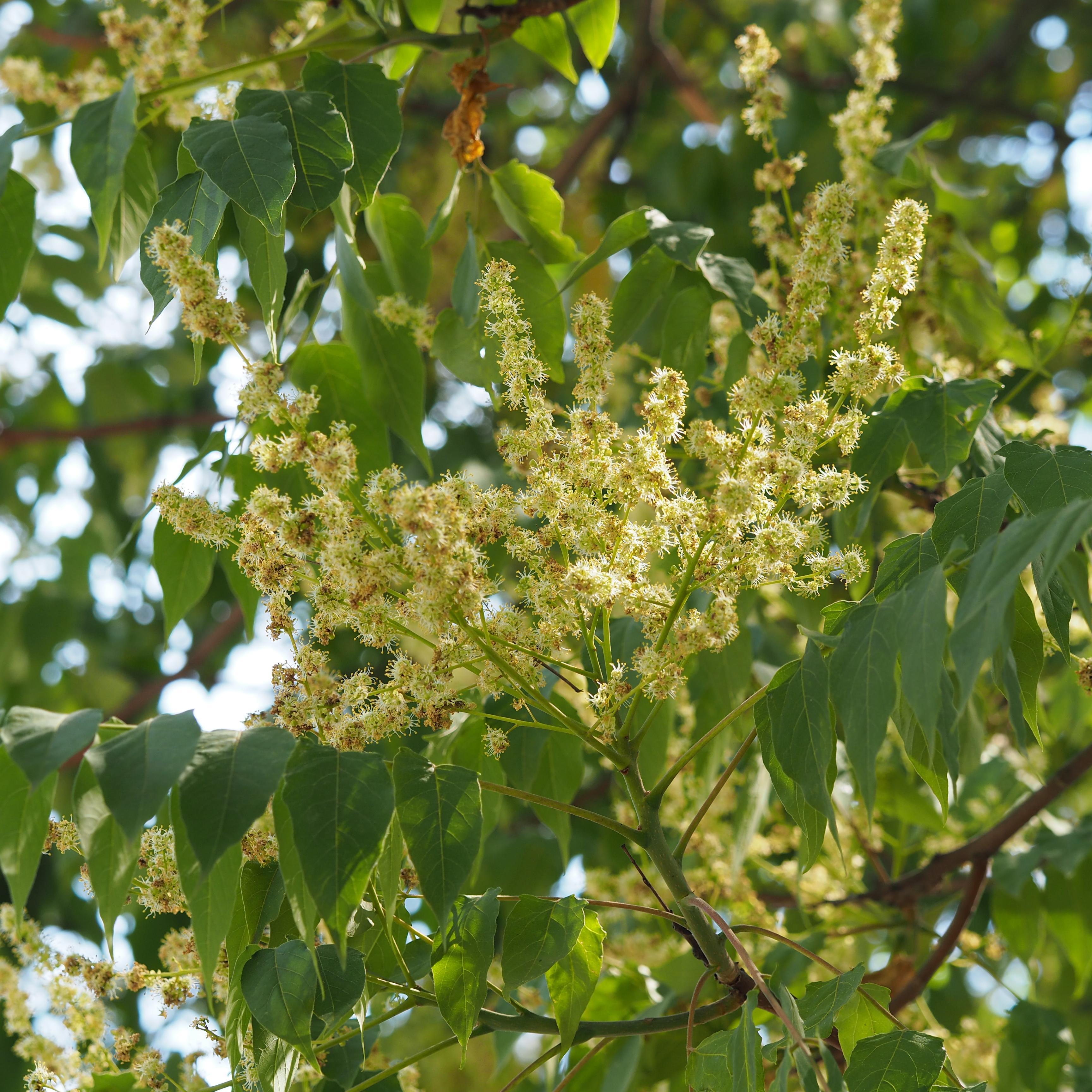
The small flowers are green-white and stand in upright panicles (flower head).
The fruit is a long brownish to reddish winged nut fruit.
Features
Tree of heaven
Ailanthus altissima
very large pinnate leaves
unpleasant strong odour from the leaves
In the city
The tree of heaven is particularly widespread in urban settings. It is often planted as a park or roadside tree. It prefers warm sites and often colonises wasteland or railway tracks. It is comparatively undemanding and little impaired by salt or urban air pollution.
Allergic skin reactions may occur after touching the leaves. The pollen is mildly allergic.
Fun Facts
The tree of heaven is considered the fastest-growing tree in Central Europe. In the first year, it can already grow to a height of one to two metres.
The fruit ripening season is in September to October.
In China, the tree of heaven is used as timber; its leaves are used in silk production as fodder for the ailanthus silkmoth (Samia cynthia).
In traditional Chinese medicine, its bark and roots are used to treat gastrointestinal disorders.
Trees of heaven are generally dioecious, i.e. male and female flowers are found on different trees.
It flowers from June to July.
- Endangerment level Germany: not evaluated
- Usage:
In Germany, it is used in honey production.
The tree is native to eastern Asia and was introduced to Germany in the 18th century. The tree of heaven is thus considered a non-native plant (neophyte).
Seeds and bark are poisonous. The sap, too, has an irritating effect on skin.
Sources
Blatt, Alice Kracht, CC BY-SA 4.0, https://offene-naturfuehrer.de/web/Datei:Ailanthus_altissima_(80).JPG
.JPG)
Habitus, Marina Torres, PD, https://commons.wikimedia.org/wiki/File:Ailanthus_altissima_Arg.jpg

Blütenstand, Alice Kracht, CC BY-SA 4.0, https://offene-naturfuehrer.de/web/Datei:Ailanthus_altissima_(5).JPG
.JPG)
Aas, G. & Riedmiller, A. (2002) Laubbäume. Bestimmen – Kennenlernen – Schützen, Bindlach: Gondrom Verlag.
Böhlmann, D. (2015) Laubbäume temperierter Klimate mit ihrer Artenvielfalt, Berlin: Patzer Verlag.
Mitchell, A. (1975) Die Wald- und Parkbäume Europas. Ein Bestimmungsbuch, Hamburg und Berlin: Verlag Paul Parey.
Roloff, A. (2013) Bäume in der Stadt. Besonderheiten - Funktion - Nutzen - Arten - Risiken, Stuttgart: Verlag Eugen Ulmer.
Roth, L., Daunderer, M. & Kormann, K. (2008) Giftpflanzen - Pflanzengifte. Vorkommen, Wirkung, Therapie. Allergische und phototoxische Reaktionen, Hamburg: Nikol Verlag.
Page „Götterbaum“. : Wikipedia, The Free Encyclopedia. Date of last revision: 22.12.2015, 10:39 UTC. URL: https://de.wikipedia.org/w/index.php?title=G%C3%B6tterbaum&oldid=149311286 (Accessed: 21.04.2016).