
Short Description
The Eastern hemlock is an evergreen conifer. It grows up to 30 metres high in Central Europe.
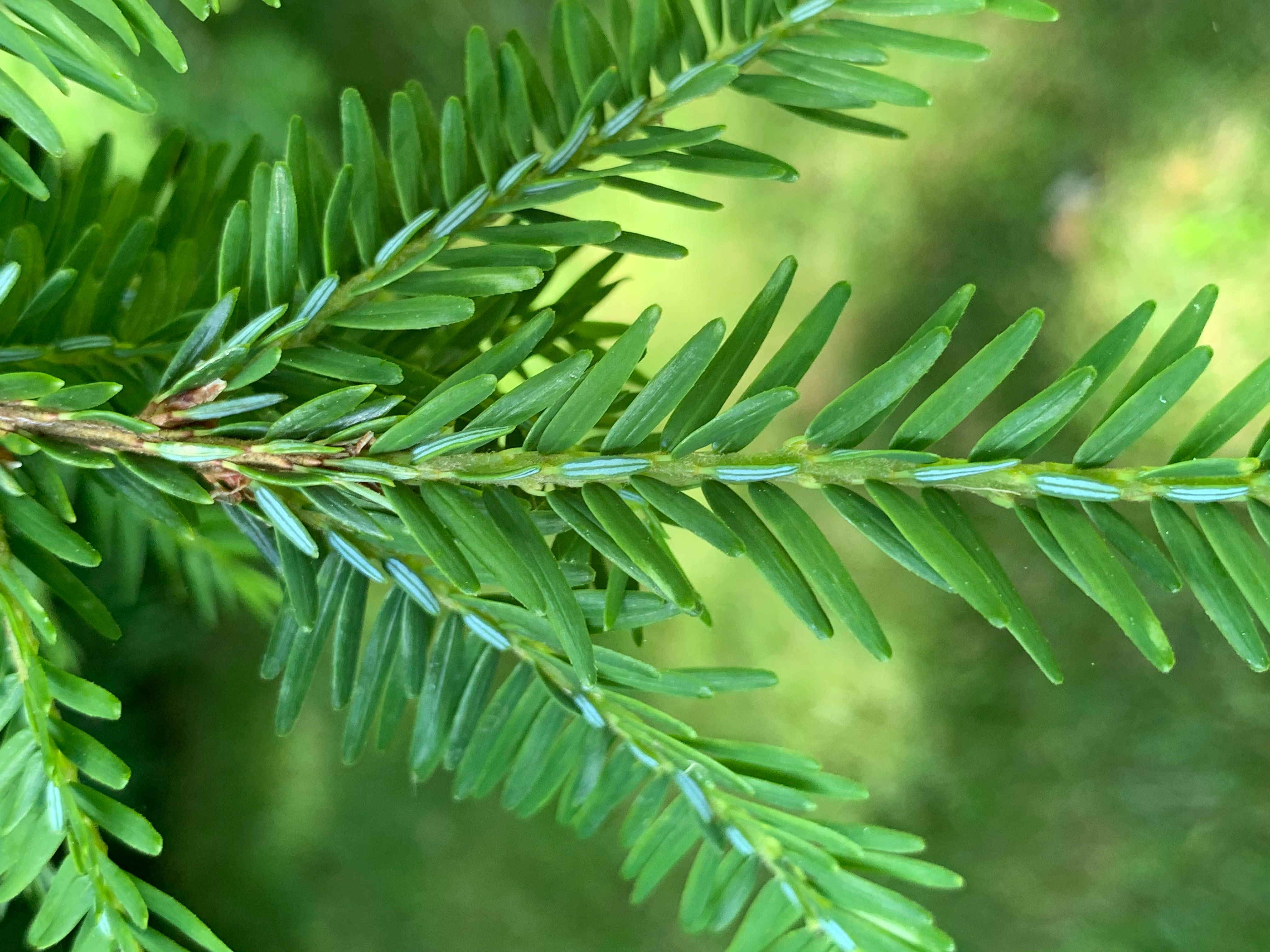
The shiny green needles are round at the tip. They have two white stripes on the underside. In the centre of the twig, needles usually grow with the underside facing upwards.
The bark is reddish brown to blackish brown. Older trees have deep cracks.
There are male and female flower cones. The male flower cones are small and yellowish. They sit on the side of the branch. The female flower cones are larger, greenish and sit at the tip of the shoot.
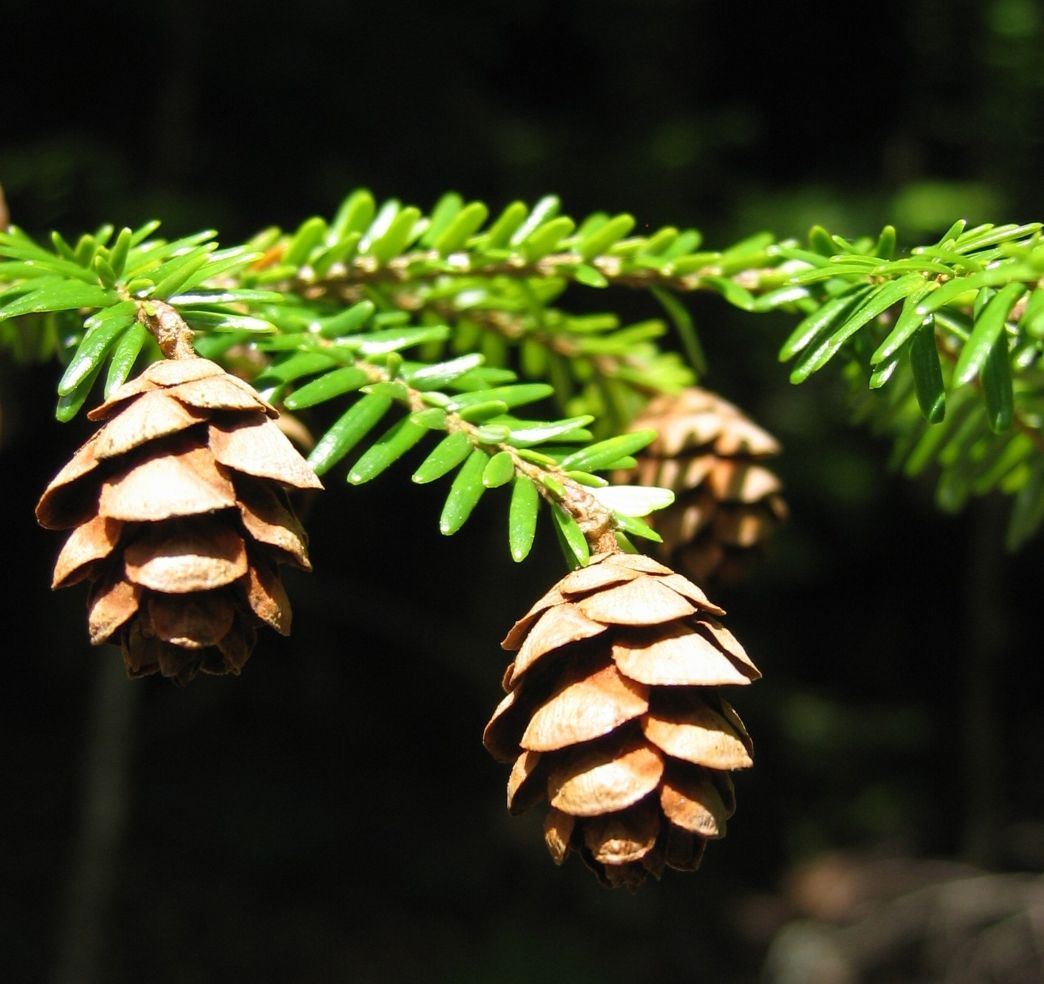
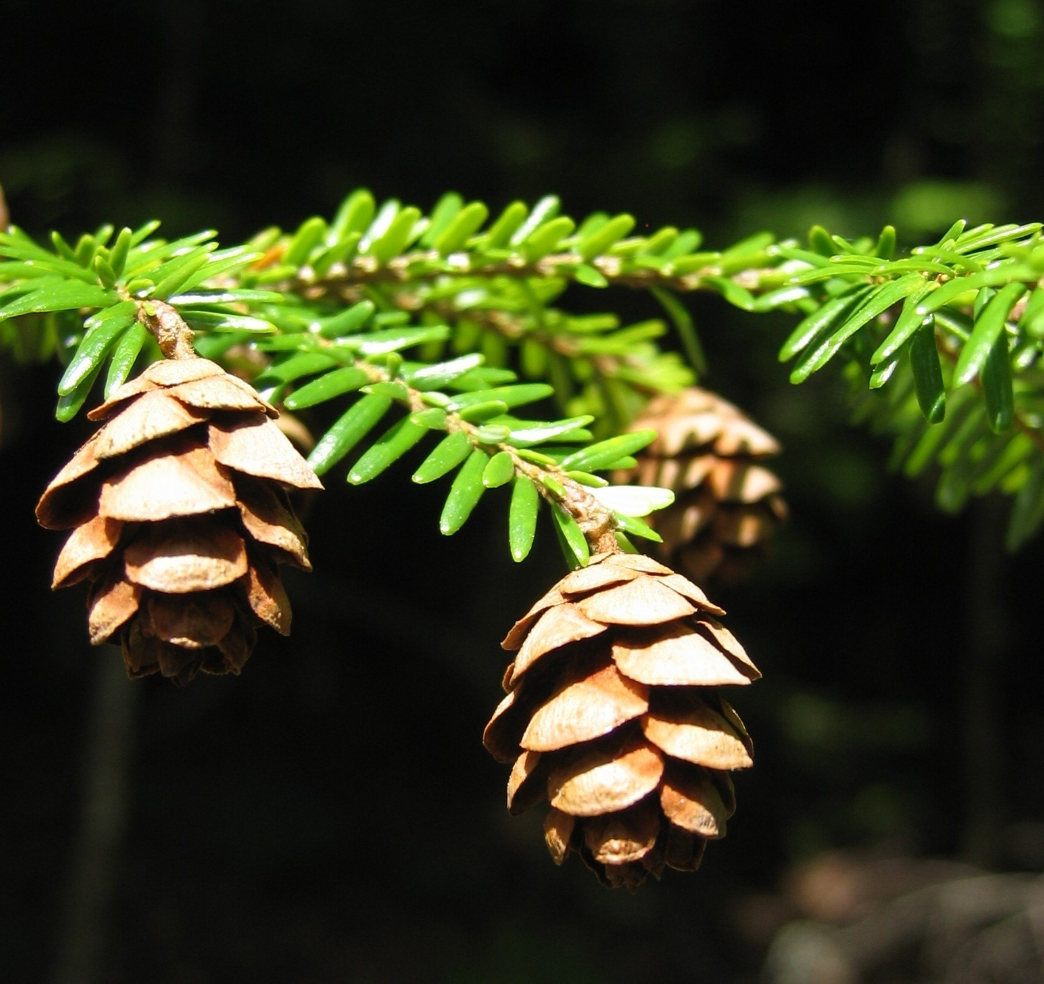
The ripe cones are brown and about two centimetres long. They hang on stalks on the twig.
Features
Eastern hemlock
Tsuga canadensis
row of needles with underside up
the lower branches often reach the ground
In the city
The Eastern hemlock prefers nutrient-rich and moist clay soils. It is very common in the city as a popular park and garden tree. Originally from North America, it was brought to Europe as an ornamental tree.
Fun Facts
The flowering period is from April to May.
The common name Eastern hemlock refers to the smell of the crushed needles, which is said to be similar to that of hemlock and to smell like mouse urine.
In North America, its wood is used in the construction and paper industries.
Fresh bark and young twigs are used in homeopathy for digestive problems.
- Endangerment level Germany: not evaluated

Sources
Nadeln und Zapfen, Keith Kanoti, Maine Forest Service, USA, CC BY 3.0 US, https://upload.wikimedia.org/wikipedia/commons/4/45/Tsuga_canadensis_cones_USDA.jpg
Nadeln, KATHERINE WAGNER-REISS, CC BY-SA 4.0, https://upload.wikimedia.org/wikipedia/commons/d/d9/Tsuga_canadensis_with_undersides_of_leaves_showing_two_white_stomatal_bands.jpg

Männliche und weibliche Blütenzapfen sowie reife Zapfen, Famartin, CC BY-SA 4.0, https://upload.wikimedia.org/wikipedia/commons/9/9c/2021-04-18_10_44_45_Pollen%2C_immature_and_mature_seed_cones_on_an_Eastern_Hemlock_along_Briargate_Court_in_the_Franklin_Farm_section_of_Oak_Hill%2C_Fairfax_County%2C_Virginia.jpg

Page „Kanadische Hemlocktanne“. : Wikipedia, The Free Encyclopedia. Date of last revision: 23.08.2019, 13:02 UTC. URL: https://de.wikipedia.org/w/index.php?title=Kanadische_Hemlocktanne&oldid=191605975 (Accessed: 23.09.2021).
Bachofer, M. & Mayer, J. (2015) Der Kosmos Baumführer. 370 Bäume und Sträucher Mitteleuropas. Stuttgart: Franckh-Kosmos Verlags-GmbH & Co. KG.