
Short Description
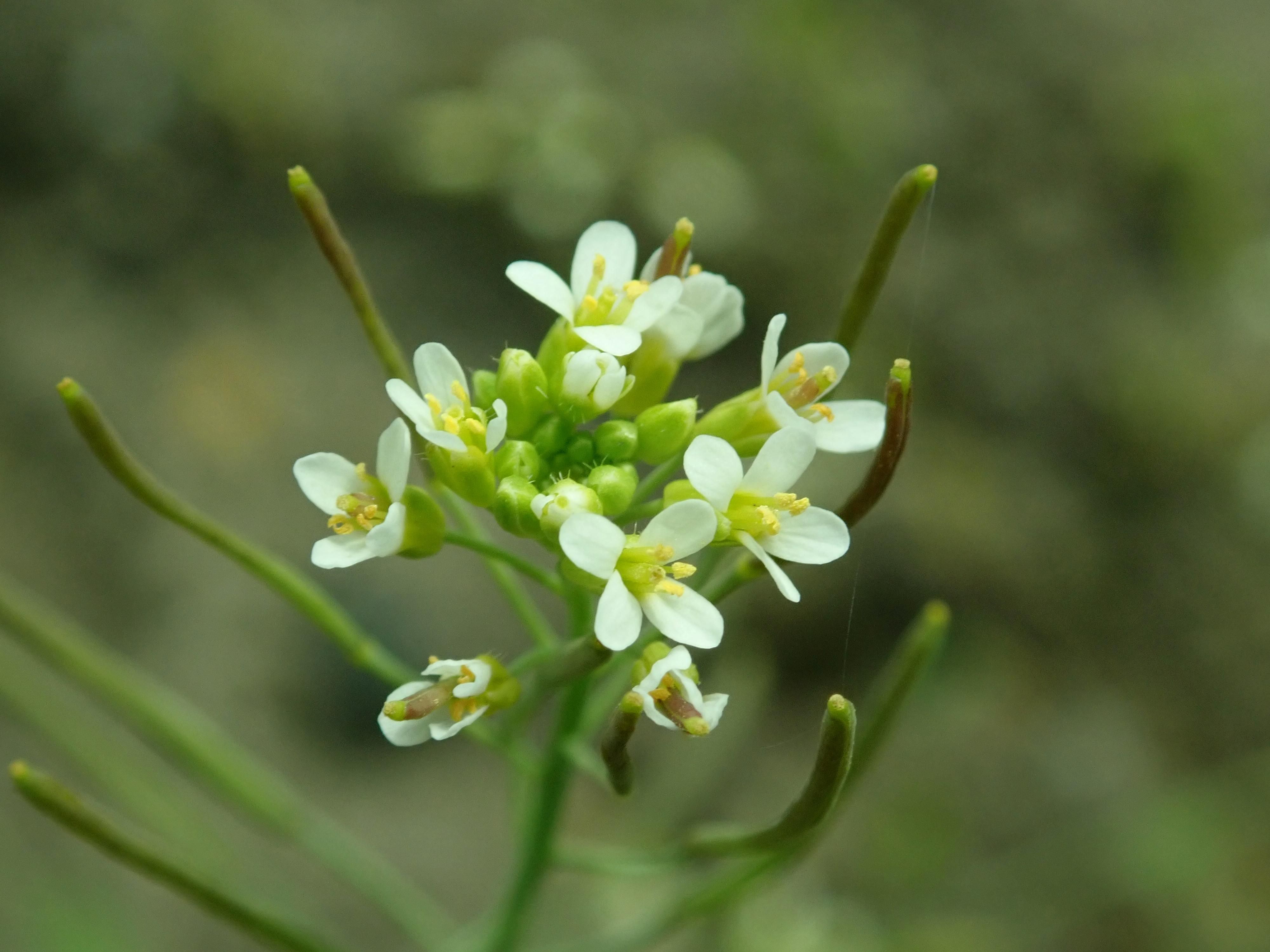
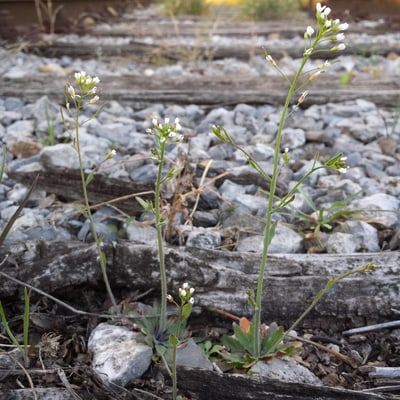
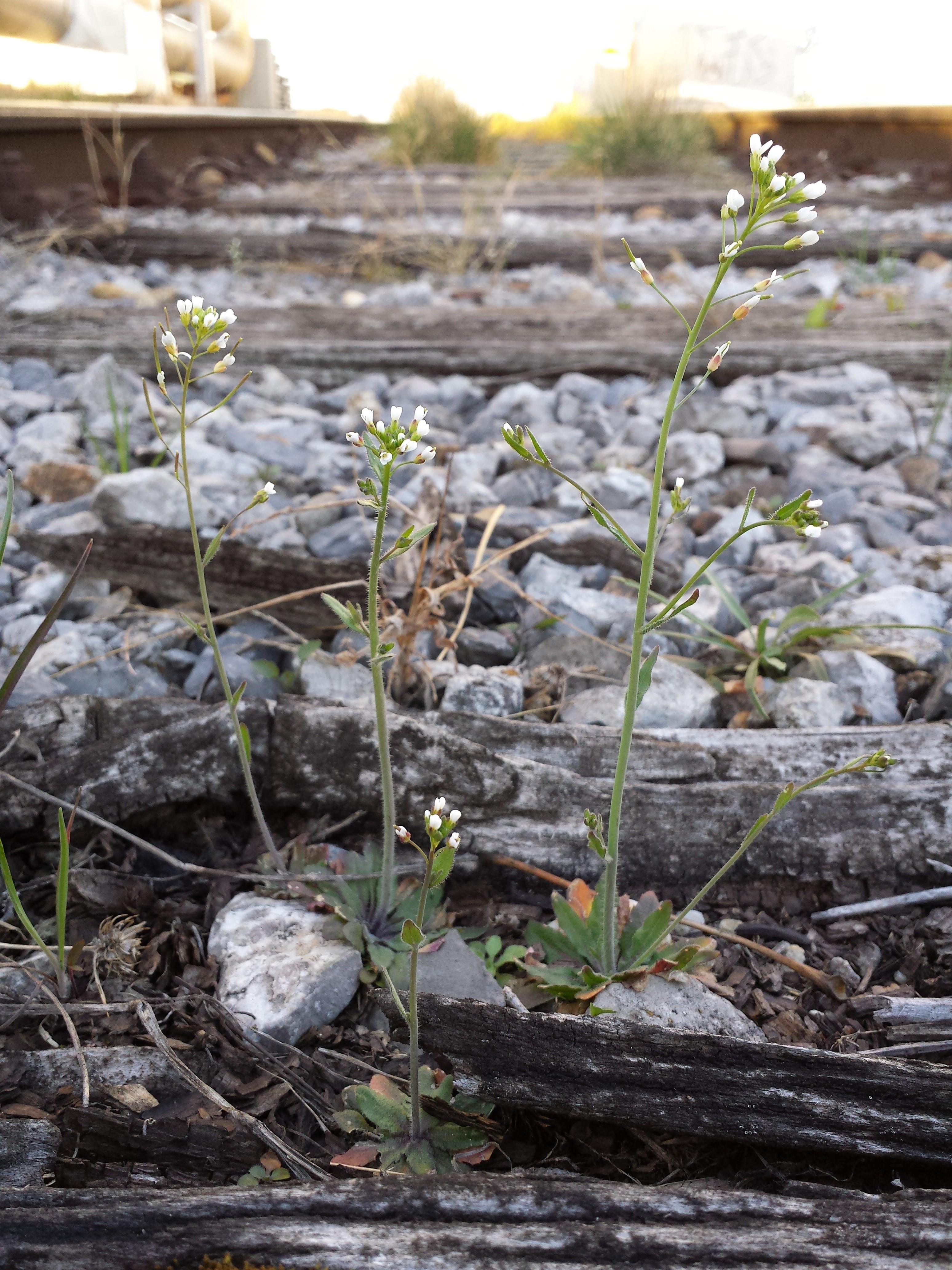
The thale cress can grow up to 30 centimetres high.
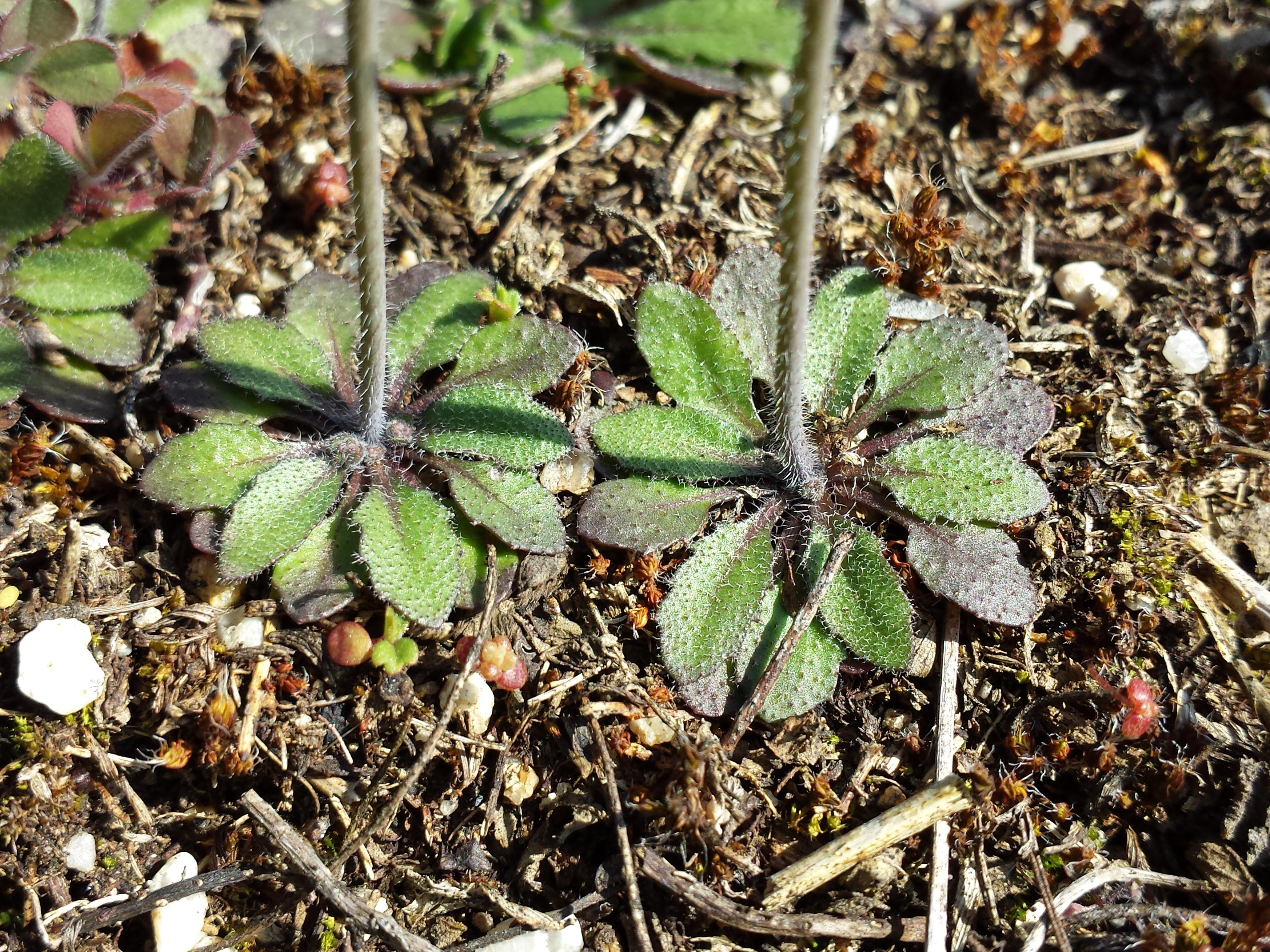
The leaves are grey-green and fine-haired. They appear to emerge directly from the soil in a rosette (basal) or are arranged singly and alternately on the stem.
The erect stem is hairless on the upper part and hairy on the lower part.
The flowers are clustered at the end of a racemose inflorescence. They are white and have four petals. In the centre of the flower there are four long and two short stamens.
The fruits are long, narrow pods. They stand below the flowers on the stem.
Features
Thale cress
Arabidopsis thaliana
four white petals
narrow green pods
Similar species
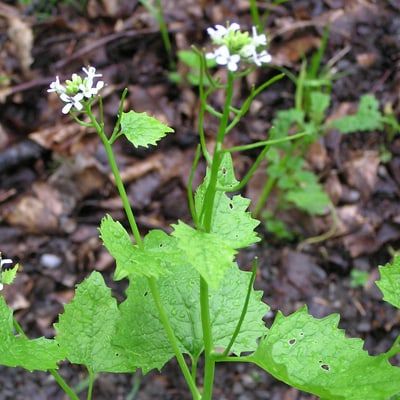
Garlic mustard
Alliaria petiolata
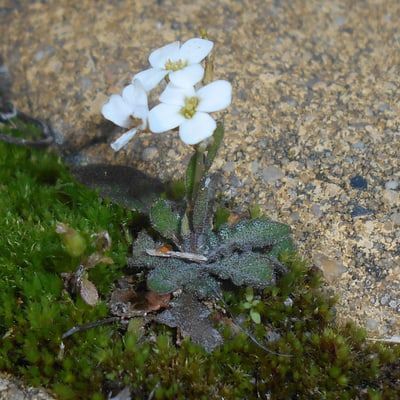
Sand rock-cress
Arabidopsis arenosa
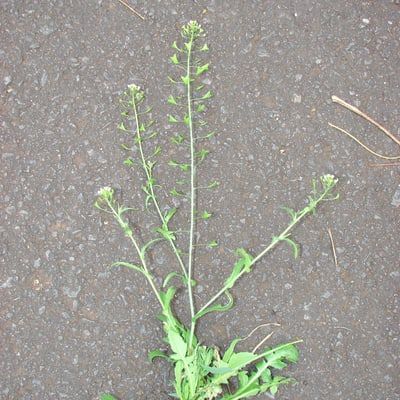
Shepherd's purse
Capsella bursa-pastoris
In the city
In the city, the thale cress is mainly found on open soils in sunny locations.
Fun Facts
The thale cress belongs to the same plant family as mustard and cabbage. It contains glucosinolates, which are often found in the cruciferous family.
The four crosswise arranged petals, the pod fruits and the four longer and two shorter stamens are typical of the cruciferous plant family.
The flowering period is from April to May.
It is an annual plant, i.e. it flowers for only one summer and dies after the seeds have ripened.
- Endangerment level Germany: not endangered
In plant genetics, the thale cress is the world's most important model plant.
Sources
Blütenstand, Salicyna, CC BY-SA 4.0, https://commons.wikimedia.org/wiki/File:Arabidopsis_thaliana_2019-04-27_2236.jpg

Blattrosette, Stefan.lefnaer, CC BY-SA 4.0, https://commons.wikimedia.org/wiki/File:Arabidopsis_thaliana_sl13.jpg

Habitus, Stefan.lefnaer, CC BY-SA 3.0, https://commons.wikimedia.org/wiki/File:Arabidopsis_thaliana_sl1.jpg

Eggenberg, S. & Möhl, A. (2007) Flora Vegetativa: Ein Bestimmungsbuch für Pflanzen der Schweiz im blütenlosen Zustand, Bern, Stuttgart, Wien: Haupt Verlag.
Spohn, M., Golte-Bechtle, M. & Spohn, R. (2015) Was blüht denn da? Stuttgart: Franckh Kosmos Verlag.
Jäger, E. J. (2011) Rothmaler - Exkursionsflora von Deutschland. Gefäßpflanzen: Grundband, Heidelberg: Spektrum Akademischer Verlag.
Kammer, P. M. (2016) Pflanzen einfach bestimmen. Schritt für Schritt einheimische Arten kennenlernen, Bern: Haupt Verlag.
Lippert, W. & Podlech, D. (1993) GU Naturführer. Blumen: die wichtigen Blütenpflanzen Mitteleuropas erkennen und bestimmen, München: Gräfe und Unzer Verlag.
Schauer, T., Caspari, C. & Caspari, S. (2015) Der illustrierte BLV-Pflanzenführer für unterwegs. 1150 Blumen, Gräser, Bäume und Sträucher, München: BLV.
Page „Acker-Schmalwand“. : Wikipedia, The Free Encyclopedia. Date of last revision: 05.01.2017, 09:41 UTC. URL: https://de.wikipedia.org/w/index.php?title=Acker-Schmalwand&oldid=161305092 (Accessed: 20.04.2017).