
Short Description
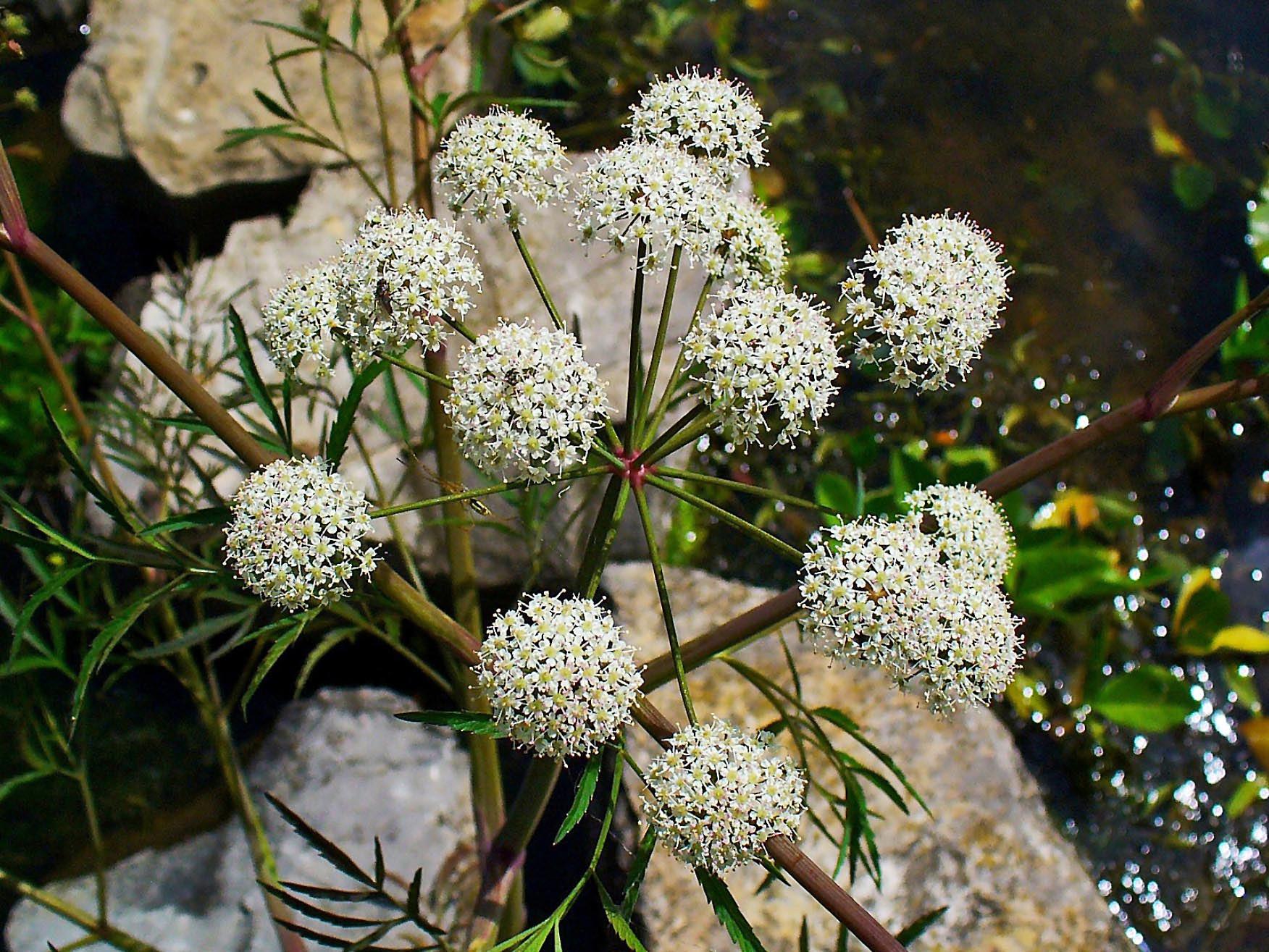
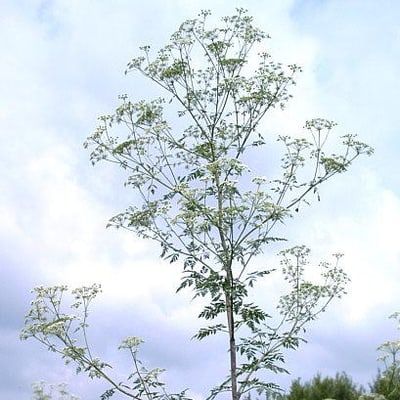
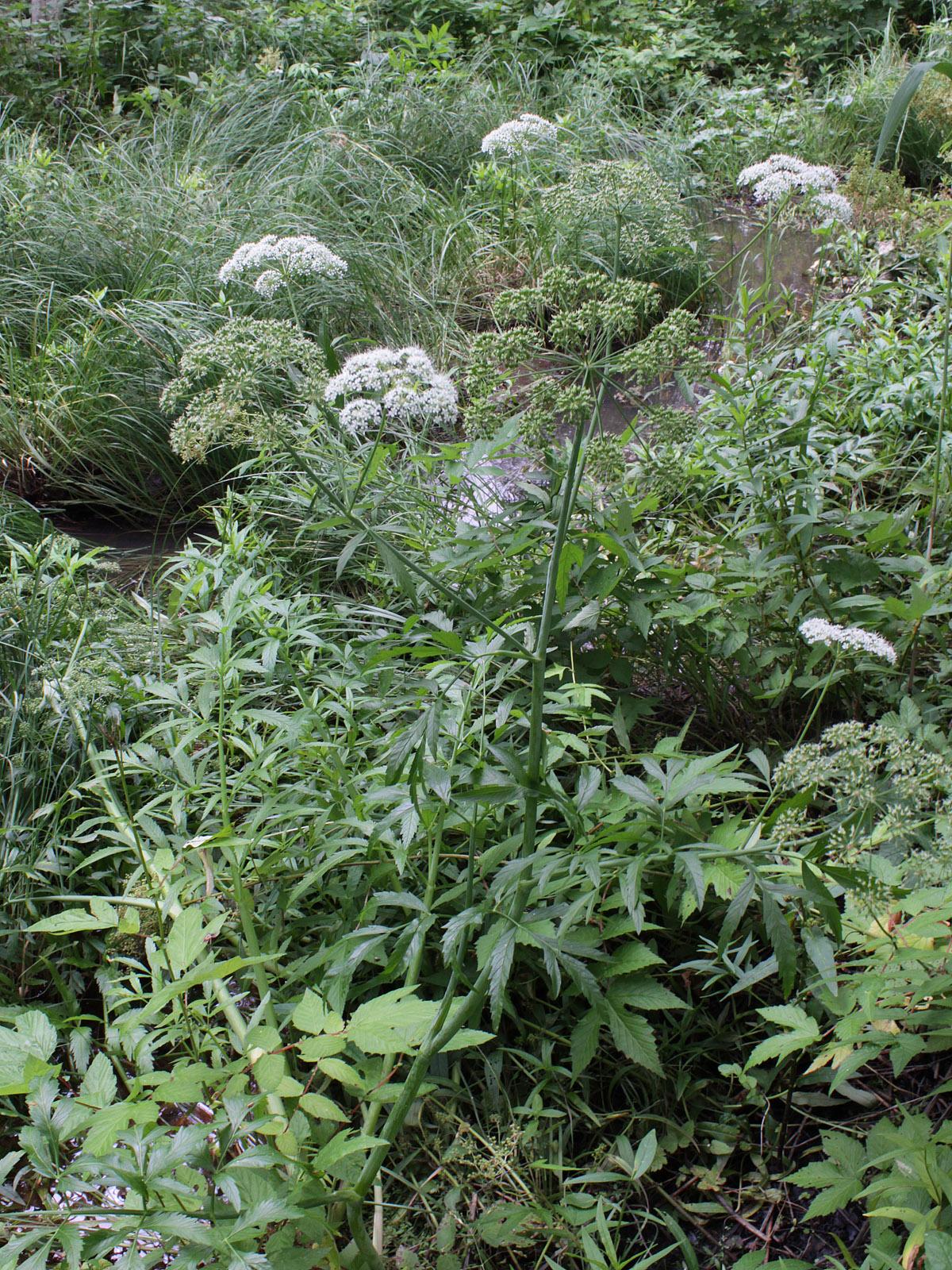
Cowbane can grow to a height of 1.5 m.
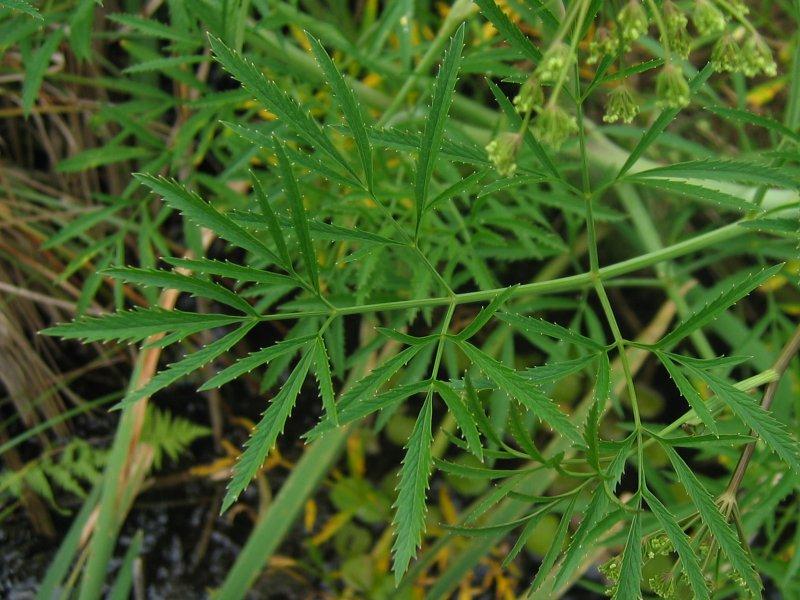
The leaves are divided into two or three sections (bi- or tripinnate). The individual leaflets are elongated with a coarsely toothed margin.
The stem is obviously groove, hollow inside and hairless. If cut, it oozes a yellow sap.
The individual small white flowers are clustered in double umbels (flower heads). This means that each branch of the umbel (like ribs of an umbrella) is again tipped with a smaller umbellule.
The schizocarp is spherical and consists of two mericarps.
Features
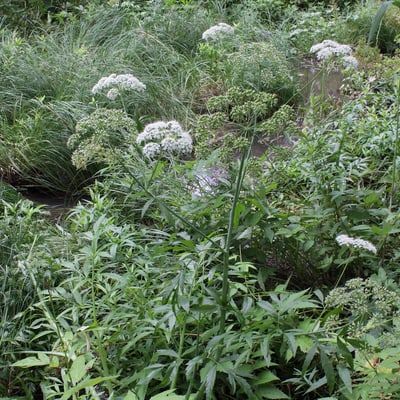
Cowbane
Cicuta virosa
highly poisonous
leaves divided into large sections and coarsely toothed
spherical fruit
Similar species
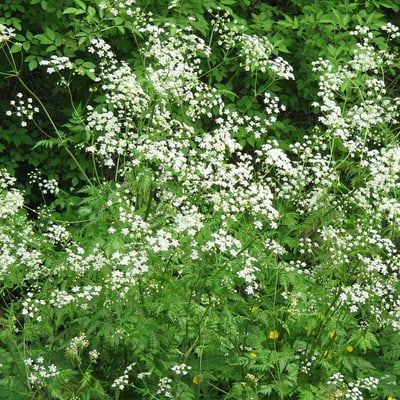
Cow parsley
Anthriscus sylvestris
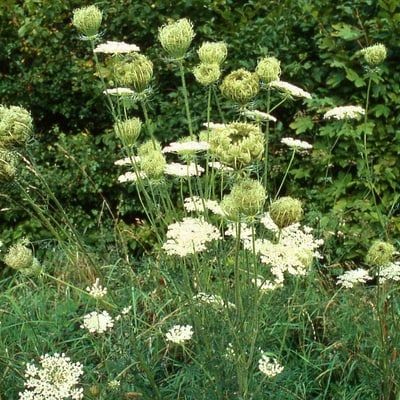
Wild carrot
Daucus carota
Hemlock
Conium maculatum
In the city
In an urban environment, cowbane can be found around ponds and in the shore areas of stagnant waters. It prefers damp to wet sites.
Fun Facts
It flowers from July to August.
The underground shoot section is bulbously thickened and interspersed with horizontal air chambers. The highly poisonous tubers are thus able to swim.
In some parts of Asia, cowbane poison was used for poisonous arrow tips.
Cowbane was formerly used externally against pain, rheumatism and gout.
In homoeopathy, cowbane is administered in the treatment of epilepsy and meningitis.
It is a perennial plant. This means that a plant lives for several years, but flowers only once and dies after the seeds have ripened.
- Endangerment level Germany: Warning list
Caution! The plant is very poisonous. Even small quantities can be fatal.
Sources
Blütenstand, H. Zell, CC BY-SA 3.0, https://commons.wikimedia.org/wiki/File:Cicuta_virosa_002.JPG

Laubblatt, Kristian Peters, CC BY-SA 3.0, https://commons.wikimedia.org/wiki/File:Cicuta_virosa_blatt.jpeg

Habitus, Matti Virtala, CC0, https://commons.wikimedia.org/wiki/File:Cicuta_virosa_Oulu,_Finland_18.07.2013.jpg

Eggenberg, S. & Möhl, A. (2007) Flora Vegetativa: Ein Bestimmungsbuch für Pflanzen der Schweiz im blütenlosen Zustand, Bern, Stuttgart, Wien: Haupt Verlag.
Spohn, M., Golte-Bechtle, M. & Spohn, R. (2015) Was blüht denn da? Stuttgart: Franckh Kosmos Verlag.
Jäger, E. J. (2011) Rothmaler - Exkursionsflora von Deutschland. Gefäßpflanzen: Grundband, Heidelberg: Spektrum Akademischer Verlag.
Lippert, W. & Podlech, D. (1993) GU Naturführer. Blumen: die wichtigen Blütenpflanzen Mitteleuropas erkennen und bestimmen, München: Gräfe und Unzer Verlag.
Schauer, T., Caspari, C. & Caspari, S. (2015) Der illustrierte BLV-Pflanzenführer für unterwegs. 1150 Blumen, Gräser, Bäume und Sträucher, München: BLV.
Page „Wasserschierling“. : Wikipedia, The Free Encyclopedia. Date of last revision: 11.12.2016, 23:33 UTC. URL: https://de.wikipedia.org/w/index.php?title=Wasserschierling&oldid=160555926 (Accessed: 13.03.2017).